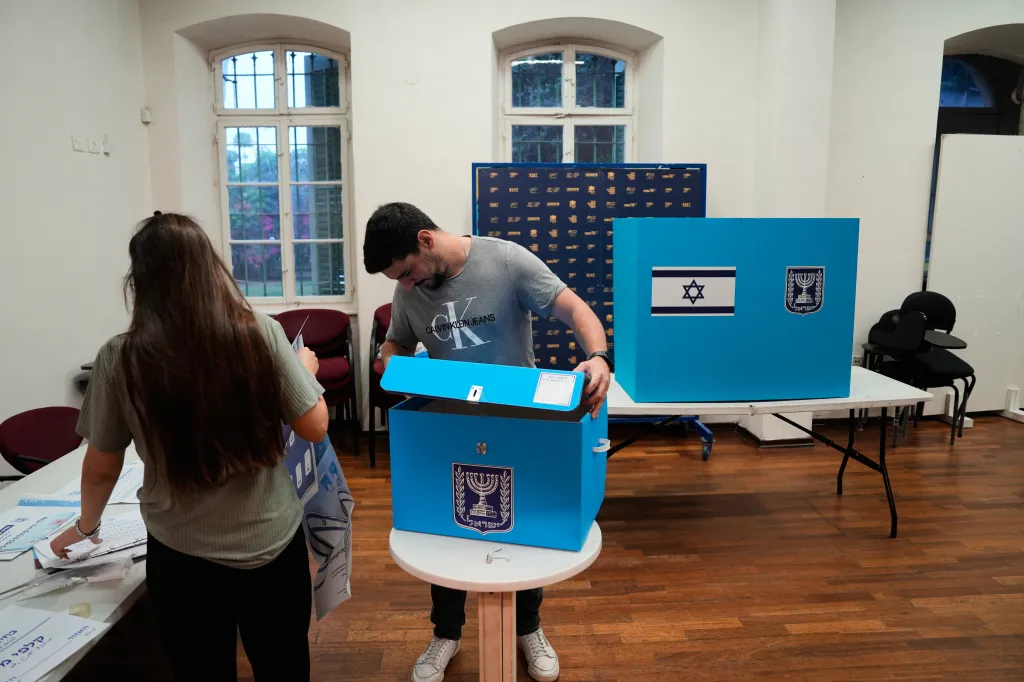
As Israelis vote in the 2026 election for the 26th Knesset, Yaniv Ashtamker, a community leader from Kiryat Gat, is seeking to bring the concerns of Indian-origin Jews into Israel’s national legislature. Contesting on the Tzomet Beit Yisrael ticket, Ashtamker is placed third on the party’s candidate list, offering the community another opportunity to pursue political representation.
His candidacy revives a question that has confronted Indian-origin Jewish communities for decades: how can a population with deep historical roots, a distinct cultural heritage and an established place in Israeli society translate those strengths into a more visible presence in national politics?
The challenge is not new. In July 1984, a political movement called Shiluv, meaning “integration”, contested the election to Israel’s 11th Knesset in an attempt to represent Indian-origin Jews independently. It received 5,499 votes, or 0.3% of the total, but failed to secure a seat.
More than four decades later, Ashtamker’s candidacy represents a different route towards that objective. Rather than relying solely on a community-specific electoral platform, his placement on a party list creates a potential pathway to Parliament. However, being third on the list does not guarantee election, and the outcome depends on the party’s electoral performance and the allocation of seats.
Bene Israel: The Historical Roots of Indian Jewish Identity in Israel
The story of Indian-origin Jews in Israeli politics begins with the Bene Israel, the largest Indian-origin Jewish community, whose history is centred largely in Maharashtra, particularly along the Konkan coast.
The Bene Israel developed a distinctive Jewish identity over centuries in India. Their traditions, community life and historical experiences differed in some respects from those of Jewish populations in other parts of the world, while their religious identity remained central to their sense of belonging.
Following the establishment of Israel in 1948, thousands of Bene Israel migrated from Maharashtra to the newly formed Jewish state. Migration offered the possibility of living in a country established as a national home for Jews, but it also brought the community into contact with religious and institutional systems that did not always recognise its status without dispute.
For the Bene Israel, integration therefore involved more than moving to a new country. They also had to establish that their longstanding religious traditions and identity entitled them to recognition within Israeli society.
The Struggle for Religious Recognition
One of the most consequential challenges facing the Bene Israel after migration was the dispute over their religious status. Although the community had maintained its Jewish identity in India, questions about its standing emerged within Israel’s religious establishment.
The resulting tensions became a source of public protest. A research paper by Suraj Rajan Kadanthodu, titled Migration, Discrimination and Assimilation in the State of Israel, describes a demonstration in Jerusalem involving almost 2,000 Indian-origin Jews.
The protesters challenged what they regarded as discriminatory treatment, arguing that their community had lived as loyal Jews in India for approximately two millennia, only to encounter hostility after arriving in Israel. Their protest reflected the frustration of people who expected religious solidarity but instead found themselves having to defend their place within the society they had joined.
In August 1964, the Israeli Parliament adopted a resolution affirming that members of the Bene Israel community were Jews in every respect. The resolution marked an important development in the community’s struggle for religious recognition.
However, formal recognition and political representation are different issues. A community can have its religious status affirmed and become part of the national population without automatically gaining influence over political parties, government priorities or legislative decisions.
This distinction helps explain why the question of representation continued long after the dispute over religious identity had reached an important milestone.
Dimona Became a Centre of Indian Jewish Political Activism
Dimona, a city in southern Israel where many Indian-origin Jews settled, became an important location for community organising. Local politics provided an opportunity to address concerns at a level where a relatively small population could potentially exercise greater influence.
According to Kadanthodu’s account in The Times of Israel, Bene Israel activists established a municipal political party called Kiddum Dimona in 1980. The party won a seat on the city council, demonstrating that organised community participation could translate into representation at the local level.
Local government can offer smaller communities a practical starting point for political engagement. Municipal representatives may have opportunities to raise neighbourhood concerns, participate in civic decisions and build relationships with other political groups.
For Indian-origin Jews, the experience also offered a foundation for a more ambitious project: extending their political presence beyond individual cities and into Israel’s national legislature.
Shiluv’s 1984 Election Bid: Why the Independent Political Experiment Failed
Four years after Kiddum Dimona’s formation, activists attempted to take their movement to the national stage through Shiluv, whose name means “integration”. The party contested the July 1984 election to the 11th Knesset, seeking to provide Indian-origin Jews with an independent political platform.
The result, however, exposed the difficulty of building a national electoral movement around a relatively small community.
Shiluv received 5,499 votes, representing 0.3% of the total vote. At the time, Israel’s electoral threshold was 1%, and the party failed to reach the minimum required to win parliamentary representation. It subsequently faded from the political landscape.
The result was not simply a setback for one party. It illustrated a structural problem faced by smaller communities seeking to elect representatives through a nationwide proportional representation system.
A party can attract meaningful support within a particular community but still fail to secure seats if its overall vote share falls below the electoral threshold. Independent political organisation therefore requires either a sufficiently large electoral base or support from voters beyond the community that initially inspired the party.
Shiluv’s experience remains relevant to the political choices facing Indian-origin Jews today. A dedicated party can provide a clear platform for community-specific concerns, but contesting independently may limit its prospects if the available voter base is too small.
How Israel’s Electoral System Shapes the Representation Debate
Israel’s Knesset has 120 members, elected through a nationwide proportional representation system. Rather than electing individual representatives from separate geographical constituencies, voters choose party lists, and seats are allocated according to parties’ electoral performance, subject to the applicable threshold.
Under the current system described in the source material, a party must secure at least 3.25% of valid votes to enter the Knesset. This is substantially higher than the 1% threshold that applied when Shiluv contested the 1984 election.
The difference matters for smaller political movements. A community that struggles to attract enough votes to establish an independent parliamentary party may have a better chance of gaining representation by supporting a candidate within a broader political organisation.
There are trade-offs between these approaches:
- An independent party: It can focus directly on the concerns and priorities of Indian-origin Jews, but must attract enough votes to cross the national electoral threshold.
- A candidate on an established party list: This route can offer access to a wider electoral base, although the candidate’s prospects depend on the party’s performance and list position.
- Participation through mainstream politics: Community members can support candidates across different parties, potentially gaining influence through established political networks rather than a single community-specific organisation.
Ashtamker’s candidacy on the Tzomet Beit Yisrael list follows the second approach. His third-place position creates a potential route to the Knesset without requiring Indian-origin Jewish voters to build a separate national party from the ground up.
Nevertheless, the significance of his placement depends on the party’s electoral performance. A high position on a list is not, by itself, proof that a candidate will be elected.
Eli Ben Menachem: An Indian-Born Politician in the Knesset
The history of Indian-origin representation in Israeli politics is not limited to attempts by community-specific parties. Indian-born politicians have also served in the Knesset through established political organisations.
One prominent example is Eli Ben Menachem, who was born in Bombay, now Mumbai, in 1947. He moved to Israel with his family in 1949 and later entered national politics.
Ben Menachem served in the Knesset from 1988 to 2006, representing the Alignment, the Labour Party and the One Israel alliance during his parliamentary career. His public service also included positions as deputy minister of Housing and Construction and deputy minister of Industry and Trade, as well as service as a deputy speaker of the Knesset.
His career demonstrates that Indian-born politicians can reach senior positions within Israel’s political institutions through mainstream parties. It also highlights an important distinction in the current representation debate: the presence of politicians with Indian origins does not necessarily mean that a community has an organised political voice dedicated to its collective concerns.
Representation can take several forms. An individual politician may reflect a community’s heritage, while a community-focused movement may seek to raise particular historical, cultural or social issues. These approaches can overlap, but they are not identical.
Ben Menachem’s parliamentary career provides a historical example of participation within established political structures. Ashtamker’s candidacy raises the related question of whether a more explicit community-focused effort can secure a place in national politics.
How Many Indian-Origin Jews Live in Israel?
Approximately 85,000 Indian-origin Jews live in Israel, according to the Indian Embassy in Tel Aviv. The population includes several communities with different historical backgrounds and migration experiences.
The Bene Israel, whose roots are largely associated with Maharashtra, form the largest Indian-origin Jewish community. Other groups include the Cochin Jews from Kerala, Baghdadi Jews and more recent immigrants from northeastern India.
These communities share connections to India, but they should not be treated as a single, historically uniform population. Their experiences of migration, religious practice and settlement differ, even as Indian heritage provides a common point of cultural identification.
Their presence also illustrates the long-standing relationship between India and Jewish communities. The migration of Indian Jews to Israel brought established traditions and cultural practices into Israeli society, creating communities whose identities combine Indian historical roots with life in their adopted country.
Yet population size alone does not determine political influence. The approximately 85,000 Indian-origin Jews cited by the embassy are part of Israel’s wider population, and their voting choices are not necessarily concentrated around a single candidate or political platform.
Community members may prioritise national security, economic concerns, religious questions, public services or the policies of the parties they support. A shared heritage does not automatically produce uniform political preferences.
Why Indian-Origin Jews Have Remained Less Visible in National Politics
Rafi Bhonker, an Indian-origin Israeli who chairs the Indian Jewish Heritage Centre, has described the community as proud of its Indian heritage and well-integrated into Israeli society. He has also observed that Indian-origin Jews have generally remained less involved in politics.
Integration can create opportunities for participation in mainstream institutions, but it does not automatically lead to collective political organisation. Community members who feel established in their adopted country may participate in elections primarily as individual citizens rather than mobilising around a shared ethnic or historical identity.
This may help explain why Indian-origin Jewish political activity has not consistently translated into a dedicated national parliamentary presence. A community can be socially integrated and culturally distinctive without necessarily developing a single political agenda.
Revital Moses, who moved to Israel in March 2020, has also pointed to the community’s relatively small numbers as a factor limiting targeted political outreach. In her assessment, political parties have not mounted campaigns specifically aimed at Indian Jewish voters.
For political organisations, targeted outreach depends partly on whether a voter group is perceived as large enough, organised enough or strategically important enough to influence an election. If community members are dispersed across different locations and political preferences, parties may have less incentive to develop a distinct campaign around their shared heritage.
This creates a potential cycle: limited targeted outreach can make a community less visible in political debate, while limited visibility can make it harder to demonstrate the electoral value of addressing its specific concerns.
Israel’s 2026 Election: National Issues May Outweigh Community Identity
The 2026 election takes place in the aftermath of the October 7 attacks, an event that Bhonker identified as a major consideration for voters. He said the national situation would weigh heavily on Indian-origin Jews, as it would on other Israeli citizens.
His observation highlights the limits of interpreting the election primarily through the lens of ethnic representation. Although Ashtamker’s candidacy draws attention to Indian-origin Jewish political participation, voters from the community are also citizens making choices within Israel’s broader national debate.
Security, the country’s political direction and other nationwide concerns may influence how voters evaluate the available parties and candidates. The extent to which Indian-origin Jews prioritise community-specific issues over these wider questions cannot be established from the information available.
For Ashtamker, the challenge is therefore twofold. He must operate within a political system in which candidates depend on party-level electoral performance, while also establishing why the concerns of Indian-origin Jews deserve attention alongside the priorities shared by the wider electorate.
That does not necessarily require voters to choose between their community identity and their national interests. Instead, effective representation could involve bringing cultural, historical or community-related concerns into the existing political conversation without assuming that every voter of Indian origin holds the same views.
What Yaniv Ashtamker’s Candidacy Could Mean for Future Representation
Ashtamker’s attempt to enter the Knesset marks another stage in a political story that stretches from the Bene Israel’s struggle for religious recognition to local organising in Dimona and the failed independent campaign of 1984.
The significance of his candidacy lies partly in the electoral strategy it represents. Shiluv attempted to secure a national platform through an independent party, while Ashtamker is contesting on a party list that potentially offers access to a broader electorate.
If elected, he could provide a more direct parliamentary platform for raising issues relevant to Indian-origin Jewish communities. The extent of that influence would depend on his political role, the party’s position and the priorities he pursues within the Knesset.
If he does not secure a seat, the candidacy could still draw attention to the longer-running question of how a culturally distinctive but relatively small population can gain visibility in national politics. However, its wider impact would depend on whether the campaign produces sustained political engagement beyond the election itself.
The outcome also cannot be judged solely by whether an Indian-origin candidate enters Parliament. Representation can involve local government, participation in established parties, civic organisations and efforts to preserve community history alongside national political activity.
For Indian-origin Jews in Israel, the central challenge is not simply to secure a symbolic presence in the Knesset. It is to ensure that their historical experiences and community concerns can be heard within the institutions that shape the country’s future, while recognising the diversity of political views among Indian-origin citizens themselves.
From Religious Recognition to Political Representation
The journey of Indian-origin Jews in Israel reflects several distinct stages of integration. The Bene Israel first faced questions about religious recognition after migrating from India. Community activists subsequently established a foothold in local politics, and the 1984 Shiluv campaign tested the possibility of independent national representation.
The parliamentary career of Eli Ben Menachem demonstrated another route through mainstream parties. Now, Yaniv Ashtamker’s candidacy offers a fresh opportunity to examine how Indian-origin Jewish identity can find expression within Israel’s electoral system.
These developments are connected, but they are not interchangeable. Religious recognition establishes communal standing, social integration enables participation in everyday life, and political representation provides a route for influencing public decisions. Progress in one area does not guarantee progress in the others.
As Israel votes in 2026, the question facing Indian-origin Jews is therefore larger than the prospects of one candidate. It concerns how a community with centuries of history in India and generations of experience in Israel can maintain its distinctive heritage while ensuring that its concerns remain visible in the country’s political institutions.
For breaking news and live news updates, like us on Facebook or follow us on Twitter and Instagram. Read more on Latest World on thefoxdaily.com.






COMMENTS 0