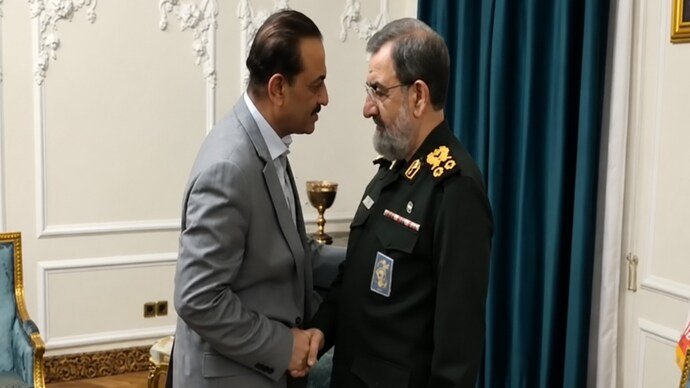
Pakistan Army Chief Field Marshal Asim Munir allegedly raised concerns about growing ties between Hindus and Jews during a four-nation security meeting in Tehran on October 26, according to claims made by Iran‘s senior security official Mohsen Rezaei. The remarks, which have not been independently verified, reportedly portrayed India-Israel relations as a threat to Pakistan and the wider Muslim world.
Rezaei discussed the meeting in an interview with Iranian state television on October 31. According to reports by Pakistani news outlet 24 News HD, he said Munir had spoken about what he described as growing ties between Hindus and Jews directed against Muslims and Pakistan.
The meeting brought together senior representatives from Iran, Pakistan, Saudi Arabia and Turkey amid heightened regional tensions involving Israel and the United States. The participants included Munir, Turkish intelligence chief Ibrahim Kalin, Saudi Defence Minister Prince Khalid bin Salman and Rezaei, who hosted the discussions.
‘Hindu-Jewish Ties Against Muslims’: What Asim Munir Allegedly Told Iran, Turkey and Saudi Arabia
Pakistan Army Chief Field Marshal Asim Munir allegedly warned of growing ties between Hindus and Jews directed against Muslims and Pakistan during a four-nation security meeting in Tehran on October 26, according to Iran’s senior security official Mohsen Rezaei. The claim, which has not been independently verified, has drawn attention amid expanding India-Israel relations and heightened tensions in West Asia.
Rezaei made the remarks while discussing the meeting in an interview with Iranian state broadcaster IRIB on October 31. Pakistani news outlet 24 News HD also reported his account, in which he attributed the warning about an alleged Hindu-Jewish alignment to Munir.
The Tehran meeting brought together representatives from Iran, Pakistan, Saudi Arabia and Turkey to discuss regional security. Munir represented Pakistan, Turkish intelligence chief Ibrahim Kalin attended for Turkey, Saudi Arabia was represented by Defence Minister Prince Khalid bin Salman, and Rezaei hosted the discussions for Iran.
What Munir Allegedly Said, According to Iran’s Security Chief
During his October 31 interview with Iranian state television, Rezaei discussed the positions taken by the visiting officials during the October 26 meeting. He said the representatives had expressed strong concerns about Israel and its activities in the region.
Referring to Pakistan’s army chief, Rezaei said Munir had spoken about “the Israeli threat and the ties being formed between Hindus and Jews, against Muslims, and against Pakistan”.
Rezaei also said Turkish intelligence chief Ibrahim Kalin had spoken strongly about the threat from Israel. He described the discussions as part of broader regional efforts to address security concerns without relying on outside powers.
However, the remarks attributed to Munir are based on Rezaei’s account of a private diplomatic conversation. No publicly released transcript or recording of Munir making the alleged statement has been presented to independently establish the exact wording.
What Happened at the October 26 Tehran Meeting?
The four-nation security meeting was held in Tehran on October 26, bringing together senior officials from Iran, Pakistan, Saudi Arabia and Turkey amid continuing regional tensions involving Israel and the United States.
Pakistan’s Munir, Saudi Defence Minister Prince Khalid bin Salman and Turkish intelligence chief Ibrahim Kalin joined the discussions hosted by Rezaei. Iranian President Masoud Pezeshkian and Foreign Minister Abbas Araghchi also attended the gathering.
The meeting followed Munir’s earlier visit to Tehran on October 20, when he met Iranian President Pezeshkian, Parliament Speaker Mohammad Bagher Ghalibaf and Rezaei. The visit was part of Pakistan’s diplomatic engagement with Iran and efforts to address tensions involving Tehran and Washington.
During the earlier meeting, Rezaei maintained that Iran would retain its enriched nuclear material and would not negotiate with the United States without confidence-building measures.
Following the October 26 discussions, the four countries agreed to continue dialogue to strengthen cooperation on regional peace and security. The joint statement did not publicly mention the alleged Hindu-Jewish remarks attributed to Munir.
India-Israel Strategic Partnership Has Expanded
The allegations come as India and Israel continue to strengthen their bilateral relationship across defence, intelligence, trade, agriculture, water management and emerging technologies.
During Prime Minister Narendra Modi’s state visit to Israel on February 25-26, 2026, the two countries elevated their relationship to a Special Strategic Partnership for Peace, Innovation and Prosperity. Their joint statement identified defence, security, cybersecurity, agriculture, water management and emerging technologies as important areas of cooperation.
India and Israel have also maintained defence and security cooperation, with counterterrorism and intelligence engagement forming part of their broader relationship.
In February 2026, Israeli Prime Minister Benjamin Netanyahu proposed a “hexagon of alliances” involving India, Israel, Greece, Cyprus and other countries. He presented the proposed grouping as a way to build regional partnerships in response to what he described as radical Shia and Sunni axes.
Netanyahu also identified India as an important partner in his plans for alternative alliances during October, amid discussions about Israel’s long-term strategic position.
Najam Sethi Also Attributes Hindu-Jewish Warning to Munir
Pakistani journalist Najam Sethi discussed Rezaei’s account during a YouTube programme on regional developments. He said Rezaei was explaining what Munir had told him during the Tehran discussions.
“He [Rezaei] was explaining what Asim Munir had told him,” Sethi said.
Sethi then attributed a warning about an alleged alliance between Hindus and Jews to Pakistan’s army chief.
“Look, this alliance between Hindus and Jews is a very big threat to us.”
Sethi also said Munir had described the alleged development as a “geopolitical convergence against Muslims and Pakistan”.
His comments echoed Rezaei’s account, but they do not independently establish what was said during the private meeting.
Munir’s Earlier Remarks on Hindu-Muslim Differences
Munir has previously made public remarks emphasising religious and cultural differences between Hindus and Muslims. He has invoked the Two-Nation Theory, which formed an ideological basis for the creation of Pakistan, and described the two communities as fundamentally distinct in their religious beliefs, customs, traditions and ambitions.
In remarks made shortly before the April 2025 Pahalgam terror attack, Munir again referred to the Two-Nation Theory and highlighted differences between Hindus and Muslims.
The latest statement attributed to him by Rezaei extends that narrative to an alleged alignment between Hindus and Jews. However, because the account comes from Rezaei’s description of a private conversation, its precise context and wording remain unconfirmed.
Ajit Doval Spoke to Mohsen Rezaei Before the Tehran Meeting
India’s National Security Adviser Ajit Doval held a telephone conversation with Rezaei on October 12, two weeks before the four-nation meeting in Tehran.
According to the Iranian Embassy in India, the two officials exchanged views on regional and international developments and matters of mutual interest between their countries. India’s Ministry of External Affairs later confirmed that the conversation covered bilateral issues, the regional situation and international developments, including the safety of Indian seafarers and tankers.
The conversation highlighted India’s continued diplomatic engagement with Iran amid regional tensions and concerns over maritime security.
While Rezaei’s account has brought Munir’s alleged remarks into focus, the central claim remains an account of a private diplomatic exchange rather than a publicly verified statement by Pakistan’s army chief.
For breaking news and live news updates, like us on Facebook or follow us on Twitter and Instagram. Read more on Latest World on thefoxdaily.com.






COMMENTS 0