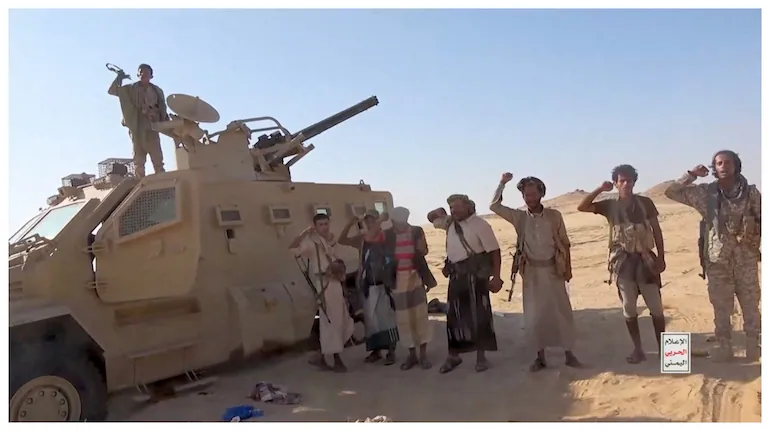
Yemen’s Houthi rebels have threatened to target Jeddah port and other Saudi ports along the Red Sea coast if the Saudi-led military coalition launches an attack on the Houthi-controlled port of Hodeidah. The group has also warned international airlines that Saudi airspace could become an arena for military operations, raising concerns about aviation safety and the risk of a wider regional escalation.
The threats were issued on Friday by Houthi military spokesperson Yahya Saree in separate statements on social media. They followed an evacuation advisory from the Saudi-led coalition, which asked civilians to leave Hodeidah port ahead of a potential military operation.
The latest confrontation comes amid renewed fighting between the Saudi-backed Yemeni government and the Iran-aligned Houthis. With threats now extending to major Saudi ports, airspace and strategic infrastructure, the escalation could have implications for regional security, commercial shipping and the movement of humanitarian supplies into Yemen.
Houthis Threaten to Target Jeddah and Other Saudi Red Sea Ports
Houthi military spokesperson Yahya Saree warned that Jeddah port and other Saudi ports along the Red Sea coastline would become targets if the Saudi-led coalition carried out its threat to strike Hodeidah.
In a statement posted on X, Saree said: “The armed forces announce that Jeddah port and all ports of the Saudi enemy on the Red Sea coast will be a target for our forces if the enemy carries out its threats to bomb Hodeidah port.”
He also called on employees, workers and people living or working near the targeted port facilities to evacuate immediately. Saree urged shipping companies to remove their vessels from the ports, warning of potential military action.
The threat is significant because Jeddah is one of Saudi Arabia‘s major commercial gateways. Its port handles substantial cargo traffic and plays an important role in the country’s trade and supply chains. Any attack or disruption could affect maritime operations, shipping schedules and commercial activity along the Red Sea.
However, the Houthi statement represents a threat rather than confirmation that an attack has taken place. The immediate risk will depend on whether the coalition launches an operation against Hodeidah and how the Houthis respond.
Houthis Warn Airlines That Saudi Airspace Is ‘Unsafe’
In a separate message, Saree warned airlines that Saudi airspace was unsafe and could become an operational area for Houthi military activities in the coming hours.
The spokesperson said Saudi airspace “will be an arena for our operations during the coming hours”. He excluded the airspace over Mecca and Medina from the warning.
The statement raises concerns for airlines operating flights to and from Saudi Arabia, particularly those using routes that pass through or near areas potentially affected by military activity. If the threat is considered credible by aviation authorities, airlines may need to reassess flight routes, operating schedules and safety procedures.
Airspace warnings during military escalations can lead to precautionary changes in commercial aviation. Airlines may reroute aircraft, suspend selected services or avoid certain flight corridors depending on security assessments and official aviation advisories.
The Houthi warning does not, by itself, establish that Saudi airspace has been officially closed. Airlines and aviation regulators would need to assess the threat through relevant security notices and operational guidance.
Why Did the Saudi-Led Coalition Issue an Evacuation Warning for Hodeidah?
The Houthi threats followed an evacuation advisory issued by the Saudi-led military coalition for civilians at Hodeidah port in western Yemen.
Coalition spokesperson Turki al-Malki said in a post on X that the Joint Forces Command was asking civilians to leave the port area according to an attached map for their safety.
The advisory has raised the possibility of a military strike against the strategic facility. However, the available information does not confirm that the coalition has carried out an attack on Hodeidah.
Hodeidah is one of Yemen’s most important ports and a critical entry point for food, fuel and humanitarian assistance. It serves large parts of the population living in Houthi-controlled territory, where years of conflict have contributed to severe humanitarian and economic difficulties.
Any military operation that damages port infrastructure or interrupts shipping could make it more difficult to bring essential goods into the country. The consequences could extend beyond the immediate conflict zone, particularly for civilians who depend on imported food and other basic supplies.
Why Hodeidah Port Is Strategically Important for Yemen
Hodeidah’s importance goes beyond its role as a commercial shipping facility. Its location on the Red Sea makes it a major supply route for western and northern parts of Yemen.
Because Yemen relies heavily on imported essential commodities, port operations are closely connected to food availability, fuel distribution and humanitarian assistance. Disruption at Hodeidah could affect the movement of goods through supply networks serving millions of people.
The port has also been a major point of contention throughout Yemen’s conflict. Control over Hodeidah provides the Houthis with access to an important maritime gateway, while the Saudi-led coalition has repeatedly viewed the facility through the wider security and military dynamics of the war.
This makes the current evacuation warning particularly sensitive. A strike on the port could trigger retaliation against Saudi infrastructure, as suggested by the Houthis’ threat to target Jeddah and other Red Sea ports.
Saudi Arabia Reports Interception of Two Drones
The latest threats have emerged alongside reports of renewed aerial attacks targeting Saudi territory. On Friday, the Saudi-led coalition said it had intercepted and destroyed two drones in the Riyadh region and southern Saudi Arabia.
The reported interceptions indicate that Saudi authorities are facing security threats beyond the immediate area around Hodeidah. The use of drones also highlights the potential for the conflict to affect locations far from Yemen’s front lines.
A day earlier, a Houthi attack reportedly damaged Riyadh’s tallest skyscraper, which houses the headquarters of Saudi Arabia’s sovereign wealth fund. The incident marked another reported strike against important infrastructure in the Saudi capital.
These developments have increased concerns about the possibility of further attacks on economic and strategic facilities. Saudi Arabia is the world’s leading oil exporter, making the security of its infrastructure particularly important for regional energy markets and international trade.
How the Yemen Conflict Reached This Point
The conflict in Yemen has its roots in the political upheaval that followed the country’s transition after the 2011 uprising. The Houthis, a movement originating in northern Yemen, expanded their military influence and seized the capital, Sanaa, in 2014. The internationally recognised government was subsequently forced out of the capital.
In 2015, a Saudi-led coalition intervened militarily to support the internationally recognised government and push back against the Houthi takeover. The intervention turned the conflict into a prolonged regional confrontation involving local Yemeni factions and outside powers.
Iran-aligned Houthis have received political and military support from Tehran, although the extent and nature of that support have been subjects of international debate. Saudi Arabia, meanwhile, has backed forces opposing Houthi control and has treated the group’s military capabilities as a direct security concern.
The war has devastated Yemen’s economy and infrastructure, displaced large numbers of people and contributed to one of the world’s most serious humanitarian crises.
Although a truce helped reduce major fighting for a period, it did not produce a comprehensive political settlement. The latest developments indicate that the confrontation has again intensified, with military threats increasingly involving infrastructure and locations outside Yemen.
What Could the Escalation Mean for Shipping and Regional Trade?
The threat against Jeddah and other Saudi ports could create uncertainty for shipping companies operating in the Red Sea. The waterway is an important international trade corridor connecting the Mediterranean region with the Indian Ocean through the Suez Canal and the Bab al-Mandab Strait.
Any increase in attacks or security warnings could force shipping operators to reconsider routes, insurance arrangements and vessel schedules. Even threats that do not result in an actual strike can raise operating costs if companies consider the surrounding waters too risky.
The potential consequences are not limited to Saudi Arabia or Yemen. Disruption to Red Sea shipping can affect international supply chains, particularly trade between Asia and Europe. Longer alternative routes can increase fuel consumption, transit times and freight costs.
For Saudi Arabia, threats against Jeddah and other coastal ports also raise concerns about the security of commercial infrastructure. A sustained disruption could affect cargo movement and business confidence, depending on the scale and duration of any military confrontation.
Could the Latest Threats Trigger a Wider Regional Conflict?
The latest statements have increased the possibility of further confrontation between the Houthis and the Saudi-led coalition. The Houthis have directly linked potential attacks on Saudi ports to military action against Hodeidah, creating a clear warning of retaliation if the coalition proceeds.
Saudi Arabia now faces the challenge of protecting its territory and infrastructure while assessing the consequences of any operation against the Houthi-controlled port. A strike on Hodeidah could trigger attacks on Saudi maritime facilities or other strategic locations, while restraint could leave the threat unresolved.
The warning to airlines adds another layer of risk because military activity near commercial flight routes can affect international aviation even without a direct attack on an aircraft. The exclusion of Mecca and Medina from the Houthi warning does not remove the broader uncertainty surrounding other parts of Saudi airspace.
For now, the central question is whether the evacuation advisory for Hodeidah will be followed by military action. The Houthis’ response has made clear that they are threatening retaliation beyond Yemen if the port is attacked.
The situation remains fluid, and the threats should not be confused with confirmed strikes against Jeddah or an officially declared closure of Saudi airspace. However, the combination of an evacuation warning, drone interceptions and threats against major ports and aviation routes points to a serious escalation with potential consequences for civilians, regional security and international trade.
For breaking news and live news updates, like us on Facebook or follow us on Twitter and Instagram. Read more on Latest World on thefoxdaily.com.






COMMENTS 0