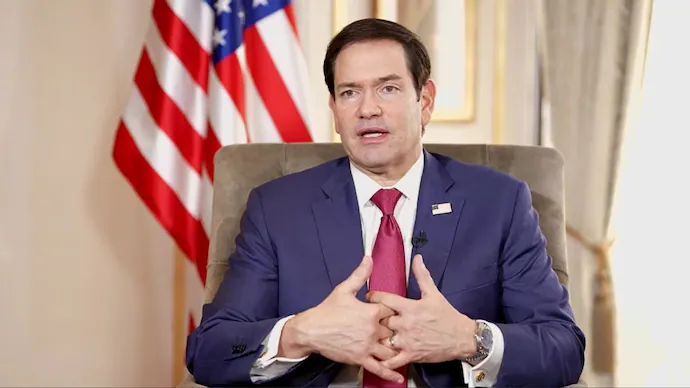
US Secretary of State Marco Rubio has expressed optimism about an upcoming India-US trade agreement, defended Washington’s immigration restrictions affecting foreign professionals, and called for deeper cooperation in energy, nuclear technology and defence. In an interview with India Today TV on Thursday, Rubio also sought to reassure New Delhi that closer US relations with Pakistan would not come at India’s expense and stressed that the Russia-Ukraine war could only be resolved through diplomacy.
Rubio’s remarks covered several major areas of the bilateral relationship, including trade negotiations, H-1B visa restrictions, crude oil imports, small modular nuclear reactors, counterterrorism and the Quad. US Ambassador to India Sergio Gor, who joined the interview, highlighted growing economic and defence ties between the two countries and described the partnership as stronger than ever.
While Washington signalled progress on trade and strategic cooperation, Rubio’s comments also underscored continuing differences over immigration policy, energy purchases and the broader geopolitical challenges facing India and the United States.
India-US Trade Deal Nears Completion, Says Marco Rubio
Rubio said India and the United States were close to reaching a trade agreement, with only a few issues remaining under negotiation. He expressed confidence that the outstanding matters could be resolved, although he did not disclose the specific points of disagreement or confirm whether India would receive the competitive tariff advantage it had sought under an interim agreement.
According to Rubio, the objective of the proposed deal is to create greater certainty for businesses operating in both countries. Predictable trade rules, he said, would help companies make investment decisions and understand the conditions governing bilateral commerce.
“We are very close,” Rubio said, indicating that the negotiations had reached an advanced stage. He emphasised that the agreement would need to benefit both countries rather than serve the interests of only one side.
The comments come amid concerns about changes in US trade policy, including the possibility of repeated tariff revisions and the implications of the Super 301 provision concerning retaliatory tariffs. Rubio did not explain how the proposed agreement would address these concerns but identified business certainty as one of its principal objectives.
The absence of details on the remaining negotiating points means that the final terms, including any tariff concessions, remain unconfirmed in the interview.
Gor highlighted the expansion of economic ties between the two countries, citing trade across sectors such as information technology, pharmaceuticals and defence. He said bilateral trade had increased from approximately $20 billion 15 years ago to $240 billion, presenting the growth as evidence of the economic relationship’s expansion.
The ambassador also pointed to investments by Indian companies in the United States, including major facilities being developed by the Essar Group. He argued that investments by companies from both countries supported employment and economic activity on either side.
Gor further maintained that American technology companies operating in India complemented job creation in the United States rather than simply transferring employment overseas. His remarks highlighted the administration’s emphasis on investment flows and commercial cooperation as central components of the bilateral relationship.
H-1B Visa Restrictions: Rubio Says Policies Are Not India-Specific
One of the key issues discussed during the interview was the Trump administration’s immigration policy, particularly restrictions and higher costs affecting Indian professionals seeking to work in the United States.
Rubio defended the changes, saying they formed part of a broader effort to reform the US immigration system and were not specifically designed to target India. He acknowledged that the measures affected Indian workers and American companies seeking to hire international talent but maintained that the policies applied across countries.
“The United States has had a broken immigration system,” Rubio said, citing unlawful immigration, alleged fraud and abuse in business-related immigration programmes, as well as concerns among American workers about competition for jobs.
He argued that the administration wanted an immigration system that served the interests of the US economy and its citizens. The policy approach, he said, was connected to broader efforts to rebuild American industry and address concerns about foreign workers entering highly skilled occupations.
Although Rubio maintained that the restrictions were not directed specifically at India, the measures have particular relevance for Indian professionals because of their significant participation in US work visa programmes. Higher costs and tighter requirements can also affect American employers that depend on international talent.
Gor echoed Rubio’s position, saying the immigration changes were not targeted at any single country. He described the policy shift as an effort to reset the US immigration system and defended the administration’s emphasis on domestic priorities.
“America First,” Gor said, did not mean that the United States wanted to act alone. Rather, he argued, Washington expected other countries to understand its decision to prioritise its national interests.
The comments underline an important aspect of the relationship: while India and the United States are seeking closer economic and strategic cooperation, differences over immigration policy remain a concern for Indian professionals, students and businesses with operations in both countries.
US Wants India to Diversify Crude Oil Imports
Energy cooperation was another major topic, with Rubio urging India to diversify its crude oil suppliers by purchasing more oil from the United States and other Western Hemisphere producers. He said Washington’s objective was not simply to persuade India to reduce its Russian oil imports but to encourage a broader mix of energy sources.
“It’s not so much about buying less Russian oil than it is about buying more US crude or Venezuelan or others from the Western Hemisphere,” Rubio said.
The remarks reflect Washington’s preference for India to expand purchases from alternative suppliers while maintaining a wider view of global energy markets. Rubio argued that diversification would serve India’s interests by reducing reliance on a narrower range of sources.
Asked about US President Donald Trump’s decision to allow additional energy supplies into the global market, including a temporary waiver affecting sanctions on Russian oil purchases, Rubio referred to the broader economic consequences of the Russia-Ukraine war and disruptions around the Strait of Hormuz and the Red Sea.
He said the temporary measure was intended to increase the availability of supplies in international markets at a time when diesel prices were high in many parts of the world. Rubio maintained that US Foreign Policy decisions had to take account of the wider effects of conflicts on the global economy rather than focus exclusively on one country or crisis.
Rubio also highlighted India’s substantial refining capacity, suggesting that the country could process additional crude oil and attract investment to expand its refining infrastructure.
He referred to his visit to a Reliance Industries refinery in Jamnagar, Gujarat, saying it offered an opportunity to understand the facility’s operations and its potential to process more crude from the Western Hemisphere.
The secretary also mentioned Reliance’s investment in a facility in Brownsville, Texas, which he said was expected to come online by 2029. His comments linked the energy discussion to the wider investment relationship between Indian companies and the US economy.
However, Rubio did not announce any new Indian commitment to change its crude oil purchasing pattern. His remarks amounted to an expression of Washington’s preference for greater diversification, with the actual balance of India’s energy imports remaining a matter for future commercial and policy decisions.
India Could Become an Early International Market for US Small Modular Reactors
Rubio indicated that India could become one of the first international markets for American small modular nuclear reactors (SMRs), pointing to India’s decision to open parts of its civil nuclear sector to private participation.
He credited Prime Minister Narendra Modi’s government with passing the SHANTI Bill, which he said created opportunities for private technology and new equipment to enter India’s nuclear sector.
Rubio described India as a potential early destination for US-developed SMR technology, highlighting discussions that had taken place in Washington, New Delhi and Mumbai, where India’s nuclear regulatory agency is based.
“India is one of the first places that the United States is looking at possibly to have our first SMRs internationally,” he said.
Small modular reactors are a form of nuclear technology designed around smaller reactor units. Their potential deployment involves complex technical, regulatory and long-term investment considerations, making cooperation in the sector dependent on more than an initial political understanding.
Rubio acknowledged that regulatory challenges remained and cautioned that the partnership would take time to develop. He said nuclear cooperation required careful consideration because of the technology’s complexity and the long-term implications of introducing new reactor systems.
His remarks nevertheless pointed to nuclear energy as a potential area of expanded commercial and technological cooperation between India and the United States. If regulatory and other requirements are addressed, collaboration could create opportunities for American technology providers and India’s evolving nuclear sector.
Rubio did not announce a final agreement for the deployment of US small modular reactors in India. Instead, he described the country as one of the markets Washington was considering for early international cooperation.
Rubio Says US-Pakistan Relations Will Not Come at India’s Expense
Rubio sought to reassure New Delhi that Washington’s engagement with Pakistan would not weaken its relationship with India or undermine India’s concerns about terrorism.
Asked how the United States would ensure that closer ties with Islamabad did not come at the expense of India’s fight against terrorism, Rubio said Washington had longstanding relationships with both countries and hoped to use its engagement with Pakistan to influence its decisions.
“In no way does the relationship with Pakistan come at the expense of our relationship with India,” Rubio said.
He also emphasised that the United States shared India’s concerns about terrorism. As examples of Washington’s counterterrorism efforts, he cited operations against the Islamic State and al-Qaeda, as well as the killing of al-Qaeda leader Osama bin Laden.
Rubio referred to US counterterrorism operations in parts of Africa, arguing that Washington had demonstrated a sustained commitment to combating extremist groups and ideologies that threaten both countries.
His comments came against the backdrop of questions about US diplomatic engagement during Operation Sindoor, which followed the Pahalgam terror attack. Asked about his conversations with Indian and Pakistani leaders during that period, Rubio declined to disclose the details.
He said the United States was prepared to play a constructive role when tensions between countries risked escalating into a wider conflict. The objective, he explained, was to prevent war and encourage countries to pursue cooperation in areas such as business and commerce.
Rubio acknowledged that reaching a diplomatic settlement required both sides to engage and make concessions. He also recognised that bringing the parties to the negotiating table would not automatically resolve their underlying differences.
His remarks sought to present US relations with India and Pakistan as separate diplomatic relationships rather than competing partnerships. However, he did not outline specific new measures to address India’s concerns, instead reiterating Washington’s commitment to counterterrorism and its willingness to support efforts to prevent escalation.
India-US Defence Cooperation and Quad Activities Expand
Gor described defence cooperation between India and the United States as being at an all-time high, pointing to joint military exercises, co-production initiatives and the presence of American defence companies in India’s market.
He cited the participation of approximately 500 US Army personnel in the Yudh Abhyas exercise as an example of military engagement. He also referred to the involvement of American F-35 fighter jets in the Tarang Shakti exercise, describing their participation as a sign of the depth of the defence partnership.
According to Gor, Tarang Shakti marked the first time F-35 fighter jets had participated in a joint exercise in India. He said the aircraft were deployed only to countries Washington trusted, using the participation to underline the level of military cooperation between the two countries.
The ambassador also identified Lockheed Martin and Boeing as American companies involved in India’s defence sector. He argued that joint production and industrial cooperation could generate employment in both countries.
Beyond bilateral defence ties, Rubio and Gor highlighted the importance of the Quad, the grouping comprising India, the United States, Japan and Australia.
Rubio said the Quad was moving beyond diplomatic meetings towards practical cooperation in areas such as maritime awareness and supply-chain security. He said Washington was working towards a leaders-level meeting that he expected could take place around December, while seeking further engagement before the end of Trump’s term.
One area of focus involves monitoring potential threats to undersea cables, which are important to international communications. Rubio also referred to efforts to reduce excessive dependence on any single country for critical goods and technologies.
He said India and the United States could develop domestic capabilities in strategic sectors, including artificial intelligence, biotechnology, pharmaceuticals and critical minerals. These areas reflect the broader economic and security interests that have become increasingly important to the bilateral relationship.
Gor added that Washington had invited India to join the Pax Silica initiative, describing New Delhi as a trusted partner in strategic supply chains.
He also said senior US officials, including the attorney general and representatives of American law enforcement agencies, were expected to visit India for discussions on counter-narcotics cooperation.
The announcements and comments point to a partnership that extends beyond traditional military exercises into technology, industrial capacity, maritime security and law enforcement. However, the precise scope and timing of individual initiatives will depend on subsequent discussions and implementation.
Russia-Ukraine War Can End Only Through Diplomacy, Rubio Says
Rubio said the Russia-Ukraine war would have to end through diplomatic negotiations rather than a military victory. He identified the dispute over the Donbas region as a central obstacle to reaching a settlement.
According to Rubio, Russia wants territory that Ukraine is unwilling to surrender because of concerns about sovereignty and long-term security. He said the territorial dispute remained a major barrier to an agreement between the two sides.
Asked about Russian President Vladimir Putin’s reported willingness to consider a trilateral meeting involving Russia, the United States and Ukraine, Rubio did not provide a specific negotiating framework. Instead, he focused on the disagreement over Donbas and the difficulty of reconciling the two sides’ positions.
“This war is not going to be solved militarily. This war is only going to end diplomatically,” Rubio said.
He argued that any settlement would require both sides to weigh potential concessions against their own interests. Rubio said the disputed territory accounted for about 11 per cent of the relevant part of Ukraine and maintained that Russia had been unable to take it militarily while Kyiv remained unwilling to give it up.
Rubio said Washington was prepared to help bring the parties together but acknowledged that negotiations would not necessarily produce an immediate resolution.
His comments reflected the US administration’s stated preference for a diplomatic end to the conflict while recognising that territorial questions and security concerns remain significant obstacles.
Trump and Modi Remain in Regular Contact, Says US Ambassador
Gor said US President Donald Trump and Prime Minister Narendra Modi remained in close contact, including through multiple phone calls during the month of the interview.
He described the two leaders as focused on delivering results and advancing cooperation between their countries. According to Gor, their longstanding relationship helped maintain momentum across areas of shared interest.
“They’re dear friends, and it works well because of that, because they see eye to eye on moving the ball forward, on getting things done, on delivering,” Gor said, adding that Trump held Modi in high regard.
Rubio also praised Trump’s approach to foreign policy, describing him as a business-minded and unconventional leader willing to pursue decisions that traditional politicians might consider difficult or unrealistic.
Gor similarly predicted that Trump’s presidency would be viewed as historically significant. However, the interview did not provide a detailed assessment of how the leaders’ relationship had affected individual negotiations or the resolution of outstanding bilateral issues.
Asked whether he would contest the 2028 US presidential election, Rubio declined to discuss the possibility. He said his responsibilities as secretary of state and national security adviser were occupying his attention.
What Rubio’s Remarks Mean for India-US Relations
Rubio’s interview outlined a broad agenda for India-US engagement, spanning trade, immigration, energy, nuclear technology, defence, counterterrorism and international diplomacy. The comments indicated areas where both governments see opportunities for cooperation, while also highlighting issues on which their priorities do not always align.
The proposed trade agreement remains one of the most immediate priorities. Rubio’s assessment that the two sides are close to a deal suggests progress in negotiations, but the remaining issues and final terms have yet to be publicly detailed in the interview.
Immigration remains another sensitive area, particularly for Indian professionals and businesses connected to the US labour market. Although Rubio and Gor insisted that the Trump administration’s restrictions were not India-specific, their effects on Indian applicants and employers remain an important concern in the bilateral relationship.
Energy policy presents a different challenge, with Washington encouraging India to purchase more crude from the United States and other Western Hemisphere suppliers. Rubio framed the issue around diversification rather than an exclusive focus on Russian oil, while also emphasising the importance of refining capacity and investment.
At the strategic level, the two governments are exploring greater cooperation in nuclear technology, defence production, maritime security and supply chains. Rubio’s comments on Pakistan and the Russia-Ukraine war also underscored Washington’s interest in maintaining diplomatic engagement across competing geopolitical relationships.
For now, the interview offers a picture of a relationship with substantial areas of cooperation but several unresolved questions. The next steps will depend on the completion of trade negotiations, the implementation of strategic initiatives and how both governments manage differences over immigration, energy and regional security.
For breaking news and live news updates, like us on Facebook or follow us on Twitter and Instagram. Read more on Latest India on thefoxdaily.com.





COMMENTS 0