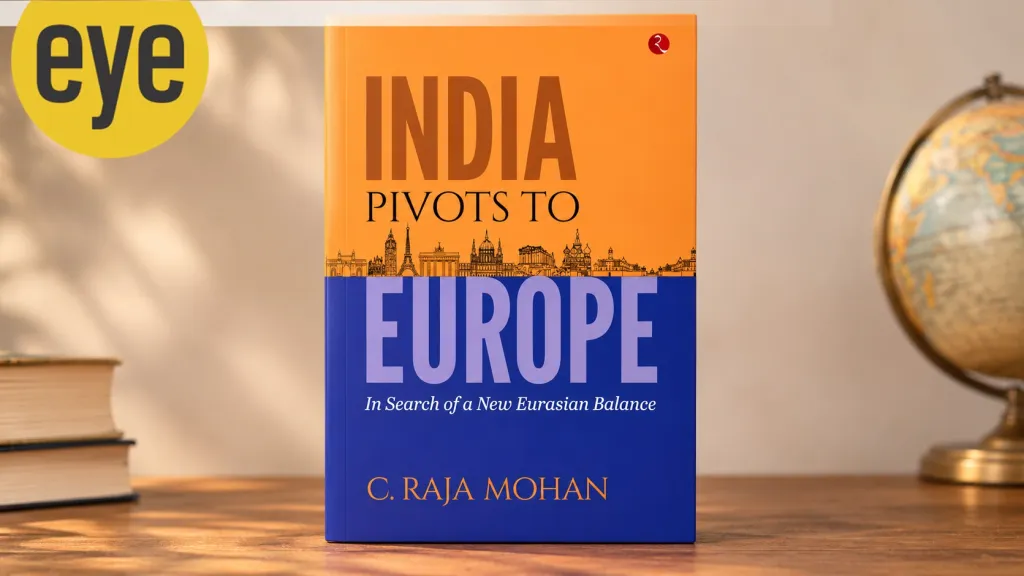
In his latest book, India Pivots to Europe, Strategic Affairs expert C Raja Mohan examines why India and Europe are moving towards a closer relationship amid shifting global power equations, rising Chinese influence, uncertainty over American leadership and growing pressure on the international order. Drawing on historical geopolitical theories and India’s evolving foreign policy, the book argues that geography and strategic interests are bringing the two sides closer at a time when neither can afford to overlook the importance of the other.
The central argument is that India-Europe engagement is no longer simply about trade, investment or historical connections. It is increasingly shaped by the changing balance of power across Eurasia, the growing importance of maritime routes, concerns about China’s ambitions and the search for a more multipolar international system. For India, a stronger European relationship could expand its global influence without limiting its strategic independence. For Europe, closer engagement with India offers an opportunity to remain relevant in an increasingly Asia-centred world.
Why geography remains central to global power politics
To understand the argument behind India Pivots to Europe, it is necessary to revisit three influential geopolitical thinkers whose ideas shaped strategic discussions during the 20th century: Halford Mackinder, Alfred Thayer Mahan and Nicholas Spykman.
In January 1904, British geographer Sir Halford Mackinder addressed the Royal Geographical Society in London and introduced the concept of the geographical ‘world island’. He used the term to describe the connected landmass of Europe, Asia and Africa, identifying the Eurasian interior as its strategic heartland. His argument was that control over this central region could provide a decisive advantage in determining global power.
Mackinder’s famous proposition was that whoever controlled the heartland could dominate the world island and, ultimately, command the world. At the time, the British Empire enjoyed extensive naval reach, supported by overseas bases stretching from the Mediterranean towards the Indian Ocean. His argument nevertheless suggested that the future of international power could not be understood through maritime strength alone.
Across the Atlantic, American naval strategist Alfred Thayer Mahan offered a different perspective. In his 1890 work, The Influence of Sea Power upon History, he examined how maritime commerce and naval strength influenced the wealth, security and international standing of nations.
Mahan’s argument placed control of the seas, protection of commercial routes and the ability to project naval power at the centre of national strategy. His thinking became particularly influential in shaping American discussions about the relationship between economic prosperity and maritime security.
Dutch-American political scientist Nicholas Spykman later connected these competing geographical perspectives. In The Geography of the Peace, published in 1944, he argued that the coastal regions surrounding Eurasia, which he called the ‘rimland’, were crucial to controlling the balance of power.
While Mackinder emphasised the Eurasian interior, Spykman believed that the coastal belt surrounding it offered the decisive strategic advantage. His thinking became closely associated with the logic of containing Soviet expansion during the Cold War.
These theories provide the historical foundation for Raja Mohan’s examination of contemporary Geopolitics. The competition over Eurasia has changed considerably since the early 20th century, but the strategic importance of its land routes, maritime approaches and surrounding regions remains significant.
How the Cold War limited India’s relationship with Europe
India’s relationship with Europe has always been influenced by the political divisions of the international system. After independence in 1947, New Delhi entered a world increasingly divided between the United States-led Western bloc and the Soviet Union-led Eastern bloc.
Western Europe was itself undergoing a major transformation. Countries devastated by the Second World War were focused on reconstruction, economic recovery and rebuilding political stability. The Marshall Plan, supported by the United States, played a major role in Western Europe’s recovery, while NATO provided the framework for its collective security.
As a result, Western European countries remained closely tied to American strategic leadership. Although India shared important intellectual and historical connections with European societies, its non-aligned foreign policy made a comprehensive political relationship with the Western bloc difficult.
India’s historical engagement with European ideas included concepts such as the nation-state, liberty, equality, nationalism and scientific inquiry. However, these shared intellectual influences did not automatically translate into a unified diplomatic relationship with Western Europe.
Instead, India developed bilateral relationships with individual European countries, particularly the United Kingdom, France and West Germany. This approach reflected the political realities of the Cold War, when Europe was not an independent strategic actor in the same sense that it would later seek to become.
Relations with Western countries also faced complications as their strategic tilt towards Pakistan became more pronounced. India’s security concerns and differences with Western governments encouraged New Delhi to strengthen its relationships with the Soviet Union and several Eastern European countries.
Poland, Hungary, Czechoslovakia and Yugoslavia became important parts of India’s broader diplomatic engagement with Europe. These relationships reflected India’s attempt to maintain strategic flexibility while navigating an increasingly polarised international environment.
The collapse of the Soviet Union changed India’s strategic calculations
The end of the Cold War forced India to reconsider its international position. The collapse of the Soviet Union removed one of the most important pillars of India’s diplomatic and strategic relationships, while the resulting economic challenges placed pressure on New Delhi to reconsider its domestic and international priorities.
India’s economic reforms and liberalisation in the early 1990s created new opportunities for engagement with Western economies. Greater integration with international markets became essential for economic growth, investment and technological development.
This period also saw India begin to look beyond its traditional diplomatic partnerships. The Look East policy reflected an effort to strengthen economic and strategic engagement with Southeast and East Asia, while relations with the United States and Europe gradually gained greater importance.
A tentative India-US dialogue began in 1992. Although the relationship experienced several difficulties, including disagreements over nuclear policy, it gradually developed into a more substantial strategic partnership towards the end of the decade and into the early 2000s.
Europe, meanwhile, was occupied with its own transformation. German reunification, the integration of former Eastern European countries and the introduction of the euro were among the major developments shaping the continent’s political and economic agenda.
India continued to strengthen ties with individual European powers rather than treating Europe as a single strategic partner. The signing of a strategic partnership agreement with France in 1998, followed by a similar agreement with Germany in 2001, reflected the importance of these bilateral relationships.
By 2010, India’s sustained economic growth had created greater opportunities for trade, investment and diplomatic engagement with both Europe and the United States. New Delhi was increasingly able to diversify its international relationships rather than relying heavily on a limited group of strategic partners.
Why the return of Eurasian power competition matters
Raja Mohan’s argument becomes particularly relevant when viewed against the changing international environment after the end of the Cold War.
The period of American dominance that followed the Soviet Union’s collapse did not produce a permanent unipolar world. Instead, the international balance of power gradually became more complicated as China expanded its economic and military influence and Russia sought to reassert its position as a major geopolitical power.
The growing strategic relationship between Beijing and Moscow has added another dimension to Eurasian politics. China’s Belt and Road Initiative, along with its involvement in international groupings such as the Shanghai Cooperation Organisation and BRICS, has strengthened its engagement across the Eurasian landmass.
These developments have renewed interest in Mackinder’s heartland theory. The competition for influence across Eurasia is no longer simply a contest among European imperial powers, as it was during the period in which Mackinder developed his ideas. Today, major Asian powers are also shaping the region’s strategic direction.
China’s expanding ambitions have generated concerns among countries across Eurasia and beyond. Its growing economic influence, infrastructure investments and military modernisation have changed how governments assess regional security and their dependence on Beijing.
At the same time, the wars in Afghanistan and Iraq exposed limitations in the ability of military intervention and conventional containment strategies to deliver lasting geopolitical outcomes. These experiences have encouraged a wider reassessment of how influence should be exercised across strategically important regions.
The result is a more complex international environment in which land-based power, maritime access, technological capabilities, economic interdependence and diplomatic partnerships increasingly overlap.
Why India and Europe are finding common strategic ground
One of the central themes of India Pivots to Europe is that the changing international environment is creating a stronger foundation for India-Europe cooperation.
For decades, India’s relationship with Europe was shaped largely by historical connections, trade and bilateral diplomacy. Those areas remain important, but the strategic circumstances surrounding the relationship have changed.
Europe increasingly recognises that China is not simply a major export market or manufacturing centre. It is also an economic competitor and a potential strategic challenger. Concerns about industrial dependence, supply-chain vulnerabilities and China’s growing geopolitical influence have encouraged European governments to reconsider their approach towards Beijing.
India, meanwhile, has its own reasons to seek stronger engagement with Europe. Its position in the Indo-Pacific, its security concerns involving China and its ambition to become a more influential global power make European partnerships increasingly valuable.
Cooperation can provide opportunities in areas such as technology, industrial development, investment, defence-related capabilities and international diplomacy. It can also help both sides diversify their economic relationships and reduce excessive dependence on individual countries.
The relationship is therefore being driven by more than diplomatic goodwill. Structural changes in the global balance of power are creating incentives for India and European countries to work more closely together.
Europe’s search for strategic autonomy
Another important factor in the changing relationship is Europe’s continuing discussion about strategic autonomy.
For much of the post-war period, European security depended heavily on the United States through NATO. This arrangement provided the foundation for Western Europe’s defence during the Cold War and continued to shape transatlantic relations after the Soviet Union’s collapse.
However, changing American priorities and uncertainty about the future direction of US foreign policy have encouraged European governments to think more seriously about their ability to protect their own interests.
Strategic autonomy does not necessarily mean Europe intends to abandon its relationship with Washington. Rather, it reflects a desire to develop greater independence in areas such as defence, industrial capacity, technology, energy security and foreign policy decision-making.
India’s foreign policy approach offers an important point of connection. New Delhi has traditionally avoided becoming permanently aligned with any single major power. Its strategic partnerships with different countries are intended to advance national interests without surrendering independent decision-making.
There are differences between India’s strategic autonomy and Europe’s ambitions in this area. European countries remain part of a deeply integrated security and political framework, while India follows a distinct foreign policy shaped by its own history and security priorities.
Nevertheless, both sides have an interest in preserving room for independent choices in an international system increasingly influenced by competition among major powers.
The depth of Europe’s dissatisfaction with American leadership remains an open question. However, the discussion around strategic autonomy indicates that European governments are increasingly interested in strengthening their capacity to act independently when their interests require it.
Why a multipolar world creates opportunities for India-Europe cooperation
India and Europe also share an interest in a more balanced international system, although their approaches and priorities are not identical.
India has consistently supported multipolarity, arguing that global decision-making should reflect the interests and influence of a wider range of countries rather than being dominated by a small group of powerful states.
European governments have also recognised the importance of strengthening multilateral institutions and international cooperation. However, the existing global order faces growing pressure from geopolitical rivalry, institutional disagreements and declining confidence in international mechanisms.
Multilateralism remains the preferred framework for addressing shared international challenges through established institutions and broad participation. Where global agreement becomes difficult, countries may instead pursue plurilateral arrangements involving smaller groups of nations willing to cooperate on specific issues.
For India and Europe, these approaches offer opportunities to coordinate their positions on international governance, economic rules and emerging geopolitical challenges.
Closer engagement could also help both sides develop a stronger collective voice on issues where neither can achieve its objectives independently. India’s growing economic and diplomatic influence, combined with Europe’s institutional, technological and economic capabilities, provides a potentially significant foundation for cooperation.
However, shared support for multipolarity does not mean that India and Europe will agree on every international issue. Differences over Russia, China, trade, security and regional conflicts can still complicate their relationship. The challenge will be to build practical cooperation without assuming complete strategic alignment.
India’s strategic flexibility remains central to the relationship
One of the most important points in Raja Mohan’s argument is that stronger relations with Europe do not require India to abandon its existing partnerships.
India’s foreign policy has historically been based on maintaining multiple channels of engagement. Its relationships with the United States, Russia, Europe, Japan and countries across the Indo-Pacific serve different strategic and economic purposes.
Moving closer to Europe can therefore be understood as an expansion of India’s diplomatic options rather than a shift into another geopolitical bloc.
This distinction matters because India faces a complicated security environment. Its relationship with China remains competitive, its ties with Russia continue to carry historical and strategic significance, and its growing partnership with the United States is important for technology, defence and economic cooperation.
A deeper European relationship can complement these existing connections. It can also strengthen India’s ability to negotiate with major powers from a position of greater economic and diplomatic confidence.
For Europe, India offers access to one of the world’s major emerging economies and an important partner in shaping the future of Asian and Indo-Pacific affairs. India’s demographic scale, economic ambitions and strategic location make it difficult for European policymakers to overlook New Delhi’s growing importance.
What India Pivots to Europe says about the future of global politics
India Pivots to Europe places the growing India-Europe relationship within a much longer history of geopolitical change. By revisiting Mackinder, Mahan and Spykman, Raja Mohan highlights how geography, maritime power and the competition for influence across Eurasia continue to shape international relations.
The book’s broader argument is that the present moment offers an opportunity for India and Europe to move beyond a relationship based primarily on trade and historical connections. The changing balance of power, China’s rise, uncertainty surrounding American leadership and pressure on multilateral institutions have created stronger strategic incentives for cooperation.
Yet the relationship’s potential should not be confused with an automatic convergence of interests. India and European countries will still have to manage differences over security priorities, foreign policy choices and their respective relationships with other major powers.
The most significant opportunity lies in building a partnership that allows both sides to cooperate where their interests overlap while retaining the freedom to make independent decisions elsewhere.
Raja Mohan captures this central idea by arguing that engagement with Europe allows India to expand its global role while preserving its strategic flexibility. For Europe, closer relations with India support its wider search for relevance in what is increasingly becoming an Asian century.
The significance of the book, therefore, extends beyond the future of bilateral diplomacy. It examines how a changing Eurasian landscape could reshape the wider international order and why India and Europe may become increasingly important partners in that transformation.
For breaking news and live news updates, like us on Facebook or follow us on Twitter and Instagram. Read more on Latest India on thefoxdaily.com.





COMMENTS 0