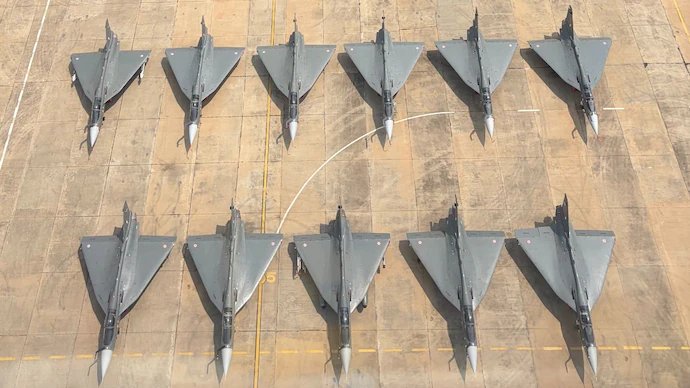
The Indian Air Force (IAF) is preparing to induct its first squadron of the indigenous Light Combat Aircraft (LCA) Tejas Mk1A by the end of March 2027. The milestone will mark an important step in India’s efforts to strengthen its fighter fleet with domestically developed combat aircraft after repeated delays pushed the programme well beyond its original delivery schedule.
Manufactured by Hindustan Aeronautics Limited (HAL), the Tejas Mk1A is an upgraded version of the Tejas Mk1, which is already operational with the IAF. Although both variants share the same basic aircraft design, the newer version incorporates significant improvements in radar technology, electronic warfare, flight-control computing and cockpit avionics.
The most important difference is not simply that the Mk1A can carry more weapons or fly faster. Its upgrades are intended to improve how effectively the aircraft detects potential threats, understands its surroundings, protects itself from enemy radar and manages complex combat missions.
The distinction matters in modern aerial warfare, where the ability to detect an opponent early, interpret incoming information and respond before being targeted can be as important as the aircraft’s speed or manoeuvrability.
However, the Mk1A is not receiving every combat capability from scratch. The original Tejas Mk1, particularly its Final Operational Clearance (FOC) configuration, already had beyond-visual-range missile capability and aerial refuelling. The Mk1A builds on that foundation with a more sophisticated collection of onboard systems.
1. AESA Radar: Helping Tejas Detect and Track Threats More Effectively
One of the most significant upgrades in the Tejas Mk1A is its Active Electronically Scanned Array (AESA) radar. It replaces the mechanically scanned multimode radar associated with the original Tejas Mk1 configuration.
Radar is one of a fighter aircraft’s most important sensors. It sends out radio waves and analyses the signals reflected by objects to identify and track aircraft, terrain features and other potential targets. The quality of this information can influence how much time a pilot has to assess a threat and decide what action to take.
A conventional mechanically scanned radar uses a physically moving antenna to direct its radar beam towards different parts of the sky. An AESA radar works differently. It uses numerous small transmit-and-receive modules that electronically steer radar beams without requiring the entire antenna to move mechanically.
This electronic steering allows the radar to change the direction of its beam rapidly. It can also manage multiple tasks more efficiently, including searching for potential targets and maintaining tracks on detected objects.
For a fighter pilot, this can translate into several operational advantages:
- Faster scanning: Electronic beam steering allows the radar to direct attention towards different areas rapidly.
- Multiple target tracking: The system can maintain information on several detected targets while performing other radar functions.
- Improved situational awareness: More effective radar surveillance can help pilots build a clearer picture of the surrounding airspace.
- Greater operational flexibility: AESA technology supports different radar tasks, including air-to-air and air-to-ground functions.
- Improved resistance to interference: Modern AESA systems can use sophisticated techniques to make radar operations more difficult to disrupt.
The Ministry of Defence identified AESA radar as one of the important capabilities included in the Mk1A procurement programme announced in January 2021.
The upgrade is particularly relevant when a fighter is operating in an environment where several aircraft, ground-based radar installations and other threats may be present. Detecting an opposing aircraft is only the first step; the ability to maintain a reliable track and process the information is equally important.
It is worth noting that an AESA radar does not make an aircraft invisible to enemy sensors or guarantee that it will detect every threat first. Its actual performance depends on factors such as radar design, operating conditions, target characteristics, electronic interference and the wider combat environment.
2. Advanced Electronic Warfare Suite: A Stronger Defence Against Enemy Radar
Modern fighter aircraft operate in increasingly complex electronic environments. Enemy forces use ground-based surveillance radars, fire-control radars, airborne sensors and missile systems to detect, track and engage aircraft.
That means a fighter needs more than the ability to locate an opponent. It must also recognise when hostile radar systems are tracking it and take appropriate measures to reduce the danger.
The Tejas Mk1 already had a self-protection suite. The Mk1A is designed to incorporate a more advanced and integrated Electronic Warfare (EW) system, including a Radar Warning Receiver (RWR) and an Advanced Self-Protection Jammer (ASPJ).
Radar Warning Receiver: Identifying Hostile Radar Signals
A Radar Warning Receiver detects radar emissions in the surrounding environment. If a hostile radar begins searching for or tracking the aircraft, the system can identify relevant signals and alert the pilot.
Different radar systems operate using different signal characteristics. Analysing these emissions can help an aircraft’s electronic warfare system distinguish between potential threats and other radar activity.
This information is important because radar tracking may indicate that an enemy aircraft or ground-based installation is preparing to engage. An early warning gives the pilot an opportunity to assess the situation and take suitable defensive action.
Advanced Self-Protection Jammer: Disrupting Enemy Tracking
The Advanced Self-Protection Jammer performs a different function. Rather than simply detecting hostile radar activity, it attempts to interfere with the radar’s ability to track the aircraft accurately.
DRDO’s technical documentation describes the Mk1A’s electronic warfare equipment as including an Advanced Self-Protection Jammer designed to counter threats from ground-based acquisition radars, fire-control radars, anti-aircraft artillery and airborne radar systems.
The system uses Active Phased Array technology and Digital Radio Frequency Memory (DRFM). These technologies allow the jammer to generate and manage electronic signals intended to confuse or disrupt hostile radar tracking.
DRFM technology can capture and digitally process incoming radio-frequency signals before generating modified signals for electronic countermeasures. Depending on the system and the threat, this can make it harder for an opposing radar to maintain an accurate picture of the aircraft.
However, electronic jamming is not the same as making an aircraft completely undetectable. Its effectiveness depends on the characteristics of the opposing radar, the type of threat, the operating environment and the countermeasures being used.
The broader advantage is that the Mk1A is designed to combine threat detection with electronic protection. In an environment where radar-guided weapons and networked air-defence systems play a major role, this can improve an aircraft’s ability to operate under hostile conditions.
3. Upgraded Digital Flight Control Computer: Improving Aircraft Handling
Another important improvement in the Tejas Mk1A is its upgraded Digital Flight Control Computer (DFCC), which forms a central part of the aircraft’s flight-control system.
Tejas uses a fly-by-wire flight-control architecture. In a conventional aircraft, mechanical connections can transmit a pilot’s control inputs to the aircraft’s control surfaces. In a fly-by-wire system, electronic signals carry those commands to the flight-control computers, which process them and control the aircraft’s movement.
The flight-control computer is therefore critical to the aircraft’s stability and handling. It processes pilot inputs and information from onboard sensors to manage the control surfaces and help the aircraft maintain the required flight behaviour.
On February 20, 2024, the Defence Research and Development Organisation (DRDO) announced that an indigenously developed Digital Fly-by-Wire Flight Control Computer for the Mk1A had been integrated into a prototype and successfully flown.
DRDO highlighted the computer’s more advanced processing architecture and enhanced computational capability. These improvements are intended to strengthen the system responsible for managing the aircraft’s flight controls.
For pilots, the importance of such technology lies in predictable and responsive aircraft handling. A fighter may need to perform rapid manoeuvres, change direction under demanding conditions and maintain stability while carrying different weapons or external equipment.
The upgraded computer is designed to support these requirements by processing flight-control information more efficiently. It is an important internal improvement, even though it may not be as visually obvious as a new radar or cockpit display.
4. Smart Multi-Function Displays: Giving Pilots Better Access to Information
The Mk1A also features an upgraded cockpit and avionics package intended to improve how pilots interact with the aircraft’s systems.
According to DRDO, the aircraft includes an advanced mission computer and Smart Multi-Function Displays (SMFD). These systems help bring together information from different onboard equipment and present it through digital cockpit displays.
The mission computer acts as an information-processing centre. It receives and processes data from the aircraft’s various systems, helping the pilot manage navigation, sensors, weapons and other mission-related functions.
The Smart Multi-Function Displays provide a digital interface for presenting relevant information. Instead of relying on numerous separate instruments, pilots can access different categories of flight and mission data through integrated screens.
This is important because a modern fighter pilot must manage several tasks simultaneously. These can include monitoring aircraft performance, tracking other aircraft, assessing threats, communicating with other units and preparing to engage a target.
A better-organised cockpit can reduce the need to shift attention between separate instruments and make important information easier to access. It does not eliminate the complexity of flying a fighter, but it can help pilots manage the information required during a mission.
5. Digital Map Generator, Advanced Radio Altimeter and Identification Systems
The Tejas Mk1A’s upgraded equipment also includes several systems that support navigation, low-level flying and identification of other aircraft.
HAL’s official description of the aircraft lists a Digital Map Generator (DMG), an Advanced Radio Altimeter and a Combined Interrogator and Transponder (CIT) among its equipment.
Digital Map Generator
The Digital Map Generator provides geographical information relevant to the aircraft’s mission. Digital mapping can help pilots understand their position in relation to terrain, navigation points and operational areas.
This is particularly useful during missions that require accurate navigation or operations close to the ground. Access to relevant geographical information can support mission planning and help pilots maintain situational awareness.
Advanced Radio Altimeter
A radio altimeter measures an aircraft’s height above the ground by transmitting radio signals and analysing their reflections. Unlike a conventional barometric altimeter, which measures altitude relative to a pressure reference, a radio altimeter provides information about the aircraft’s height above the terrain directly below it.
This information can be especially important during low-level flight, where the aircraft may be operating relatively close to the ground. Accurate height information helps pilots monitor their clearance from terrain and manage flight operations safely.
Combined Interrogator and Transponder
The Combined Interrogator and Transponder supports aircraft identification and communication with compatible systems. Identification equipment helps distinguish friendly aircraft from other contacts and can contribute to reducing the risk of misidentification during military operations.
These systems may not receive as much attention as radar or electronic warfare equipment, but they contribute to the aircraft’s overall mission-management capabilities.
6. Beyond-Visual-Range Missiles: A Capability Already Present in Tejas Mk1
One common misunderstanding about the Tejas Mk1A is that its ability to engage enemy aircraft beyond visual range is entirely new. In reality, the original Tejas Mk1 had already acquired this capability in its Final Operational Clearance configuration.
Beyond-visual-range (BVR) missiles allow a fighter to engage an opposing aircraft without requiring the pilot to see the target with the naked eye. The aircraft can use its sensors and other available information to identify and track a target before launching a compatible missile.
The Tejas Mk1’s FOC configuration received BVR missile capability in February 2019. This represented an important step in the aircraft’s evolution from an initial operational platform towards a more capable multirole fighter.
The Mk1A’s significance lies in the improvements to the systems that support such engagements. A more advanced radar, improved mission computing and upgraded electronic warfare equipment can contribute to a more capable overall combat system.
However, the effectiveness of a BVR engagement depends on several factors, including radar performance, missile characteristics, target information, electronic countermeasures and coordination with other aircraft or surveillance platforms.
It is therefore more accurate to describe the Mk1A as improving the technological foundation around existing combat capabilities rather than presenting BVR missile use as an entirely new feature.
7. Air-to-Air Refuelling: Extending Operational Flexibility
Air-to-air refuelling is another capability that was already demonstrated on the original Tejas Mk1. The aircraft successfully carried out an aerial refuelling trial in September 2018, and the capability became part of its FOC configuration.
During aerial refuelling, a tanker aircraft transfers fuel to a fighter while both aircraft are flying. This allows the receiving aircraft to replenish its fuel without landing at an airbase.
The operational benefit is greater flexibility in mission planning. Refuelling can help an aircraft remain airborne longer, extend its operational range or reduce the need to return to base during a mission.
For the IAF, such capabilities are relevant to a range of operational requirements, particularly when aircraft need to cover large distances or remain available for extended periods.
As with BVR missile capability, air-to-air refuelling should not be presented as a new Mk1A breakthrough. It is part of the broader capability inherited from the earlier Tejas configuration.
Tejas Mk1 vs Mk1A: What Are the Main Differences?
The Mk1A retains the basic Tejas design while introducing improvements across its sensors, electronic warfare equipment and avionics. The comparison below highlights the broad differences between the two variants.
| Capability | Tejas Mk1 | Tejas Mk1A |
|---|---|---|
| Radar | Mechanically scanned multimode radar | Active Electronically Scanned Array (AESA) radar |
| Electronic warfare | Existing self-protection suite | Upgraded EW suite with Radar Warning Receiver and Advanced Self-Protection Jammer |
| Flight controls | Digital fly-by-wire system | Upgraded Digital Flight Control Computer |
| Cockpit | Existing digital cockpit and avionics | Advanced mission computer and Smart Multi-Function Displays |
| Navigation and identification | Existing onboard navigation and identification equipment | Upgraded equipment including Digital Map Generator and Combined Interrogator and Transponder |
| BVR missile capability | Available in FOC configuration | Retained as part of the upgraded combat platform |
| Air-to-air refuelling | Demonstrated and incorporated into FOC configuration | Capability carried forward |
The comparison shows why the Mk1A should be viewed as a systems upgrade rather than a completely different aircraft. Its main advantage comes from improvements to the equipment that helps the pilot detect, interpret and respond to threats.
Why Tejas Mk1A Deliveries Were Delayed
The Tejas Mk1A was originally expected to begin reaching the IAF in March 2024. HAL had received an order for 83 aircraft in February 2021, but the manufacturer missed the initial delivery schedule.
One of the major reasons was the delay in receiving F404-IN20 engines from US-based GE Aerospace. The Mk1A uses this engine, and disruptions in its supply affected HAL’s ability to complete and deliver production-standard aircraft on schedule.
However, the engine shortage was not the programme’s only challenge. The integration and validation of radar, weapons and other onboard systems also required additional work. An aircraft being assembled or completing initial flight tests does not automatically mean it is ready for formal acceptance by the IAF.
The aircraft must meet the agreed operational and technical requirements before the Air Force accepts it. This includes ensuring that critical systems function together as intended and that the aircraft is cleared for the required operating conditions.
By November 2026, the programme had moved closer to its first delivery milestone. The IAF had indicated that it was prepared to accept 16 to 18 Mk1A aircraft by March 31, 2027, while HAL was working towards delivering a squadron’s worth of fighters within that timeframe.
According to officials familiar with discussions between HAL and the IAF, hardware-related concerns, including those connected to weapons trials, had been resolved, while remaining software-related issues, including radar-related work, were in the final stages of resolution. The IAF has maintained that it will accept the aircraft without relaxing its capability requirements.
Air Chief Marshal Ashutosh Dixit also said in November 2026 that the IAF expected to have a Tejas Mk1A squadron within the current financial year, which ends on March 31, 2027.
India Has Ordered 180 Tejas Mk1A Fighters
The Mk1A programme has expanded significantly since the first procurement contract. In February 2021, the government signed an agreement for 83 Tejas Mk1A aircraft, including 73 single-seat fighters and 10 twin-seat trainer variants.
HAL received a second order for 97 additional aircraft in September 2025. This order includes 68 single-seat fighters and 29 twin-seat trainers, taking the total number of Mk1A aircraft contracted to 180.
The two orders represent a major investment in India’s indigenous fighter manufacturing programme. They are also intended to give HAL a longer production pipeline and help the IAF gradually strengthen its fleet with domestically developed aircraft.
However, the expansion in orders makes timely production and delivery even more important. The success of the programme will depend not only on the aircraft’s technical capabilities but also on HAL’s ability to secure engines, complete system integration and maintain a reliable manufacturing schedule.
Why the Mk1A Matters for the Indian Air Force
The IAF has been dealing with a shortage of fighter squadrons for several years. Its authorised strength is 42.5 squadrons, while its operational strength has been reported at around 29 squadrons. The gap has become more significant as older aircraft have been retired and replacement programmes have faced delays.
The Tejas Mk1A is expected to help address part of this shortage while strengthening India’s domestic defence manufacturing capabilities. It will also provide the IAF with a more advanced version of a fighter already operating within the service.
Its induction is important for another reason: it can help reduce dependence on imported combat aircraft over the longer term. The programme supports the development of domestic expertise in aircraft design, radar integration, electronic warfare, flight-control systems and aerospace manufacturing.
Nevertheless, the Mk1A alone cannot resolve the IAF’s fighter-strength problem. The service will continue to require timely deliveries of other aircraft, successful development of future platforms and improvements in the wider defence supply chain.
Tejas Mk1A Is a Major Upgrade, but Not a New Generation of Fighter
The Tejas Mk1A represents an important improvement over the original Mk1, particularly in the areas of radar, electronic warfare, flight-control computing and cockpit systems. These upgrades are designed to make the aircraft better equipped for the demands of modern aerial combat.
Its AESA radar is intended to improve threat detection and tracking, while the upgraded electronic warfare suite adds more sophisticated tools for identifying hostile radar emissions and disrupting enemy tracking. The improved flight-control computer and mission systems are designed to support aircraft handling and help pilots manage complex operations.
At the same time, the Mk1A retains important capabilities already introduced on the original Tejas, including BVR missile employment and air-to-air refuelling. Its development is therefore an evolution of the existing aircraft rather than a complete redesign.
The next major test will be operational induction. If HAL delivers the first squadron by March 2027 and the aircraft meets the IAF’s requirements, the Mk1A will begin moving from a long-delayed procurement programme into active service. Its ultimate contribution will depend on how reliably the aircraft performs, how quickly production expands and how effectively the IAF integrates it into its wider combat operations.
For breaking news and live news updates, like us on Facebook or follow us on Twitter and Instagram. Read more on Latest India on thefoxdaily.com.






COMMENTS 0