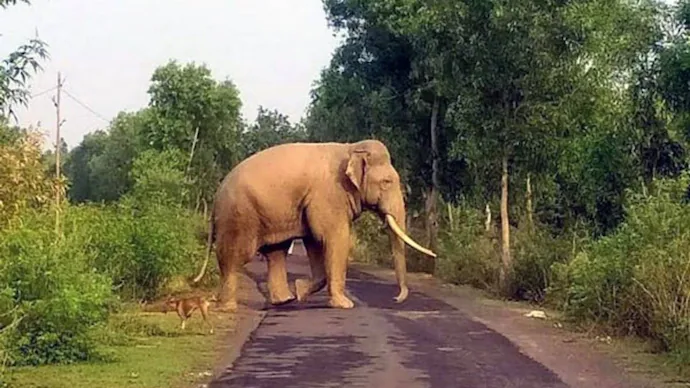
A large-scale forest operation began in Kerala’s Idukki district early Wednesday, November 25, as authorities deployed 140 personnel to capture and radio-collar the wild elephant known as Chakkakomban. The operation aims to tranquillise the animal, attach a tracking device and release it safely into a suitable forest location away from areas where it has repeatedly come into contact with residents.
The mission started at approximately 4 am, with forest officials monitoring the elephant’s movements near Anayirankal Dam before deciding where to carry out the tranquillisation. Authorities hope to complete the operation by noon, although the timing will depend on the animal’s location, terrain and safety conditions.
The operation has prompted precautionary restrictions across parts of Chinnakanal panchayat. Schools and other educational institutions have been ordered to remain closed in six wards, while residents have been advised to avoid unnecessary travel and stay away from the operation zone.
Why forest officials launched the Chakkakomban operation
Chakkakomban has become a familiar and controversial presence in the Chinnakanal region, particularly around the 301 Colony, where residents have repeatedly complained about the elephant entering inhabited areas.
According to local accounts, the elephant frequently approaches houses in search of jackfruits. Its name is associated with this behaviour, reflecting its repeated visits to residential properties where the fruit is available.
However, these encounters have created serious concerns among people living in the area. Residents have reported incidents involving property damage and attacks on people, prompting demands for intervention from the Forest Department.
Residents of the 301 Colony recently organised protests over the repeated movement of the elephant into residential areas. Their concerns reflect a wider challenge in parts of Idukki, where settlements, plantations and forest habitats exist close to one another.
As natural habitats become increasingly connected with human activity, elephants may enter villages and agricultural areas in search of food. Fruit-bearing trees, crops and accessible food sources can attract them towards houses, increasing the possibility of dangerous encounters.
The decision to radio-collar Chakkakomban is intended to improve the authorities’ ability to monitor its movements and respond when it approaches inhabited locations.
How the 140-member forest operation will work
The mission involves a coordinated deployment of forest personnel from multiple divisions, including Rapid Response Teams, the Elephant Squad and other specialist units. The operation is being led by Munnar Divisional Forest Officer Saju Varghese.
A separate 24-member specialist team, including four veterinary doctors, has been assigned to handle the animal’s tranquillisation and medical requirements, according to reports by the Press Trust of India.
The first priority is to locate the elephant and assess its movement patterns. Officials will then attempt to guide it towards a safer location where veterinary personnel can administer a tranquillising drug under controlled conditions.
Tranquillising a large wild elephant is a complex procedure. The animal’s position, physical condition, surrounding vegetation and distance from people all influence when and where veterinary teams can safely administer the drug.
Once Chakkakomban is sufficiently sedated, veterinary personnel can approach it to carry out the necessary checks and attach the radio collar. The team must also monitor the elephant’s condition during the process to reduce the risk of complications.
After the collar is fitted and the animal is considered fit for release, forest officials plan to move it into a safer forest area. The precise timing and location will depend on the conditions encountered during the operation.
What is a radio collar, and how will it help track Chakkakomban?
A radio collar is a tracking device fitted around an animal’s neck to help Wildlife authorities monitor its movements. Depending on the technology used, the device can transmit location information through satellite or other tracking systems.
For elephants that frequently approach human settlements, this information can help forest departments understand their movement patterns and identify areas where encounters with people are more likely.
Once Chakkakomban is fitted with the device, officials will be able to monitor its location without having to physically follow it through the forest. Tracking information can help teams identify when the elephant is moving towards villages, plantations or roads.
Radio-collar data can also help authorities study how an elephant uses its habitat, which routes it follows and whether it repeatedly returns to the same areas. Such information may support decisions about habitat management and future conflict-prevention measures.
However, a radio collar is not a physical barrier. It cannot prevent an elephant from entering a settlement or automatically keep people safe. Its effectiveness depends on regular monitoring, timely communication and the ability of forest teams to respond when the animal approaches populated areas.
Schools closed and restrictions imposed in six Chinnakanal wards
The district administration has introduced precautionary measures to protect residents during the operation. Prohibitory orders have been imposed in wards 1, 2, 9, 10, 11 and 12 of Chinnakanal panchayat.
All educational institutions in these wards, including anganwadis, will remain closed on Wednesday. The temporary closure is intended to reduce public movement and prevent children and other residents from accidentally entering areas where the forest teams are working.
Authorities have also prohibited the use of drones, night-vision cameras and camera traps in and around the operation zone. These restrictions are intended to avoid disturbing the elephant or interfering with the work of the forest personnel.
Residents have been advised not to approach the operation site, gather to watch the elephant or travel unnecessarily through the affected areas. Officials have warned that the animal could become agitated during the tranquillisation process and move unpredictably, including towards nearby residential locations.
The restrictions are particularly important because an elephant under stress or affected by tranquillising medication may not behave in the same way as it normally would. Maintaining distance gives veterinary and forest personnel more room to manage the situation safely.
Five hospitals kept ready for medical emergencies
Emergency medical arrangements have been made at five hospitals in the region as part of the operation’s safety preparations.
The medical readiness is intended to ensure that assistance is available if residents, forest personnel or other people require urgent treatment during the mission. The presence of medical facilities is an important precaution given the possibility of unpredictable elephant movement in an area close to human settlements.
Forest operations involving large wild animals require coordination beyond the wildlife department. District administration officials, police personnel, medical teams and local authorities may all have responsibilities in maintaining public safety and managing movement around the operation site.
A base camp has been established at Fatima Mata High School in Chinnakanal to coordinate the operation. The facility is serving as a central point for personnel and departments involved in the mission.
Chakkakomban brings back memories of the Arikomban controversy
The current operation has revived memories of another elephant-related controversy in the same region involving Arikomban, a wild elephant that repeatedly entered residential areas in search of food.
Arikomban became widely known after reports of damage to houses, shops and other properties, along with concerns about encounters with people. The animal was eventually captured and relocated by forest authorities in 2023 following a prolonged public debate over human-elephant conflict in Chinnakanal.
The relocation generated discussion about whether moving a problem elephant to another forest area provides a lasting solution. Wildlife conservationists and authorities have to consider the animal’s behaviour, habitat requirements and the possibility that it could move towards human settlements again.
Chakkakomban’s case raises similar questions. Residents want protection from repeated elephant incursions, while forest officials must manage the animal without causing unnecessary harm or creating additional risks.
The two elephants are different animals, and the circumstances surrounding their management should not be treated as identical. However, both cases illustrate the difficulties of managing human-elephant conflict in areas where wildlife habitats and settlements overlap.
Why human-elephant conflict remains a challenge in Idukki
Idukki contains extensive forest areas, plantations and settlements that exist in close proximity. This landscape creates frequent interactions between people and wildlife, particularly elephants that move across large territories in search of food and water.
When elephants enter residential areas, the consequences can be serious. They may damage crops, destroy structures or come into direct contact with people. Even an encounter that begins with an elephant searching for food can become dangerous if the animal feels threatened or is blocked from moving away.
Food availability is one of the factors that can influence elephant movement. Jackfruit trees and other fruit-bearing plants around houses may attract elephants, especially when natural food sources are less accessible.
For residents, the immediate priority is preventing injuries and protecting homes and livelihoods. For wildlife authorities, the challenge is to address those concerns while maintaining the safety and conservation of elephants.
Radio-collaring can improve monitoring, but long-term conflict management generally requires a combination of measures. These can include better early-warning systems, habitat protection, management of food attractants near settlements, safer movement corridors and rapid response arrangements.
What happens after Chakkakomban is radio-collared?
Once the tranquillisation and collaring process is completed, forest officials will need to monitor the elephant’s condition and movements closely. The tracking device should provide information that helps teams understand whether it remains within the designated forest habitat or begins moving towards populated areas again.
The operation’s success will therefore depend on more than safely fitting the collar. Authorities will need to use the location data effectively and maintain a response system capable of warning residents when the elephant approaches vulnerable areas.
For people living around Chinnakanal and the 301 Colony, the immediate hope is that the operation will reduce the risk of further dangerous encounters. The forest department’s longer-term challenge will be to prevent repeated conflict without relying solely on emergency capture and relocation exercises.
For now, residents have been asked to follow the administration’s restrictions, avoid the operation zone and allow the specialist teams to complete their work. The authorities’ priority is to tranquillise Chakkakomban under controlled conditions, fit the radio collar and release the elephant safely into the forest.
For breaking news and live news updates, like us on Facebook or follow us on Twitter and Instagram. Read more on Latest India on thefoxdaily.com.






COMMENTS 0