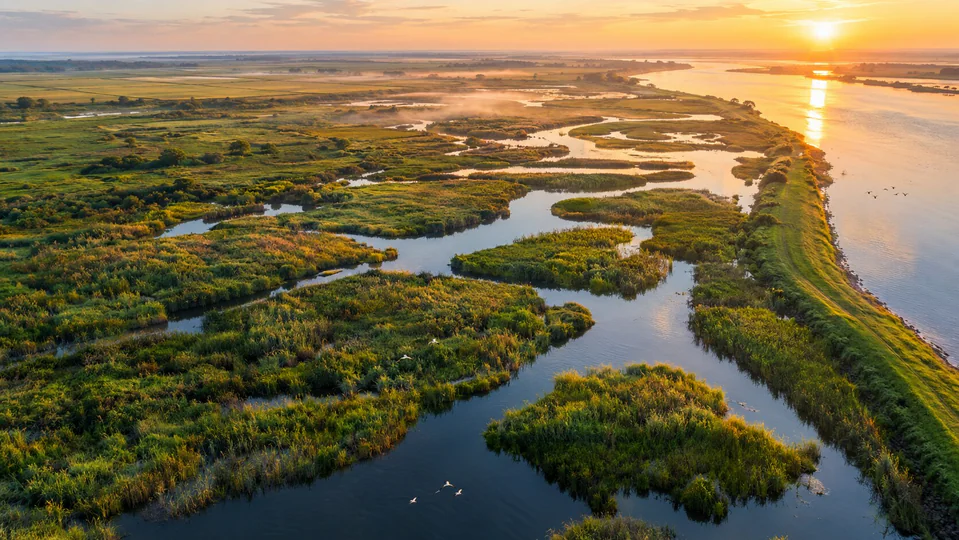
In California’s Sacramento-San Joaquin Delta, a major wetland restoration project is transforming 1,187 acres of former dairy and grazing land into tidal marsh designed to provide young salmon with food, shelter and a more natural environment in which to grow.
The Dutch Slough restoration project, located near Oakley on the western edge of the Delta, began construction in 2018 under the California Department of Water Resources (DWR) and its state and local partners. The initiative aims to restore tidal processes to land that had previously been used for agriculture, helping rebuild habitat for fish and Wildlife affected by decades of development and levee construction.
The project’s central idea is straightforward: reconnect the land to the tides so water can move naturally through the marsh. As the water flows in and out, the restored landscape can support aquatic organisms and create feeding and shelter opportunities for juvenile Chinook salmon as they move downstream from their spawning grounds.
Dutch Slough was described by DWR as the Delta’s largest tidal wetlands restoration project when its groundbreaking was celebrated in 2018. That distinction has since passed to the 3,400-acre Lookout Slough project in Solano County, which DWR reported as completed in September 2024.
Beyond fish habitat, Dutch Slough is intended to serve as a site for scientific research, improve environmental conditions and provide public access to nature. Its progress also illustrates a broader challenge in California: restoring wetlands while managing water resources, protecting communities and preparing for climate-related hazards.
What Is the Dutch Slough Tidal Wetlands Restoration Project?
Dutch Slough is a large-scale effort to restore tidal wetlands in the Sacramento-San Joaquin Delta, a vital waterway system in Northern California. The project covers 1,187 acres near Oakley, where former agricultural land is being reshaped to support the movement of tidal water and the return of native fish and wildlife.
The California Department of Water Resources and its partners launched the restoration effort to address the loss of natural habitat caused by land development and the construction of levees. By reconnecting parts of the landscape to the Delta’s waterways, the project aims to recreate ecological conditions that existed before extensive agricultural development altered the shoreline.
Dutch Slough is part of California EcoRestore, a state initiative designed to advance habitat restoration across the Delta. The broader effort sought to restore at least 30,000 acres of habitat by 2020. According to DWR’s 2020 summary, the programme was on track to exceed that target.
Although Dutch Slough was once described as the Delta’s largest tidal wetlands restoration project, it is no longer the biggest. The 3,400-acre Lookout Slough project in Solano County surpassed it in scale and was reported completed in September 2024.
The significance of Dutch Slough lies not simply in the amount of land being restored, but in how the project is designed to function. Rather than creating an isolated artificial wetland, the restoration reconnects land to the surrounding waterways so tides can help shape the habitat.
How the Tides Help Rebuild a Natural Marsh
A functioning tidal marsh needs more than water and vegetation. Its elevation and shape must allow water to enter and leave as tides rise and fall. If the land is too high or too low, the resulting water conditions may not support the full range of habitats that restoration planners want to establish.
That is why the Dutch Slough project began with extensive earth-moving work. In May 2018, DWR started shifting soil from higher ground to lower areas to create a landscape with the gradual elevation changes needed for tidal wetland development.
The reshaping allowed Delta water to move through the site once connections to surrounding channels were reopened. As the tides rise and recede, water can circulate through the restored landscape rather than remaining separated from it by protective levees.
The project proceeded in stages. Grading on the first two parcels was completed in late 2019, followed by revegetation. DWR initially planned to breach the levees in late fall 2021, depending on the establishment of vegetation.
The levees were ultimately breached at five locations, with the final breach completed in November 2021. This opened approximately 700 acres of the 1,187-acre site to tidal flows and access by native fish and wildlife during the initial phase.
The distinction between the project’s total size and the area opened during the first phase is important. The restoration covers 1,187 acres, but the initial tidal reconnection involved about 700 acres. The remaining land was still to be restored under the plans described in the project account.
Once tidal connections are established, the water itself becomes an important part of the restoration process. Regular circulation can create changing water conditions and support the development of wetland vegetation and aquatic habitats.
Why Young Chinook Salmon Need Tidal Wetlands
For juvenile salmon, the journey from freshwater spawning grounds towards the ocean involves major changes in their surroundings. Young fish need suitable places to find food, avoid predators and grow before continuing downstream.
Tidal wetlands can provide these opportunities by connecting fish to shallow aquatic habitats and food resources that may be less available in heavily modified waterways. The value of a restored marsh therefore depends not only on its size, but also on whether its channels and water conditions support the needs of young fish.
Chinook salmon are a central focus of research at Dutch Slough. The restoration aims to provide juvenile fish with habitat that supports their survival during an important stage of their life cycle.
Patty Finfrock, who managed the Dutch Slough project for DWR at the time, described the intended benefit as creating a safe neighbourhood for fish. The comparison captures the project’s purpose: give young salmon access to an environment where they can feed and grow before continuing their downstream migration.
The location is particularly relevant to that objective. Dutch Slough lies near the western edge of the Sacramento-San Joaquin Delta, close to the confluence of the Sacramento and San Joaquin rivers. It is also near Suisun Marsh, where freshwater and saltwater mix.
DWR has highlighted this mixture of water conditions as a feature that can provide a more diverse habitat than some other marsh sites. However, the presence of varied habitat does not automatically guarantee improved fish survival. Researchers still need to determine how fish use the restored channels and whether the conditions support growth over time.
What Research Says About Restored Salmon Habitat
Research into tidal wetland restoration suggests that reconnecting waterways can recover some important habitat functions, but the ecological benefits are not necessarily immediate or uniform.
A 2024 paper published in San Francisco Estuary and Watershed Science summarised a symposium held in fall 2023 by DWR and the State Water Contractors. The paper highlighted the need for further research into how fish use restored habitats and emphasised better monitoring and adaptive management.
These recommendations are important because the success of a restoration project cannot be measured solely by the number of acres reconnected to the tides. Scientists also need to understand whether fish occupy the habitat, whether it provides suitable feeding conditions and how environmental changes affect its performance.
Lessons from a restoration project in Washington State
A 2014 study published in Transactions of the American Fisheries Society examined a comparable tidal wetland restoration at the delta of Washington State’s Nisqually River.
The project restored tidal flows to 364 hectares, or approximately 900 acres, of marsh. Researchers compared channels in the restored habitat with reference channels to examine their potential value for juvenile Chinook salmon.
The findings showed that restored and reference channels offered similar potential for foraging and growth. However, salmon densities were lower in the restored channels, and growth potential was more variable because the water was warmer and less stable.
The study illustrates an important distinction between recreating habitat features and fully reproducing the ecological conditions that fish need. A restored channel may offer feeding opportunities comparable to those in a reference habitat without attracting the same number of fish or providing equally stable conditions.
For Dutch Slough, this research provides a useful reason to evaluate the quality of the restored habitat rather than relying only on acreage or the presence of tidal water. It does not establish that Dutch Slough will experience the same results, since the projects are in different locations and have their own environmental conditions.
Instead, the comparison highlights why long-term monitoring matters. Restoration can recover some ecological functions relatively quickly, while other features may require more time, further intervention or changes in management.
Why Monitoring and Adaptive Management Matter
Wetland restoration is not necessarily finished when levees are breached and water begins to flow through the site. Once tidal connections are established, researchers must assess how the habitat develops and whether it meets its ecological objectives.
The 2024 research paper’s emphasis on monitoring and adaptive management reflects this challenge. Monitoring helps scientists document changes in the environment and the use of the habitat by fish. Adaptive management allows project managers to use those findings when deciding whether adjustments are needed.
For juvenile salmon, useful questions include whether fish enter the restored channels, how they use available food resources and whether water temperature and other conditions support growth. These observations can help distinguish between a wetland that has been physically restored and one that is delivering the intended ecological benefits.
Monitoring is also relevant to the wider Delta because the region must support multiple water-management and environmental objectives. Evidence from Dutch Slough could contribute to the understanding of how restored tidal wetlands function and how future projects might be designed.
However, the available research summary does not establish a specific improvement in salmon survival attributable to Dutch Slough. The project’s objectives and the broader scientific rationale should therefore be distinguished from measured outcomes. Determining whether survival rates improve requires evidence from fish monitoring and other ecological assessments.
Benefits Beyond Salmon and Wildlife
Although fish habitat is a central objective, Dutch Slough is intended to provide broader environmental and community benefits.
DWR Deputy Director Kristopher Tjernell said the project would advance scientific knowledge while benefiting fish and wildlife affected by decades of land and levee development. He also highlighted potential improvements to water and air quality and described the site as a living laboratory for studying future wetlands.
The research value extends beyond a single species. Restored marshes can provide opportunities to study how water movement, vegetation and wildlife interact in landscapes that have been altered by human activity. The resulting knowledge may help guide future habitat restoration efforts.
The project also has a public-access component. According to DWR, the City of Oakley is developing a 55-acre portion of the site into a community park with a loop trail intended for activities such as hiking, cycling and birdwatching.
That park would create a way for residents and visitors to experience the restored landscape. Public access can also help connect local communities with wetland conservation, although recreational facilities must be managed in ways that remain compatible with the site’s environmental objectives.
Flooding is another consideration. The project account identifies the potential to help reduce flood risk for surrounding housing as sea levels rise. However, the extent of any reduction would depend on site conditions and how the restored landscape interacts with surrounding waterways and flood-protection infrastructure. The available information does not quantify a specific reduction in flood risk.
How Dutch Slough Fits Into California’s Water and Climate Challenges
The Sacramento-San Joaquin Delta is important to California’s water system and supports a range of ecological functions. Managing the region requires balancing water needs with the protection of fish, wildlife and communities living near its waterways.
Decades of land development and levee construction have changed the Delta’s shoreline and reduced or altered natural wetland habitat. Projects such as Dutch Slough seek to reverse some of those changes by allowing water to move through selected areas of former agricultural land.
Climate hazards add another layer of complexity. DWR has emphasised the need to plan for climate-related risks while continuing to provide clean water to 27 million Californians. Wetland restoration forms part of the wider effort to understand how the Delta can function under changing environmental conditions.
Nevertheless, habitat restoration is not a substitute for all other water-management or flood-protection measures. Its value depends on the ecological functions it restores and how those functions fit into the region’s broader planning needs.
Dutch Slough offers an opportunity to study these relationships in a landscape where agricultural use is giving way to tidal wetland habitat. Its long-term contribution will depend on how successfully the restored marsh supports wildlife, what researchers learn from monitoring it and how the site is managed as conditions change.
From Agricultural Land to a Living Wetland
The origins of Dutch Slough’s restoration effort go back further than its 2018 groundbreaking. In 1999, John Cain of American Rivers recognised the site’s potential and worked to persuade local leaders that restoring marsh habitat offered a way to protect the Delta shoreline.
That early vision has since developed into a large restoration project combining ecological objectives, scientific research and plans for public recreation. The conversion of former dairy and grazing land demonstrates how landscapes previously used for agriculture can be repurposed to support wetland functions.
The transformation also highlights the difference between restoring a landscape and guaranteeing a particular environmental result. Reconnecting land to tidal water creates the physical conditions needed for a marsh, but researchers must still determine how the resulting habitat performs for salmon and other wildlife.
The approximately 700 acres opened during the initial phase marked a significant step in that process. The overall project covers 1,187 acres, and the longer-term objective is to establish a functioning tidal wetland that supports native species and provides opportunities for continued research.
What Happens Next for the Dutch Slough Project?
The key question is how the restored marsh performs over time. Continued monitoring can help determine whether juvenile Chinook salmon use the channels as intended, whether the habitat provides suitable conditions for growth and whether management adjustments are needed.
The 2024 research paper’s call for better monitoring and adaptive management points to the importance of evaluating restoration through evidence rather than acreage alone. Findings from Dutch Slough may also help scientists and project managers understand which habitat features recover quickly and which require further attention.
For the surrounding community, the development of the planned 55-acre park offers another dimension to the project. The trails could provide opportunities for outdoor recreation and wildlife observation while introducing more people to the Delta’s changing landscape.
Dutch Slough began with a major physical transformation: reshaping former agricultural land and reopening it to tidal flows. Its lasting success, however, will depend on what that transformation achieves for fish, wildlife, water management and the local community.
By restoring tidal processes to 1,187 acres near Oakley, California is creating an opportunity to rebuild important wetland habitat while learning more about the needs of young salmon. The project does not guarantee that every ecological function will return immediately, but it provides a setting in which restoration outcomes can be studied, measured and improved over time.
For breaking news and live news updates, like us on Facebook or follow us on Twitter and Instagram. Read more on Latest World on thefoxdaily.com.


COMMENTS 0