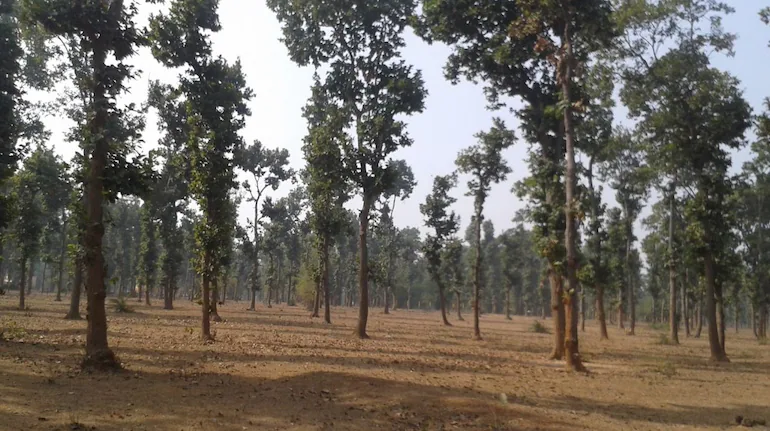
Madhya Pradesh has approved the felling of more than 1.56 lakh sal trees to contain an outbreak of the sal heartwood borer beetle, a pest whose larvae damage the trunks of the valuable hardwood species. The clearance, granted in September, covers affected forest areas in Dindori district and the Amarkantak region of neighbouring Anuppur district.
According to the approved plan, a total of 1,56,319 sal trees can be felled as forest authorities attempt to prevent the infestation from spreading further. Of these, 1,46,784 trees are located in Dindori, while another 9,535 are in the Amarkantak area of Anuppur.
The scale of the outbreak is significant in Dindori, where the Forest Department estimates that the infestation has affected 30,487 hectares of sal forest.
Alongside tree removal, officials have introduced insect-trapping measures and involved local residents in collecting the beetles. Villagers are being paid for every insect they collect and hand over to the forest department. By September, the campaign had resulted in the collection of nearly 19 lakh beetles, with the department estimating its expenditure at approximately Rs 38.5 lakh.
Sal heartwood borer outbreak: How the beetle damages trees
The sal heartwood borer, scientifically known as Hoplocerambyx spinicornis, is a dark-brown longhorn beetle that grows to approximately the length of a human finger. Its larvae bore into sal tree trunks, damaging the wood from within.
Sal trees, scientifically known as Shorea robusta, are valuable hardwood species found across several parts of India. The beetle’s ability to damage their trunks makes large-scale infestations a serious concern for forest management.
According to a forestry paper published by the United Nations’ Food and Agriculture Organization (FAO), adult beetles begin emerging from infested trees with the arrival of the monsoon in June. Their emergence continues until the end of July.
The FAO paper identifies an infestation as an epidemic when more than 1% of the trees in a forest are affected. It outlines two principal approaches to controlling the pest: using felled trees as traps to attract adult beetles before collecting and destroying them, and removing severely infested trees to prevent further damage.
Why Madhya Pradesh is paying villagers to collect beetles
The Forest Department in Dindori is combining tree removal with insect-trapping methods to reduce the beetle population. Selected sal trees are cut down, and their bark is beaten to release an odour that attracts adult beetles.
Once the insects gather around the felled trees, they are collected and destroyed. The approach uses the beetles’ attraction to the material from infested trees as part of the pest-control campaign.
Authorities have also introduced a payment system to encourage local participation. Villagers receive Rs 2 for every beetle they collect and hand over to the forest department.
The initiative had resulted in the collection of nearly 1.9 million insects by September. The department estimated the total expenditure on the operation at around Rs 3.85 million, equivalent to Rs 38.5 lakh.
By involving residents in the collection process, the forest department is combining community participation with measures aimed at reducing the number of adult beetles in affected areas.
Sal tree infestation in Madhya Pradesh has a long history
The current outbreak is not the first major infestation of sal forests by the heartwood borer. The insect was first identified as a pest affecting sal trees in 1899, and historical records show that the region has experienced several large-scale outbreaks.
One major infestation occurred in 1923-24, when the beetle spread across the Mandla and Dindori forests and affected approximately 7 million trees.
A study published in 1964 established that the beetle is endemic to the forests of Dindori and Mandla. This means the insect is naturally present in the region and can cause recurring outbreaks under favourable conditions.
Another large-scale epidemic occurred between 1996 and 2001. During this period, more than 3.5 million sal trees were affected across an area of approximately 5,000 square kilometres.
According to the FAO paper, around 1.59 million trees in Dindori and Mandla alone had to be felled during that outbreak.
The recurring nature of the infestation has been highlighted in assessments of the latest outbreak. Solanki, whose assessment was cited in the report, said the current episode follows a cycle of approximately 30 years, similar to the outbreak observed in 1997-98.
Why the beetle outbreak matters for Madhya Pradesh’s sal forests
Sal is an important hardwood species across large parts of central and eastern India. Its forests form a significant part of the region’s ecosystem, making widespread damage from insect infestations a concern for forest conservation and management.
The approval to fell 1,56,319 trees highlights the scale of the challenge facing forest authorities in Madhya Pradesh. Removing severely infested trees is one of the control measures identified in forestry guidance, while trapping and destroying adult beetles is intended to reduce the pest population.
However, the scale of the current infestation also raises concerns about the long-term management of sal forests in areas where the beetle is naturally present. Historical outbreaks in Mandla and Dindori demonstrate that the problem has affected the region repeatedly over more than a century.
Forest authorities combine tree removal and community participation
The campaign in Dindori and Anuppur involves two main approaches: cutting selected trees to address the infestation and collecting adult beetles through trapping operations. The payment system for villagers adds a community-based component to the forest department’s response.
With nearly 19 lakh beetles collected by September and more than 1.56 lakh trees approved for felling, authorities are attempting to contain the outbreak across affected forest areas.
The recurring history of sal heartwood borer infestations underlines the difficulty of managing a pest that is endemic to the region. The effectiveness of the ongoing campaign will be important for limiting further damage to Madhya Pradesh’s sal woodlands and protecting the valuable hardwood species.
For breaking news and live news updates, like us on Facebook or follow us on Twitter and Instagram. Read more on Latest Technology on thefoxdaily.com.





COMMENTS 0