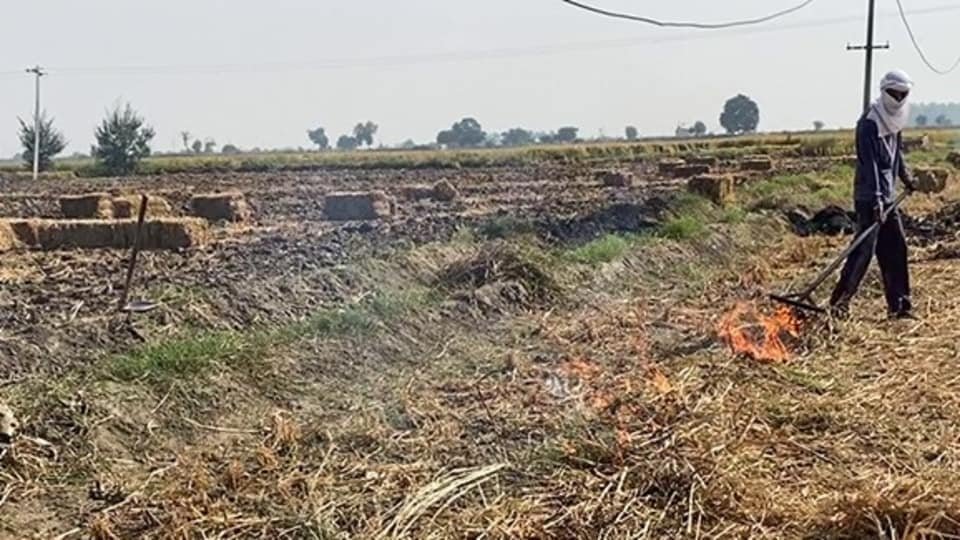
Punjab has reported a sharp rise in stubble-burning incidents, recording more than 500 farm fires in the 72 hours leading up to November 2. The state’s cumulative count has climbed to 1,612 as paddy harvesting continues across major agricultural districts.
According to the latest report by the Commission for Air Quality Management (CAQM), 77.38% of Punjab’s total paddy area had been harvested as of November 2. Tarn Taran recorded the highest number of incidents at 489, followed by Ferozepur with 193 and Amritsar with 192.
The number of farm fires stood at 1,047 on October 30, highlighting the sharp increase over the following three days.
Officials Fear Further Rise as Wheat Sowing Deadline Approaches
Officials, speaking on condition of anonymity, have expressed concern that farm fires could increase further as November 15 approaches. The date marks the deadline for the ideal wheat-sowing window, and some farmers may resort to burning crop residue to clear their fields and prepare the land for the next crop.
Despite the recent increase, Punjab’s cumulative farm fire count remains below the 2,262 incidents recorded during the corresponding period last year.
However, officials have warned that the situation could deteriorate as harvesting reaches its peak. By this stage last year, around 85% of the paddy crop had been harvested, compared with 77% this year.
Farm Fires Spread from Majha to Malwa Region
The latest increase in stubble-burning incidents has also been accompanied by a shift in their geographical distribution. During the initial phase of the harvesting season, the Majha region, particularly Amritsar and Tarn Taran, accounted for most reported cases.
As harvesting activity has picked up in central and southern Punjab, several districts in the Malwa region have also reported rising numbers.
Sangrur recorded 76 incidents, followed by Bathinda with 68, Patiala with 54 and Faridkot with 49. Fazilka and Barnala reported 34 cases each, while Moga recorded 23 and Muktsar reported 20.
The changing geographical spread has prompted concerns among pollution control officials, particularly as harvesting operations gather pace across Malwa.
CAQM Verifies 663 Farm Fires During Field Inspections
The CAQM report also highlighted the enforcement action taken against stubble burning. Crop burning was physically verified in 663 of the 1,380 fields inspected by authorities.
Environmental compensation of ₹29.15 lakh had been imposed in 573 cases. Of this amount, ₹19 lakh had been recovered as of November 2.
The figures indicate that authorities are continuing field inspections and financial penalties as part of efforts to discourage farmers from burning crop residue.
District Administrations Asked to Strengthen Enforcement
Punjab Pollution Control Board (PPCB) officials said district administrations had been asked to remain on alert as harvesting operations intensified across the Malwa region.
Authorities have been directed to coordinate with police personnel and pollution control teams to strengthen enforcement of anti-burning measures and prevent further incidents.
“The trend clearly shows that stubble burning is now shifting from the Majha to the Malwa region. With large-scale harvesting currently underway, we expect the number of incidents to rise in the coming days unless immediate preventive steps are taken,” a senior PPCB official said, requesting anonymity.
Punjab Recorded 5,114 Farm Fires During 2025 Paddy Season
The PPCB monitors farm fire incidents between September 15 and November 30 each year. During the 2025 paddy harvesting season, Punjab recorded 5,114 stubble-burning incidents.
With harvesting still underway and the wheat-sowing window approaching, the coming weeks will be important for monitoring farm fires across the state. Authorities are seeking stronger coordination at the district level to prevent a further increase in crop residue burning.
For breaking news and live news updates, like us on Facebook or follow us on Twitter and Instagram. Read more on Latest India on thefoxdaily.com.






COMMENTS 0