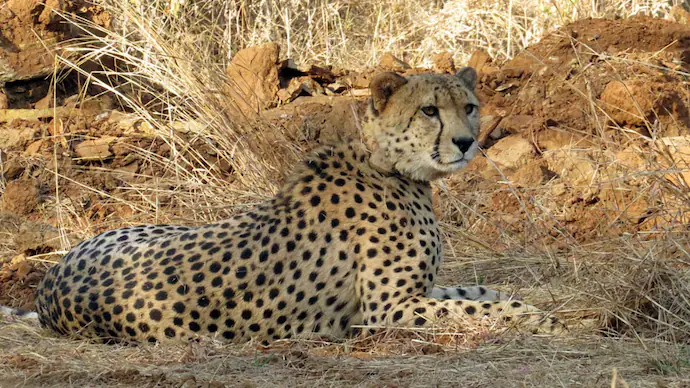
A critically injured cheetah found near Kuno National Park in Madhya Pradesh has prompted a wide-ranging investigation into the circumstances surrounding its injuries. The incident, reported on October 25 in the Pahadgarh area of Morena district, has raised concerns about the safety of cheetahs reintroduced into India and the possibility of conflict between wildlife and local communities.
The male cheetah, approximately 19 months old, was discovered injured and unable to move by a monitoring team tracking three animals in the area. Forest officials are investigating several possibilities, including whether the animal was struck with a hard, blunt object, whether the incident was connected to suspected poaching activity nearby, or whether a conflict involving livestock may have preceded the injury.
The Madhya Pradesh Forest Department has dispatched the State Tiger Strike Force to investigate the case from the poaching angle. The decision follows reports that the remains of hunted leopards had been found in the same area a few weeks earlier.
The cheetah was rescued on the evening it was discovered and transported to Kuno National Park for treatment. Officials said it remained in critical condition and was unable to walk. Medical scans are scheduled to help establish the nature and extent of its injuries.
The investigation comes at an important stage in India’s cheetah reintroduction programme, which began in September 2022. Although the precise circumstances of the incident remain unclear, the case highlights the challenges involved in monitoring wide-ranging predators and protecting them as they occupy landscapes beyond the boundaries of protected areas.
How the injured cheetah was discovered near Pahadgarh
The incident came to light on the evening of October 25, when a monitoring team responsible for tracking three cheetahs found one of the animals injured in the forests near Pahadgarh in Morena district.
The group included a male cheetah and one of the cubs of Nirva, a female cheetah brought to India from South Africa in February 2023. The team discovered that the male animal was immobile and appeared to be seriously injured.
The monitoring team rescued the cheetah that same evening and transported it to nearby Kuno National Park, where it could receive medical attention. According to sources, the animal was unable to walk and was in critical condition following the discovery.
Initial observations indicated a possible spinal injury. Sources said the cheetah appeared to have suffered damage to its backbone, potentially caused by a hard and blunt object. Officials also reported an external injury, although the precise nature of the wounds had not yet been established.
These early observations have helped determine the direction of the investigation, but they do not conclusively establish how the animal was injured. Medical examinations and the findings of investigators will be necessary to determine whether the injuries resulted from deliberate human action, an encounter involving livestock or another cause.
The fact that the cheetah was found immobile makes the medical assessment particularly important. A suspected spinal injury can have serious consequences for a wild animal, potentially affecting its ability to walk, hunt and survive independently. The available information does not establish the animal’s eventual prognosis.
Why investigators are examining a possible poaching link
One of the central questions in the investigation is whether the cheetah’s injuries are connected to suspected poaching activity in the surrounding area. Forest officials are examining this possibility because the remains of two hunted leopards were reportedly found in the same locality a few weeks before the cheetah was discovered.
The earlier reports have prompted authorities to consider whether the cheetah may also have been targeted. However, the existence of suspected leopard poaching in the area does not establish that the cheetah was attacked by poachers or that the incidents are connected.
The State Tiger Strike Force has been sent to investigate the matter from this angle. Its involvement indicates that authorities are treating the possibility of deliberate harm seriously while seeking to establish what happened to the animal.
Samita Rajora, chief wildlife warden of Madhya Pradesh, confirmed that the force had been deployed to examine the case. She said the area was the same location where two leopards had been hunted.
The investigation will need to determine whether evidence supports a link between the cheetah’s injuries and the earlier incidents. At this stage, poaching remains one of the possibilities under examination rather than an established explanation.
The case also draws attention to the risks faced by wildlife in landscapes where animals move beyond protected habitats. If deliberate attacks are established, investigators would need to determine the circumstances and identify those responsible. If the injuries resulted from another cause, the findings would help clarify what measures may be needed to prevent similar incidents.
Could a conflict involving livestock have caused the injuries?
Alongside the poaching angle, officials are examining whether the cheetah may have attacked livestock and subsequently been targeted by villagers. This possibility forms part of the wider inquiry into whether the incident involved human-wildlife conflict.
Large predators can come into contact with people when they move through areas used for grazing or other livelihood activities. Where livestock and wildlife share the same landscape, concerns about the safety of domestic animals can create tensions between local communities and conservation authorities.
However, the supplied information does not establish that the cheetah attacked livestock before it was injured. Nor does it confirm that villagers were responsible for the animal’s condition. Both possibilities remain under investigation.
Establishing whether a livestock-related incident occurred will require evidence about the animal’s movements and the circumstances preceding its discovery. Investigators will also need to distinguish between a confirmed encounter and a suspected explanation based on the location where the cheetah was found.
The distinction is important because an unsupported assumption about the cause of the injury could obscure what actually happened. If a conflict is confirmed, authorities may need to examine how wildlife movements, livestock protection and local safety concerns intersect in the area. If the incident is unrelated to livestock, the investigation will need to establish the alternative explanation.
The case therefore presents two related but separate questions: what caused the cheetah’s injuries, and whether the incident reflects a wider problem involving wildlife and people around the reintroduction landscape. The available information does not yet provide definitive answers to either question.
Medical scans expected to clarify the nature of the injuries
Medical scans are scheduled to help determine the extent of the cheetah’s injuries and how they may have occurred. The initial assessment suggests possible damage to the backbone, along with an external wound, but further examination is needed to establish the precise injuries.
Medical findings could help investigators assess whether the animal’s condition is consistent with the suspected use of a hard and blunt object. However, the available information does not indicate that a medical conclusion has already established the cause of the injury.
The cheetah’s inability to walk has raised concern about the seriousness of its condition. A spinal injury may compromise mobility and make it difficult for a wild predator to perform basic survival activities. The animal’s condition will therefore be important not only for its immediate treatment but also for assessing its longer-term prospects.
Officials have not provided a confirmed prognosis in the supplied account. Until further medical assessments are completed, the extent of the damage and the likelihood of recovery remain uncertain.
The investigation will need to bring together the medical assessment, the circumstances of the rescue and any evidence collected from the location where the cheetah was found. Together, these findings may help establish whether the injuries were caused deliberately or resulted from another incident.
The cheetah was found outside Kuno National Park
An important detail in the case is that the location where the monitoring team found the cheetah lies outside Kuno National Park. The animal was discovered in the forests near Pahadgarh, in Morena district, before being rescued and taken to the park for treatment.
The distinction matters because the incident occurred beyond the national park’s boundary, illustrating the need to monitor cheetahs as they move through the surrounding landscape. Protected areas provide a central base for conservation efforts, but the movement of wild animals can extend beyond their formal limits.
According to the supplied information, monitoring teams tracking radio-collared cheetahs generally maintain a minimum distance of 500 metres from the animals. This approach allows teams to observe the animals while maintaining separation during routine monitoring.
The monitoring team was tracking three cheetahs when it discovered the injured male. Its presence enabled the animal to be located and rescued on the same evening.
The circumstances also highlight the practical challenges of wildlife monitoring. Teams must track animals across forested terrain while maintaining appropriate distances, and they may have to respond quickly when an animal is found injured or unable to move.
Whether the cheetah’s location outside the park contributed to the incident remains unknown. The fact that the animal was found beyond the boundary does not itself establish that it encountered people or was deliberately harmed there.
India’s cheetah population and the expansion of its habitat
India currently has 60 cheetahs spread across three locations in Madhya Pradesh, according to the supplied report. Kuno National Park remains the main centre of the reintroduction programme and houses most of the animals.
The programme began in September 2022 as part of efforts to re-establish cheetahs in India after the species had disappeared from the country’s landscape. Kuno became the principal site for the initiative and continues to play a central role in monitoring and managing the reintroduced population.
More recently, some cheetahs have been shifted to Gandhi Sagar Wildlife Sanctuary and Rani Durgawati Tiger Reserve. The objective is to extend the areas in which the animals are managed and to distribute the population across additional habitats.
Expanding the locations where cheetahs live can support a broader reintroduction strategy, but it also increases the importance of understanding how animals move through different landscapes. Their presence may require sustained monitoring and coordination among wildlife officials working across protected areas and their surroundings.
The incident near Pahadgarh has brought these issues into focus because it involves a young cheetah found critically injured outside Kuno National Park. It remains too early to determine whether the case reveals a broader threat to the reintroduced population or represents an isolated incident.
The findings of the investigation may help clarify the risks the animal faced and whether any changes to monitoring or protection arrangements are warranted. At present, officials have not established a definitive cause for the injuries.
Why the investigation matters for Project Cheetah
Project Cheetah depends on more than the successful movement and release of animals. Monitoring their condition, understanding their movements and investigating threats are also important elements of managing a reintroduced population.
The case near Pahadgarh raises questions about the security of cheetahs moving through areas outside Kuno National Park. If deliberate harm is confirmed, authorities will need to understand the circumstances and consider how similar risks can be addressed. If the incident is found to involve a livestock-related conflict, the findings may help identify where conservation management and local concerns intersect.
At the same time, the incident should not be treated as proof of a wider pattern before the investigation is complete. The available information confirms that a male cheetah was found critically injured and that officials are examining multiple possible explanations. It does not establish who or what caused the injuries.
The earlier reports of hunted leopards have made the poaching angle a significant part of the inquiry, while the possibility of a livestock-related conflict remains another line of investigation. Medical scans and evidence gathered by the State Tiger Strike Force may help establish which explanation, if any, is supported by the findings.
The immediate priority is to determine the extent of the cheetah’s injuries and understand how it came to be in that condition. The answers will matter for the animal’s treatment and may also provide information relevant to wildlife protection in the region.
What investigators are trying to establish
The wide-ranging probe into the injured cheetah centres on several unresolved questions. Investigators are examining whether the animal was struck with a hard and blunt object, whether the incident could be connected to suspected poaching activity involving leopards in the same area, and whether a possible encounter involving livestock preceded the injury.
Medical scans are expected to provide a clearer picture of the cheetah’s condition. Meanwhile, the State Tiger Strike Force is examining the poaching angle, with officials seeking to establish whether the available evidence supports a connection to the earlier incidents.
The circumstances surrounding the discovery are also relevant. The monitoring team found the animal immobile in the forests near Pahadgarh on October 25 and rescued it that evening. Its location outside Kuno National Park makes the surrounding landscape an important part of the investigation.
For now, the cause of the injuries remains undetermined. The deployment of specialist investigators reflects the seriousness with which officials are treating the case, but it should not be mistaken for confirmation of any particular theory.
The investigation’s findings will help establish whether the incident involved deliberate harm, a human-wildlife conflict or another cause. Until those findings are available, the injured cheetah’s case remains a warning about the need for careful monitoring and evidence-based investigation as India’s cheetah reintroduction programme continues.
For breaking news and live news updates, like us on Facebook or follow us on Twitter and Instagram. Read more on Latest India on thefoxdaily.com.






COMMENTS 0