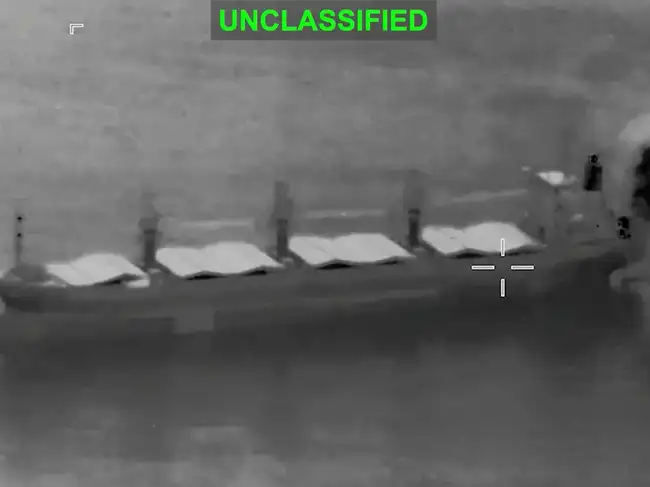
The United States military has fired on and disabled a commercial cargo vessel in the Gulf of Oman after it allegedly attempted to violate Washington’s naval blockade against Iran. The incident, announced by US Central Command (CENTCOM) on November 7, adds to growing tensions around one of the world’s most important maritime trade routes.
According to CENTCOM, the St. Kitts-flagged vessel ignored repeated warnings from American forces and attempted to leave regional waters after visiting an Iranian port. A US military aircraft subsequently fired precision munitions at the ship’s stern, disabling it.
The development came as Iranian media reported explosions on Qeshm Island and in the port of Jask, while Iran’s military said two tankers had caught fire after striking mines in the Strait of Hormuz. The circumstances surrounding those incidents remain unclear, and the claims have not been independently established.
The latest events underline the risks facing commercial shipping as the US-Iran Conflict continues to affect maritime operations, energy exports and security across the Gulf region.
Why Did the US Military Fire on the Commercial Vessel?
US Central Command said its forces disabled the commercial cargo ship M/V Huda in the Gulf of Oman on November 7. The vessel was flying the flag of St. Kitts and Nevis and had reportedly visited an Iranian port before attempting to depart regional waters.
According to the American military, the ship’s civilian crew repeatedly ignored warnings and instructions issued by US forces. CENTCOM said the crew was directed to abandon the areas that would be targeted before the military aircraft fired precision munitions at the vessel’s stern.
The strike disabled the ship and prevented it from continuing its journey. CENTCOM did not immediately provide detailed information about the condition of the crew, the extent of the damage or the vessel’s subsequent movements.
Washington described the operation as an enforcement action against an attempted violation of its naval blockade on Iran. The US military has maintained restrictions on commercial maritime traffic entering and leaving Iranian ports as part of its campaign to limit Tehran’s ability to export oil and move other goods.
The distinction between a vessel being disabled and sunk is important. CENTCOM said the M/V Huda was rendered inoperable, but its announcement did not say that the ship had been destroyed or had sunk.
CENTCOM Says 147 Commercial Ships Have Been Redirected
The US military said its blockade enforcement operations since July had resulted in 147 commercial vessels being redirected after complying with American instructions. Five merchant ships that refused to comply were also disabled, according to CENTCOM.
The command separately said US forces had previously destroyed 10 Iranian commercial oil tankers linked to what it described as a multibillion-dollar shadow network operated by Iran’s Islamic Revolutionary Guard Corps (IRGC).
These figures were provided by the US military and describe its account of the blockade’s enforcement. They do not independently establish the circumstances surrounding every vessel interception or the legal status of each ship’s activities.
CENTCOM has also estimated that the naval restrictions have prevented Iran from exporting more than $25 billion worth of crude oil. The figure reflects the American military’s assessment of the blockade’s economic impact.
The latest operation indicates that Washington is continuing to enforce the restrictions despite the risks of confrontations involving civilian commercial vessels. CENTCOM has warned mariners operating near Iranian coastal areas and surrounding waters to follow instructions issued by US forces.
Explosions Reported on Qeshm Island and in Jask
The vessel incident unfolded against a wider backdrop of reports of explosions in southern Iran. Iranian state television reported blasts in several locations, including Qeshm Island in the Strait of Hormuz and the port of Jask.
The cause of the explosions was not immediately established. Iranian media initially reported that missiles had struck Qeshm Island, but a source cited by the Tasnim news agency subsequently denied that the blasts were caused by missile attacks.
There was no immediate independent confirmation that the explosions resulted from a new US military operation. The American military did not immediately provide a detailed explanation of the reported blasts.
The uncertainty is significant because the reports emerged shortly after US President Donald Trump acknowledged that American forces had conducted limited strikes against an Iranian air-defence system. Trump described the action as minor, while CENTCOM did not publicly provide further details about the operation.
It is therefore important to distinguish between confirmed statements, media reports and unverified explanations. The existence of explosions does not by itself establish whether they were caused by missiles, military activity, accidents or another source.
Iran Says Two Tankers Caught Fire After Hitting Mines
Iran’s military also announced that two tankers had caught fire after striking mines while navigating the Strait of Hormuz. The statement added another layer of concern to an already volatile maritime situation.
Iranian authorities did not immediately identify the vessels by name or disclose their flags, ownership, destinations or the nationalities of their crews. Detailed information about the extent of the damage and possible casualties was also not available in the initial announcement.
The claim that the ships struck mines has not been independently verified. It remains unclear where the incidents occurred, what type of mines may have been involved or whether investigators have recovered evidence confirming the cause of the fires.
Maritime incidents in the region can have serious consequences even when crews escape without major injuries. A fire aboard an oil tanker can create risks of fuel leakage, pollution, explosions and disruption to nearby shipping traffic.
Any confirmed use of naval mines would raise additional security concerns because mines can threaten vessels that are not directly involved in military operations. Their location may also be difficult to establish without specialist detection and clearance operations.
For commercial operators, uncertainty over the presence of mines or other hazards can be enough to trigger route changes, delays and higher insurance costs.
Why the Strait of Hormuz Is So Important
The Strait of Hormuz is a narrow maritime passage connecting the Persian Gulf with the Gulf of Oman and the wider Arabian Sea. It lies between Iran to the north and Oman and the United Arab Emirates to the south.
It is one of the world’s most strategically important energy routes because a substantial share of internationally traded crude oil and petroleum products passes through it. Major oil and gas producers in the Gulf depend on the waterway to reach customers in Asia and other regions.
The strait is particularly important for exports from Saudi Arabia, Iraq, Kuwait, Qatar, the UAE and Iran. Although some countries have alternative pipelines and export infrastructure, the waterway remains a critical route for regional energy shipments.
Its geography makes the passage difficult to replace. Ships travelling between Gulf ports and international markets must generally use the narrow shipping corridor, leaving commercial traffic exposed to disruptions if military tensions increase.
Even a temporary interruption can affect oil prices, shipping schedules and energy markets. Traders may react to the possibility of supply disruptions before an actual shortage occurs, while shipping companies may reassess whether vessels can safely enter or leave the Gulf.
The latest reports involving the M/V Huda and the two tankers therefore have implications beyond the immediate military confrontation. They raise questions about whether commercial shipping can continue operating reliably in the region.
US-Iran Blockade and the Risk of Further Escalation
The naval blockade has become a central element of Washington’s pressure campaign against Tehran. By restricting maritime movements connected to Iranian ports, the United States aims to limit the country’s oil exports and reduce the revenue available to its government and military institutions.
Iran has opposed the restrictions and warned that it could retaliate against American and allied interests in the region. The confrontation has created risks for neighbouring Gulf countries, international shipping companies and foreign governments with economic interests in the waterway.
The conflict has continued for more than eight months, disrupting energy markets and complicating diplomatic efforts to reach a settlement. Commercial vessels have faced repeated security incidents, including reports of attacks, unidentified projectiles and other threats while travelling through the Gulf and nearby waters.
October saw the highest number of reported attacks on commercial ships in the Strait of Hormuz since March, according to reporting on the latest maritime developments. The increase has added to concerns among ship operators about the safety of crews and cargo.
The latest US strike is particularly significant because it involved a commercial vessel that Washington said had ignored repeated warnings. Such incidents can create difficult situations for civilian crews, who may find themselves caught between military instructions, commercial obligations and the risk of physical damage to their ships.
Trump Signals Further Military Pressure on Iran
The latest maritime confrontation follows Trump’s confirmation that the United States had carried out limited strikes against an Iranian air-defence system. He described the operation as minor, but the announcement raised concerns that military action could expand again after weeks of uncertainty.
Trump had previously indicated that he was considering another wave of strikes against Iran after the November 3 US midterm elections. Tehran, meanwhile, has warned that it could respond broadly to attacks on its territory and interests.
Any renewed military campaign could increase the danger to commercial vessels, ports, energy facilities and other infrastructure across the Gulf region. It could also make diplomatic negotiations more difficult at a time when the conflict has already disrupted international markets.
Washington’s blockade and Tehran’s threats create a cycle in which maritime restrictions, vessel incidents and military responses can reinforce one another. Even an operation that is described as limited may generate further uncertainty if the other side interprets it as a wider escalation.
US Announces New Task Force to Target Iranian Weapons Movements
Alongside the announcement about the disabled cargo ship, the US military said it was establishing a task force to address Iran’s movement of advanced weapons and other sanctioned materials.
The proposed effort is intended to target routes used to move restricted goods over land borders and through the Caspian Sea. It forms part of Washington’s broader attempt to disrupt networks that it says help Tehran obtain military equipment and maintain its defence capabilities.
The Caspian Sea is particularly relevant because it provides a connection between Iran and several neighbouring countries. Routes through the region can be used for commercial transportation, making the monitoring of sanctioned shipments a complicated task.
The announcement suggests that US pressure on Iran is not limited to naval operations. Washington is also seeking to restrict supply networks that could support military production and the movement of advanced equipment.
However, the task force’s announcement does not establish that every shipment moving through the region is military-related or illegal. The identification and interception of specific consignments would require evidence about their contents, destinations and connections to sanctioned entities.
What the Latest Incidents Mean for Global Oil and Shipping
The Gulf of Oman and Strait of Hormuz are essential to international energy transportation. Any prolonged disruption could affect the cost and availability of crude oil, refined petroleum products and liquefied natural gas.
India is among the countries with a strong interest in the security of these routes because it imports a large share of its energy requirements. Disruptions to Gulf shipping can increase transportation costs and complicate supplies for Indian refiners and energy companies.
Higher crude oil prices can also place pressure on economies that depend heavily on imported energy. The effects may spread to fuel prices, transport costs, manufacturing expenses and inflation, although the eventual impact depends on the duration and scale of any disruption.
Shipping companies may respond to increased risks by delaying voyages, changing routes where possible or seeking additional security and insurance arrangements. War-risk insurance premiums can rise sharply when vessels operate in areas exposed to military activity.
For tanker operators, the threat is not limited to direct attacks. Uncertainty over mines, navigation restrictions, port access and military warnings can make routine commercial operations more difficult.
Key Questions Remain Unanswered
Several details about the latest incidents remain unclear. US Central Command has not provided a complete account of the M/V Huda crew’s condition or the full extent of the vessel’s damage. Independent information about the two tankers reportedly damaged by mines is also limited.
The cause of the explosions reported on Qeshm Island and in Jask remains uncertain. There is also no confirmed evidence establishing that those explosions were directly connected to the US strike against the commercial ship.
Investigators and maritime authorities will need to establish the circumstances surrounding the tanker fires, including the precise locations of the incidents and whether mines were involved. Information about the vessels and their crews will be important for assessing the risks to commercial shipping.
For now, the disabled M/V Huda, reports of explosions in southern Iran and Tehran’s claims about two burning tankers point to an increasingly dangerous environment for maritime traffic.
The immediate concern is the safety of civilian crews and the possibility of further confrontations. The longer-term question is whether the United States and Iran can prevent the maritime standoff from developing into a wider escalation that threatens energy supplies and international trade.
For breaking news and live news updates, like us on Facebook or follow us on Twitter and Instagram. Read more on Latest World on thefoxdaily.com.




COMMENTS 0