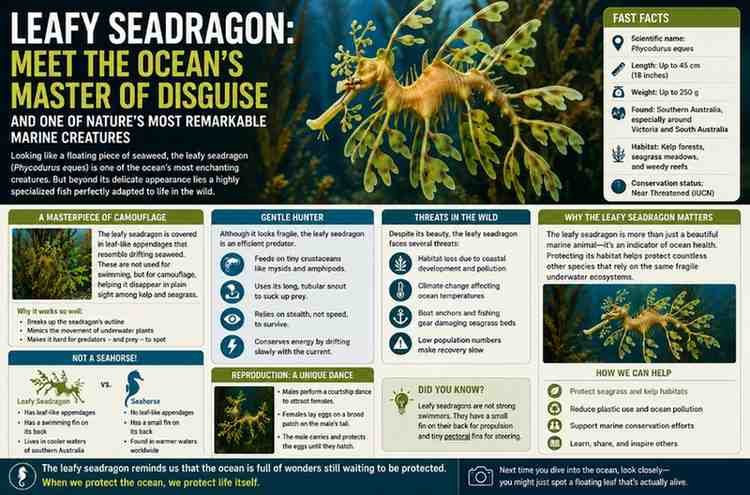
Few marine animals capture the imagination quite like the leafy seadragon. Floating gracefully through underwater kelp forests, it resembles a drifting piece of seaweed more than a living fish. Its intricate leaf-like extensions, slow movements, and remarkable camouflage have earned it recognition as one of the ocean’s greatest masters of disguise.
Yet beneath its ornamental appearance lies a surprisingly capable hunter. The leafy seadragon patiently stalks tiny crustaceans and plankton, using stealth and precision instead of brute strength. Every aspect of its body from its shape to its swimming style has evolved to help it blend seamlessly into its environment.
As climate change, habitat degradation, and human activity increasingly threaten coastal ecosystems, understanding species like the leafy seadragon has become more important than ever. Beyond its beauty, this extraordinary fish offers valuable insights into evolution, marine biodiversity, and the delicate balance of ocean life.
What Is a Leafy Seadragon?
The leafy seadragon (Phycodurus eques) is a marine fish belonging to the same family as seahorses and pipefish. Native to the temperate coastal waters of southern Australia, it is best known for the elaborate leaf-like appendages covering its body.
Contrary to appearances, these leaf-like structures are not used for swimming. Their primary function is camouflage, allowing the fish to resemble floating seaweed or kelp as ocean currents move around it.
This remarkable adaptation makes the leafy seadragon one of the most visually distinctive fish in the world.
Where Do Leafy Seadragons Live?
Leafy seadragons are found exclusively along Australia’s southern coastline, inhabiting:
- Kelp forests.
- Seagrass meadows.
- Rocky reefs.
- Coastal marine vegetation.
- Sheltered bays.
These habitats provide both food and protection, with dense underwater vegetation allowing the fish to disappear almost completely from predators.
Why Is the Leafy Seadragon Called a Master of Disguise?
Camouflage is the leafy seadragon’s greatest survival strategy. Its leaf-like appendages closely resemble the fronds of seaweed swaying in the current, making it extremely difficult for predators and even experienced divers—to spot.
Its disguise is enhanced by:
- Green, yellow, and brown coloration.
- Slow, drifting movements.
- Body shape that mimics marine plants.
- Minimal body motion while hunting.
Rather than hiding behind rocks, the fish becomes part of the underwater landscape itself.
Despite Looking Delicate, It Is a Skilled Hunter
The leafy seadragon may appear fragile, but it is a highly effective predator.
Instead of chasing prey, it relies on patience and stealth. When tiny crustaceans or zooplankton drift close enough, the seadragon rapidly sucks them into its long, tubular snout using powerful suction.
Its diet primarily includes:
- Mysid shrimp.
- Small crustaceans.
- Zooplankton.
- Tiny larval marine animals.
Because it lacks teeth and a true stomach, the leafy seadragon feeds frequently throughout the day.
| Feature | Purpose |
|---|---|
| Leaf-like appendages | Camouflage among seaweed |
| Long tubular snout | Suction feeding |
| Small transparent fins | Gentle, precise movement |
| Flexible body | Natural drifting motion |
| Excellent camouflage | Avoid predators and approach prey |
How Does It Swim?
Unlike most fish that propel themselves with strong tail movements, leafy seadragons swim using tiny, nearly transparent fins located on their neck and along their back.
These fins move so rapidly that they are difficult to see, allowing the fish to glide gracefully while maintaining the illusion of drifting seaweed.
Although not particularly fast swimmers, they are exceptionally maneuverable within dense marine vegetation.
A Unique Family Connection: Relatives of Seahorses
Leafy seadragons belong to the family Syngnathidae, which also includes seahorses and pipefish.
Like their relatives, they share several fascinating characteristics:
- Elongated snouts.
- Bony external body plates.
- Excellent camouflage.
- Specialized feeding mechanisms.
One of the most remarkable similarities is their unusual reproductive strategy.
The Male Carries the Eggs
Much like seahorses, male leafy seadragons play the primary role in caring for developing eggs.
After mating, the female deposits bright pink eggs onto a specialized brood patch located beneath the male’s tail. The male then carries and protects the eggs until they hatch several weeks later.
This unusual form of parental care is rare among fish and has fascinated marine biologists for decades.
Why Camouflage Is Critical for Survival
Unlike larger predatory fish, leafy seadragons possess few defensive abilities. They have no sharp teeth, venom, or powerful swimming speed.
Instead, survival depends almost entirely on remaining unnoticed.
Predators may include larger fish, rays, and marine birds, making camouflage an essential adaptation rather than merely an interesting appearance.
Threats Facing Leafy Seadragons
Although protected in Australia, leafy seadragons face several environmental challenges.
- Habitat loss.
- Climate change.
- Ocean warming.
- Storm damage to kelp forests.
- Marine pollution.
- Illegal collection.
Because they occupy relatively specific habitats, changes to coastal ecosystems can have significant impacts on local populations.
| Threat | Potential Impact |
|---|---|
| Habitat degradation | Loss of camouflage and feeding areas |
| Climate change | Alters marine ecosystems |
| Pollution | Reduces habitat quality |
| Extreme weather | Damages kelp forests |
| Illegal wildlife collection | Threatens wild populations |
Why Scientists Find Leafy Seadragons Fascinating
The leafy seadragon is more than just an attractive marine animal. Researchers study it to better understand camouflage, evolution, biomechanics, and reproductive behavior.
Its highly specialized adaptations demonstrate how species evolve over millions of years to occupy unique ecological niches.
The fish also serves as an important indicator of the health of temperate coastal ecosystems, making its conservation valuable for broader marine biodiversity.
What the Leafy Seadragon Teaches About Evolution
The leafy seadragon illustrates how evolution often favors specialization over strength. Rather than developing speed or powerful defenses, it evolved extraordinary camouflage that allows it to survive in environments where blending in offers the greatest advantage.
This strategy highlights nature’s incredible diversity of survival mechanisms and reminds us that successful adaptation can take many forms.
Conservation Efforts
Australia has introduced various conservation measures to protect leafy seadragons and their habitats. Marine protected areas, habitat restoration, scientific monitoring, and public awareness programs all contribute to safeguarding this iconic species.
Protecting coastal ecosystems such as kelp forests and seagrass beds benefits not only leafy seadragons but also countless other marine organisms that depend on these habitats.
Conclusion
The leafy seadragon is one of the ocean’s most extraordinary examples of natural adaptation. Its elaborate camouflage, gentle movements, and unique hunting strategy make it far more than a beautiful curiosity it is a masterfully evolved predator perfectly suited to life among underwater vegetation.
While its leaf-like appearance helps it evade predators and capture prey, the species also reminds us of the importance of protecting fragile marine ecosystems. As environmental pressures continue to reshape the world’s oceans, conserving remarkable species like the leafy seadragon becomes increasingly important for preserving marine biodiversity.
Nature’s greatest survival strategies are not always built on strength or speed. Sometimes, the most successful hunter is simply the one that no one notices.
For breaking news and live news updates, like us on Facebook or follow us on Twitter and Instagram. Read more on Latest Health on thefoxdaily.com.



COMMENTS 0