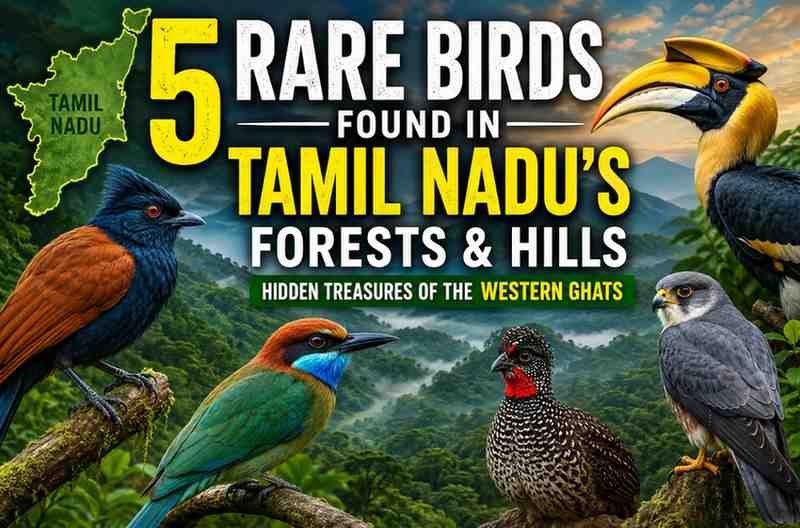
Tamil Nadu is often celebrated for its temples, beaches and rich cultural heritage, but its mountains and forests hold another treasure that remains largely unknown outside birdwatching circles. The state forms part of the biodiversity-rich Western Ghats, one of the world’s eight hottest hotspots of biological diversity.
High-altitude grasslands, evergreen shola forests and dense montane habitats create ideal conditions for rare and endemic bird species found nowhere else on Earth. Many of these birds are difficult to spot, making encounters with them especially memorable for bird enthusiasts and wildlife photographers.
Here are five of Tamil Nadu’s most remarkable avian residents and why their survival matters.
1. Nilgiri Blue Robin (Sholicola major)
The Secretive Singer of the Shola Forests
The Nilgiri Blue Robin is among the Western Ghats’ most elusive birds. Endemic to southern India, it inhabits dense undergrowth in the shola forests of the Nilgiris, Anamalai Hills and Palani Hills.
This small bird is better heard than seen. Its melodious song echoes through misty forests, while its shy nature keeps it hidden from most visitors.
Where to Spot It:
- Mukurthi National Park
- Upper Bhavani region
- Anamalai Tiger Reserve
- Kodaikanal forests
Because it depends on intact shola ecosystems, conservationists consider it an important indicator species for mountain forest health.
2. Nilgiri Flycatcher (Eumyias albicaudatus)
Tamil Nadu’s Elegant Endemic Jewel
The Nilgiri Flycatcher is instantly recognizable by its striking blue plumage and gentle behavior. Found only in the Western Ghats, it prefers evergreen forests at elevations above 1,200 meters.
Unlike many brightly colored birds, it displays remarkable calmness and often perches quietly while searching for insects.
Best Locations:
- Nilgiri Biosphere Reserve
- Ooty surroundings
- Avalanche forests
- Valparai region
Its restricted range makes habitat conservation critical for its survival.
3. White-bellied Shortwing (Sholicola albiventris)
A Rare Resident of High-Altitude Forests
Once grouped with the Nilgiri Blue Robin, the White-bellied Shortwing is now recognized as a separate species. It inhabits isolated patches of shola forests in the southern Western Ghats.
The bird’s blue upperparts and white underbelly make it particularly beautiful, though its secretive habits mean only dedicated birdwatchers are likely to encounter it.
Preferred Habitat:
- Grassland-shola mosaics
- Dense undergrowth
- Mountain valleys above 1,500 meters
Scientists regard this species as highly sensitive to climate change and habitat fragmentation.
4. Black-and-Orange Flycatcher (Ficedula nigrorufa)
One of India’s Most Distinctive Birds
The Black-and-Orange Flycatcher is perhaps one of the most visually striking birds in southern India. Its vibrant orange body contrasted with a dark head makes it unmistakable.
Endemic to the Western Ghats, this species prefers cool mountain forests and often stays close to the ground.
Where Birders Look for It:
- Eravikulam National Park
- Mukurthi National Park
- Grasslands around Ooty
- Upper Nilgiri forests
Its restricted distribution makes it especially vulnerable to environmental changes.
5. Nilgiri Pipit (Anthus nilghiriensis)
The Grassland Specialist Fighting for Survival
Unlike the forest-dwelling species on this list, the Nilgiri Pipit depends on high-altitude grasslands. This endemic bird is increasingly threatened by habitat loss and invasive plant species.
Its streaked plumage helps it blend into grassy landscapes, making sightings difficult despite its relatively open habitat.
Major Strongholds:
- Mukurthi National Park
- Grasslands around Kodaikanal
- Upper Palani Hills
- Anamalai ranges
Researchers consider the Nilgiri Pipit one of the most threatened birds of the Western Ghats.
Comparison: Tamil Nadu’s Rare Birds and Their Habitats
| Bird Species | Primary Habitat | Endemic to Western Ghats? |
|---|---|---|
| Nilgiri Blue Robin | Shola forests | Yes |
| Nilgiri Flycatcher | Evergreen forests | Yes |
| White-bellied Shortwing | Montane forests | Yes |
| Black-and-Orange Flycatcher | Cool highland forests | Yes |
| Nilgiri Pipit | High-altitude grasslands | Yes |
Why the Western Ghats Matter Globally
The Western Ghats are among the most biologically diverse regions on Earth. Stretching across six Indian states, they support thousands of plant and animal species, many of which are found nowhere else.
Tamil Nadu’s contribution to this biodiversity is particularly significant because its mountains contain unique shola-grassland ecosystems that evolved over millions of years.
These habitats act as natural water towers, feeding rivers and sustaining millions of people downstream.
An Insight Competitors Often Miss: Birds Are Climate Change Sentinels
Rare mountain birds do more than delight birdwatchers. They act as early warning systems for environmental changes.
As temperatures rise and rainfall patterns shift, high-altitude species have fewer places to retreat. Scientists are increasingly using bird populations to monitor ecosystem health and assess the impacts of climate change.
The decline of a bird species often signals broader ecological disruptions affecting forests, water resources and biodiversity.
Threats Facing Tamil Nadu’s Rare Birds
- Habitat fragmentation.
- Expansion of plantations.
- Invasive species such as wattle and eucalyptus.
- Climate change.
- Human disturbances.
- Loss of grassland ecosystems.
Conservation efforts involving forest departments, scientists and local communities are becoming increasingly important to safeguard these habitats.
Birdwatching Tourism: A Growing Opportunity
Tamil Nadu’s mountain landscapes are attracting bird enthusiasts from across India and abroad. Sustainable ecotourism can help generate awareness and economic benefits while encouraging conservation.
Regions such as Ooty, Valparai and Kodaikanal are gradually emerging as important destinations for bird photography and wildlife tourism.
Conclusion
The forests and hills of Tamil Nadu harbor some of India’s most extraordinary birds, many of which exist nowhere else on Earth. From the elusive Nilgiri Blue Robin to the endangered Nilgiri Pipit, these species represent millions of years of evolution and the incredible richness of the Western Ghats.
Protecting them means preserving not just rare birds, but entire ecosystems that sustain biodiversity, water security and ecological balance.
In the mist-covered forests of Tamil Nadu, some of nature’s greatest treasures are not tigers or elephants, but tiny feathered inhabitants whose songs continue to echo through ancient mountains.
For breaking news and live news updates, like us on Facebook or follow us on Twitter and Instagram. Read more on Latest Lifestyle on thefoxdaily.com.



COMMENTS 0