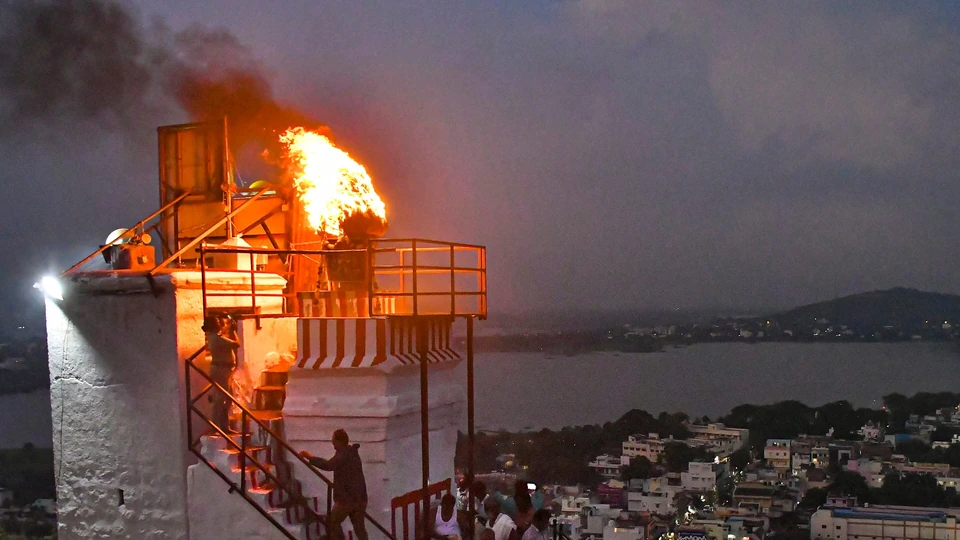
Security has been significantly tightened at Thiruparankundram hill in Tamil Nadu‘s Madurai district ahead of the ceremonial lamp-lighting ritual scheduled for Tuesday as part of the Karthigai Deepam festival. Police personnel have been deployed around the Arulmigu Subramaniya Swamy temple following heightened tensions over the proposed lighting of a traditional lamp on a stone pillar, known as the Deepathoon, atop the hill.
Madurai district collector Nishanth Krishna has also imposed prohibitory orders across the district under Section 163 of the Bharatiya Nagarik Suraksha Sanhita (BNSS), citing concerns about a possible disturbance to public tranquillity. Meanwhile, Madurai city police have designated Thiruparankundram hill a Red Zone, prohibiting the use of drones and other unmanned aerial vehicles in the area.
The security measures come amid a legal and political dispute over the location of the ceremonial lamp. The Supreme Court recently permitted the ritual for this year’s festival while making it clear that the decision would not automatically establish a customary right to conduct the ceremony at the same location in future years.
Police Deployment Increased at Thiruparankundram Temple
Police personnel were deployed in significant numbers around the Arulmigu Subramaniya Swamy temple and the surrounding hill area on Monday, a day before the scheduled Karthigai Deepam lamp-lighting ceremony.
The deployment follows concerns raised by the police about the possibility of a breach of public tranquillity during the festival. According to reports by ANI, the district administration issued prohibitory orders under Section 163 of the BNSS after receiving police inputs about potential disturbances.
The restrictions came into effect at 9 pm on Monday and are scheduled to remain in force until 10 am on November 25, unless withdrawn earlier by the authorities.
Section 163 of the BNSS empowers authorities to issue urgent orders when immediate measures are considered necessary to prevent potential danger, obstruction, injury or disturbances to public peace. Such restrictions can be used to regulate gatherings and activities in areas where officials anticipate a risk to law and order.
The district-wide order reflects the administration’s decision to take preventive steps before the festival rather than wait for tensions to escalate around the temple.
Thiruparankundram Hill Declared a Red Zone for Drones
Alongside the prohibitory orders, Madurai city police have designated the Thiruparankundram hill area a Red Zone, restricting drone operations and the use of other unmanned aerial vehicles.
The restriction is intended to prevent unauthorised aerial activity during the festival and maintain security around the temple and the proposed lamp-lighting location. Drones can be used to capture images and video of large public gatherings, but their operation near sensitive religious and security locations can create additional challenges for police personnel.
By restricting such flights, the authorities are seeking to maintain control over the area during a period of heightened public attention.
The measures also indicate the level of caution being exercised by the district administration as the legal dispute surrounding the Deepathoon ritual moves into a sensitive stage. Police deployment, restrictions on gatherings and the drone ban are part of the wider arrangements to prevent confrontations during the festival.
VCK Denied Permission to Hold Procession
The security arrangements have also affected political activity in the area. Viduthalai Chiruthaigal Katchi (VCK) chief Thol. Thirumavalavan confirmed that police had denied the party permission to organise a procession in the Thiruparankundram area on Tuesday.
The decision comes as political parties and religious groups continue to debate the implications of the Supreme Court’s ruling on the lamp-lighting ceremony.
Restrictions on processions and public gatherings are particularly significant in an area where the festival has become the centre of a wider dispute involving religious practices, court directions and competing political positions.
The authorities’ immediate priority is to prevent any incident that could disturb public order. The denial of permission to the VCK procession is part of the security context surrounding Tuesday’s events.
Supreme Court Allows Lamp Lighting for This Year’s Karthigai Deepam
The immediate background to the heightened security is a Supreme Court judgment delivered last Friday concerning the ceremonial lamp-lighting ritual at Thiruparankundram hill.
The court permitted the lighting of the lamp on the stone pillar, or Deepathoon, during this year’s Karthigai Deepam festival. At the same time, it stayed the operative portions of the Madras High Court’s January 6 judgment and clarified that its permission should not be interpreted as establishing a customary right to conduct the ritual at that location in subsequent years.
This distinction is central to understanding the legal position. The Supreme Court’s decision provides permission for the ceremony during the current festival, but it does not settle the question of whether the ritual must be permitted at the same site every year as an established customary practice.
By limiting the scope of its clarification, the court separated the immediate question of this year’s lamp lighting from the broader issue of a permanent or recurring religious right.
The ruling has nevertheless intensified political debate in Tamil Nadu, particularly over how the state government should respond to the court’s decision and manage the ceremony.
Tamil Nadu Government Seeks Review of Supreme Court Judgment
A day after the Supreme Court delivered its judgment, the Tamil Nadu government approached the court seeking a review of the decision.
The move has drawn criticism from opposition parties, which have questioned the government’s position on the dispute. The review petition has become another point of political disagreement, with parties interpreting the government’s legal response through the wider debate over religious practices and communal relations in the state.
BJP Tamil Nadu president Nainar Nagenthran criticised the state government’s decision and accused the ruling Tamilaga Vetri Kazhagam (TVK) of adopting what he described as an “anti-Hindu” position.
In a social media post on Monday, Nagenthran questioned Chief Minister C Joseph Vijay’s approach, asking: “Should (chief minister) Joseph Vijay stoop this low for the sake of vote bank politics?”
His remarks reflect the BJP’s criticism of the government’s decision to seek a review after the Supreme Court permitted the ritual for this year’s festival.
Udhayanidhi Stalin Questions Chief Minister Vijay’s Response
The dispute has also drawn criticism from the Dravida Munnetra Kazhagam (DMK), which has questioned the state government’s handling of the legal proceedings.
DMK leader and Leader of Opposition in the Tamil Nadu Assembly Udhayanidhi Stalin said on Monday that Chief Minister C Joseph Vijay should explain why the case had not been argued more effectively before the Supreme Court.
He also questioned the chief minister’s public response following the judgment.
“It has been two days since our leader (party chief MK Stalin) spoke about this, and the chief minister (C Joseph Vijay) has not opened his mouth,” Udhayanidhi said.
His remarks add another dimension to the controversy, with the DMK focusing on the government’s legal strategy and its response to the court’s decision.
The criticism also highlights the political sensitivity surrounding the issue. The dispute is no longer limited to the interpretation of a religious ritual or the location of the lamp. It has become part of a wider argument over the responsibilities of the state government, the role of the judiciary and the political implications of decisions involving religious traditions.
AIADMK and Congress Take Different Positions
The All India Anna Dravida Munnetra Kazhagam (AIADMK) has also criticised the TVK government’s approach. Party spokesperson Kovai Sathyan said there was no difference between the DMK and the TVK on the issue.
He condemned what he described as the TVK government’s “footsteps of appeasing one section”, adding to the opposition criticism directed at the administration.
Congress MP Manickam Tagore, however, offered a different interpretation of the government’s position. Speaking to ANI on Monday, Tagore said the government’s intention was to protect communal harmony and goodwill in Tamil Nadu.
The contrasting statements demonstrate how political parties are approaching the dispute from different perspectives. While the BJP, DMK and AIADMK have criticised the government, Tagore has defended its stated intention of maintaining harmony.
These competing positions have increased the political attention surrounding Tuesday’s ceremony, even as the administration focuses on implementing security arrangements and preventing disturbances.
Why Thiruparankundram Temple Is Religiously Significant
Thiruparankundram holds an important place in Tamil Hindu religious tradition. The Arulmigu Subramaniya Swamy temple is regarded as the first of the six sacred abodes of Lord Murugan, commonly known as Arupadai Veedu.
Lord Murugan is widely worshipped across Tamil Nadu, and the six sacred abodes associated with him attract devotees throughout the year. Thiruparankundram’s religious importance makes the Karthigai Deepam celebrations particularly significant for worshippers visiting the temple.
Karthigai Deepam is a traditional Tamil festival associated with the lighting of lamps. Devotees illuminate homes and temples, with the flame symbolising light and the removal of darkness. The festival is observed with particular devotion at important religious sites across Tamil Nadu.
The proposed lighting of the ceremonial lamp on the Deepathoon at Thiruparankundram hill has therefore attracted attention beyond the immediate temple premises. The dispute concerns not only the ritual itself but also the specific location where it is to be performed and the legal status of the practice.
What Happens Next at Thiruparankundram Hill?
Tuesday’s lamp-lighting ceremony will take place against the backdrop of heightened police deployment, prohibitory orders and restrictions on drone operations. The district administration has indicated through its preventive measures that maintaining public tranquillity is a priority during the festival.
The Supreme Court’s permission applies to this year’s ceremony, while the government’s review petition has opened another legal chapter in the dispute. The court’s clarification that the decision does not establish a customary right for future years also leaves the broader question of the ritual’s long-term status separate from the immediate festival arrangements.
Political criticism from the BJP, DMK and AIADMK, along with the Congress’s defence of the government’s stated position, has further intensified public debate. Meanwhile, the denial of permission for the VCK procession shows how the administration is managing planned activities around the hill.
The coming hours will test the ability of the police and district authorities to maintain order while allowing the festival-related arrangements to proceed. With religious sentiments, judicial directions and political disagreements converging at one location, the administration faces the task of ensuring that the ceremony does not become the trigger for a wider law-and-order confrontation.
For breaking news and live news updates, like us on Facebook or follow us on Twitter and Instagram. Read more on Latest India on thefoxdaily.com.






COMMENTS 0