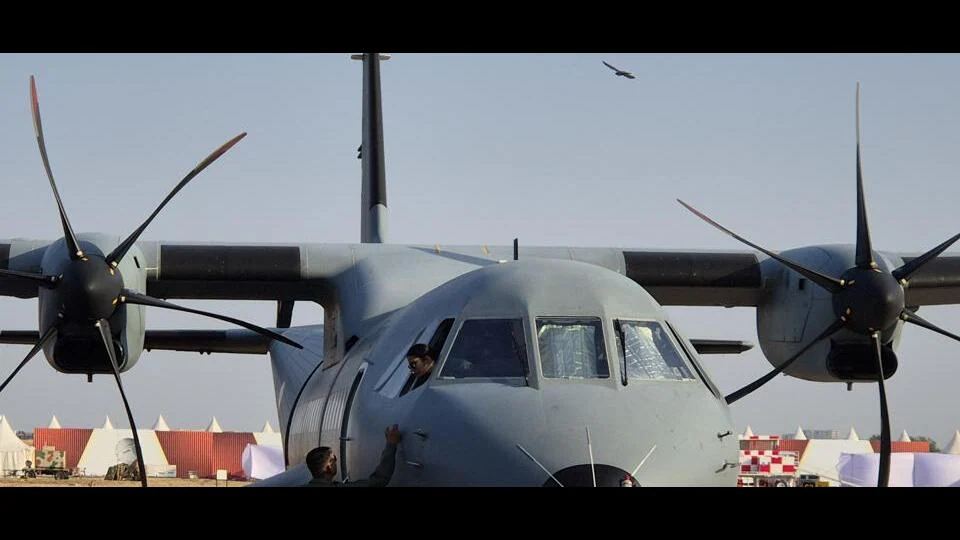
The Indian Air Force (IAF) is expected to receive its first India-made C295 military transport aircraft by December 31, marking a major milestone in India’s efforts to build advanced defence equipment through domestic private industry. The aircraft, manufactured under a partnership between Tata Advanced Systems Limited (TASL) and European aerospace company Airbus, is undergoing final flight trials and certification ahead of its planned year-end delivery.
Once handed over, the aircraft will join one of the IAF’s two existing C295 squadrons based in Agra and Vadodara. Its arrival will represent the first delivery of a military aircraft manufactured in India by the country’s private industrial sector, giving the C295 programme significance beyond the addition of another transport aircraft to the Air Force fleet.
The programme is central to India’s broader push for defence self-reliance, commonly described as Atmanirbharta. It is also expected to strengthen the domestic aerospace manufacturing ecosystem by bringing production, assembly and component manufacturing capabilities into the country.
First India-Made C295 Nears Delivery After Final Trials
The first C295 assembled in India is currently undergoing its final flight trials and certification process. TASL and Airbus are targeting delivery to the IAF by the end of December, with officials indicating that the aircraft could be handed over by December 31.
The delivery was originally expected by the end of September. However, the programme encountered minor technical issues that needed to be resolved before the aircraft could be accepted by the Air Force. In October, then Chief of the Air Staff Air Chief Marshal AP Singh had said that the issues were being addressed.
The ongoing trials and certification are important stages before the aircraft enters operational service. Military aircraft must meet the required technical and safety standards before formal acceptance, particularly when they are intended for demanding transport and logistics missions.
The first locally manufactured aircraft will be inducted into one of the IAF’s two existing C295 squadrons. These units are based at Agra and Vadodara, although the specific squadron that will receive the aircraft has not been identified.
₹21,935-Crore Contract Launched India’s C295 Manufacturing Programme
India’s C295 programme began with a major defence procurement agreement signed in September 2021. The Ministry of Defence awarded Airbus a contract worth approximately ₹21,935 crore for 56 C295 transport aircraft, with the objective of modernising the IAF’s transport fleet and expanding domestic Defence Manufacturing.
Under the agreement, Airbus is responsible for supplying the aircraft, while TASL and Airbus are jointly executing the manufacturing and assembly programme in India.
Of the 56 aircraft ordered, Airbus has already delivered 16 planes to the IAF in flyaway condition from Spain. The remaining 40 aircraft are being assembled in India, with the first of these locally manufactured aircraft now approaching delivery.
The distinction between the two groups is important. The first 16 aircraft were manufactured in Spain and delivered to India as completed aircraft. The remaining 40 are part of the domestic production programme, which involves manufacturing components, assembling major structures and integrating equipment in India.
The programme therefore goes beyond importing finished aircraft. It is designed to establish manufacturing expertise and develop a supply chain that can support future aerospace production in the country.
Domestic Manufacturing Covers Thousands of Aircraft Components
The C295 programme involves a substantial domestic manufacturing effort. India is producing more than 13,000 individual parts, 4,600 sub-assemblies and all major component assemblies for the aircraft.
These activities are expected to strengthen the capabilities of India’s private aerospace industry, including its ability to manufacture precision components and carry out complex aircraft assembly operations.
However, the aircraft is not being produced entirely from Indian-origin equipment. Critical systems, including engines, landing gear and avionics, are being supplied by Airbus and integrated into the aircraft as part of the programme.
The C295 is powered by two Pratt & Whitney PW127G turboprop engines. This arrangement reflects the current structure of the manufacturing partnership: a significant portion of component production and aircraft assembly takes place in India, while certain specialised systems continue to come from established international suppliers.
The development of domestic manufacturing capabilities is nevertheless strategically important. Aerospace production requires precision engineering, quality control, specialised materials and reliable supply chains. Building these capabilities through a major aircraft programme can help Indian companies gain experience that may be useful for future defence and commercial aviation projects.
Why the C295 Is Important for the Indian Air Force
The C295 is a tactical transport aircraft designed to move personnel, equipment and supplies. For the IAF, its importance lies in the ability to support logistics operations across different types of terrain, including remote and forward areas where conventional transport infrastructure may be limited.
The aircraft can carry a payload of up to nine tonnes, accommodate as many as 71 personnel or transport 45 paratroopers. It has a maximum speed of approximately 480 kilometres per hour and is equipped with a rear loading ramp that allows troops and cargo to be loaded and dropped during airborne operations.
One of its important operational features is its ability to use short and unprepared airstrips. This gives the Air Force greater flexibility when transporting personnel and supplies to locations where longer or fully developed runways may not be available.
Such capabilities are particularly relevant to military logistics in forward areas, including regions near India’s contested border with China. Transport aircraft play a crucial role in moving supplies, personnel and essential equipment to remote military locations, especially when road connectivity is difficult or operational conditions change.
The C295 will also help replace the IAF’s ageing Avro transport aircraft, which entered service in the early 1960s. Replacing an aircraft type that has served for several decades is an important part of modernising the Air Force’s transport fleet and improving its ability to meet present-day operational requirements.
IAF Plans to Raise Its Third C295 Squadron
The IAF is expected to begin raising its third C295 squadron next year. The expansion will allow the Air Force to gradually increase its operational use of the aircraft as more units are delivered under the India programme.
The first 16 aircraft supplied from Spain have already begun establishing the C295’s presence within the IAF. The arrival of locally manufactured aircraft will add to this fleet and support the programme’s transition towards domestic production.
Squadron expansion is important because the operational value of a transport aircraft depends not only on the number of planes available but also on trained personnel, maintenance infrastructure, logistics support and the ability to deploy aircraft where they are required.
As the fleet grows, the IAF will be able to build experience in operating the aircraft across a wider range of transport missions. The C295’s capacity to carry troops, paratroopers and cargo makes it relevant for routine logistics as well as specialised military requirements.
Remaining 39 Aircraft Scheduled for Delivery by August 2031
Despite the delay in the first India-made aircraft’s expected handover, officials have indicated that the overall C295 production and delivery programme remains on schedule.
After the first locally manufactured aircraft is delivered, the remaining 39 aircraft are scheduled to be handed over by August 2031. This timeline will allow the IAF to receive the full set of 40 aircraft being assembled in India under the agreement.
The delivery schedule is significant because the programme involves more than the completion of individual aircraft. It requires a coordinated manufacturing process involving domestic suppliers, component production, assembly operations, equipment integration, testing and certification.
Maintaining the broader schedule will be important for both the IAF’s fleet modernisation plans and the development of India’s aerospace manufacturing capabilities. Any sustained expansion of domestic production will depend on the ability of the industrial partners and their suppliers to maintain consistent quality and production standards.
Atmanirbharta Remains a Key Priority for the Indian Air Force
Defence self-reliance remains a central priority for the IAF under its current leadership. Air Chief Marshal Ashutosh Dixit, who took over as Chief of the Air Staff on October 31, has outlined his vision for the force through the acronym VAYU.
The four elements of the vision are vigilance and readiness, Atmanirbharta or self-reliance, yukti or ingenuity, and unity of effort. The framework highlights the importance of operational preparedness alongside domestic technological development and coordinated institutional effort.
The C295 programme fits into this broader direction because it brings a major military aircraft manufacturing project into India’s private industrial sector. Rather than relying exclusively on imported finished aircraft, the programme creates opportunities for Indian companies to participate in production and develop specialised aerospace capabilities.
Atmanirbharta in defence manufacturing does not necessarily mean that every component must immediately be produced domestically. The C295 programme demonstrates a phased approach in which domestic production and assembly are expanded while certain critical systems continue to be sourced from international partners.
Over time, the experience gained through manufacturing thousands of components and assembling complete aircraft could help strengthen India’s ability to undertake more complex aerospace projects. The long-term value of the programme will therefore depend not only on aircraft deliveries but also on how much technical and industrial capability remains within the country.
A Milestone for India’s Private Aerospace Industry
The expected December 31 delivery is significant because it marks a new stage in India’s military aviation manufacturing journey. The C295 programme is the country’s first effort to manufacture a military transport aircraft through a private-sector industrial partnership at this scale.
For the IAF, the aircraft will contribute to transport fleet modernisation, improve logistics flexibility and support operations in difficult-to-access areas. For the defence industry, it represents an opportunity to develop domestic manufacturing capacity, supplier networks and experience in aircraft production.
The programme’s success will ultimately be measured through reliable aircraft deliveries, operational performance and the depth of manufacturing capabilities developed in India. If the remaining production milestones are achieved as planned, the C295 project could become an important foundation for the country’s future ambitions in aerospace and defence manufacturing.
For breaking news and live news updates, like us on Facebook or follow us on Twitter and Instagram. Read more on Latest India on thefoxdaily.com.






COMMENTS 0