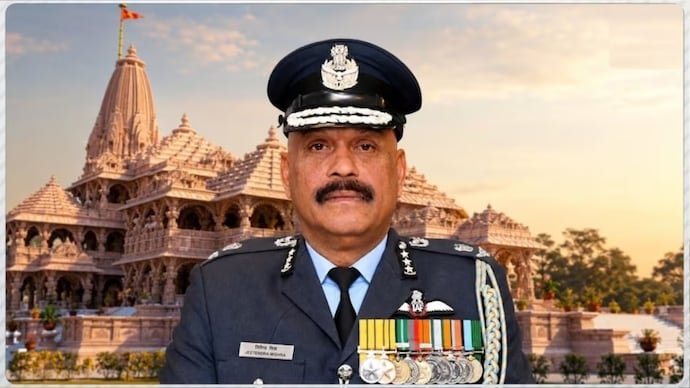
Air Marshal Jeetendra Mishra (Retd) has formally taken charge as the first Chief Executive Officer of the Shri Ram Janmabhoomi Teerth Kshetra Trust, saying the responsibility of managing the Ram temple in Ayodhya is now on his shoulders.
Mishra assumed the newly created position two days after the temple trust appointed him to oversee its administrative and operational functions. The retired Indian Air Force officer spent two days in Ayodhya during his first visit as CEO, meeting trust members and studying the systems that govern the temple’s day-to-day functioning.
His appointment comes during a major organisational reshuffle at the trust following a controversy over the alleged misappropriation of temple donations. Eight people have been arrested in connection with the case, while several leadership changes have followed.
The appointment of a former senior military commander to the newly established CEO position is being viewed as an effort to bring greater structure, accountability and professional management to an institution whose operations have expanded substantially since the opening of the Ram temple.
Mishra, who commanded the Indian Air Force’s Western Air Command and retired in April 2026, has said he intends to first understand the temple’s existing systems before proposing changes.
Jeetendra Mishra formally takes charge
Speaking to PTI Videos before leaving Ayodhya for Delhi, Mishra said he had officially taken charge of his new role.
“I have now taken charge as the CEO. The responsibility of the Ram temple has now come onto my shoulders,” he said.
The statement reflects the scale of the responsibilities attached to the newly established position. The Shri Ram Janmabhoomi Teerth Kshetra Trust oversees the management of one of India‘s most prominent religious sites, which receives large numbers of devotees and involves substantial administrative, financial and logistical operations.
Unlike the trust’s existing religious and organisational leadership, the CEO position is intended to provide a dedicated executive structure for managing those operations.
Mishra’s first visit was therefore less about announcing immediate reforms and more about understanding how the organisation currently works.
Why the trust created its first CEO post
The creation of the CEO position comes at a time when the administration of the Ram temple has become increasingly complex.
The trust is responsible not only for the temple itself but also for a growing ecosystem involving devotees, facilities, finances, Security, infrastructure, employees, vendors and future development.
As visitor numbers have grown, so too have the demands on the organisation running the temple.
The new CEO role is expected to establish a more structured administrative chain, with clearly defined responsibilities and standard operating procedures.
Sources familiar with the trust’s plans said the position is intended to strengthen administrative and financial systems as the temple’s operations expand.
The move also comes after scrutiny over the management of donations, making financial oversight one of the most important areas likely to receive attention under the new structure.
Mishra starts with a study of temple operations
Mishra has made clear that he does not intend to impose immediate changes without first understanding the existing system.
During his first visit to Ayodhya, trust members briefed him on the organisation’s administrative and financial operations. He also met trustees and office-bearers to understand their respective responsibilities and the way the temple operates on a daily basis.
He described the visit as preliminary and introductory, saying he would return to Ayodhya after a few days for a deeper assessment.
“I have only been here for one day, so this was a preliminary introductory visit. I will come here again after two or three days,” Mishra said.
His approach suggests that the initial priority will be to map the existing responsibilities and systems before introducing reforms.
That could include examining accounting practices, financial controls, administrative reporting, procurement systems and the way different teams coordinate their work.
Financial management is likely to be a major priority
The trust’s financial systems are receiving particular attention because of the recent controversy involving alleged embezzlement of temple donations.
An FIR was registered after a preliminary Investigation by a Special Investigation Team constituted by the Uttar Pradesh government. Eight people named in the case were arrested, prompting increased scrutiny of how donations were collected, handled and monitored.
Trust general secretary Champat Rai and trustee Anil Mishra subsequently resigned, taking moral responsibility amid the controversy.
The episode has increased pressure on the trust to strengthen financial controls and improve oversight.
Mishra’s appointment does not determine the outcome of the criminal investigation, and allegations against individuals must still be established through due legal process. But the controversy has clearly become part of the broader context in which the new CEO is beginning his tenure.
His first briefing reportedly included details of accounting procedures, indicating that financial management will form a significant part of his early assessment.
Who else was appointed in the trust reshuffle?
Mishra’s appointment was part of a wider restructuring of the Shri Ram Janmabhoomi Teerth Kshetra Trust.
Swami Govind Dev Giri was appointed general secretary, while businessman Mahesh Bhagchandka became treasurer.
The trust also inducted three new trustees: Madan Mohan Pandey, Mahesh Bhagchandka and Dr Nirmala Yadav.
Yadav’s appointment is notable because she became the first woman to join the trust as a trustee.
Madan Mohan Pandey is a senior lawyer associated with the legal battle over the Ram Janmabhoomi site, while Bhagchandka brings a business and philanthropic background to the organisation.
The changes collectively indicate an effort to strengthen different aspects of the trust’s functioning, from executive administration and finance to legal and institutional oversight.
From Operation Sindoor to Ayodhya
Mishra arrives at the temple trust after a long career in India’s military establishment.
He retired as the head of the Indian Air Force’s Western Air Command on April 30, 2026. The Western Air Command is one of the IAF’s principal operational commands and has responsibility for India’s western airspace and associated military operations.
Mishra also played a leadership role during Operation Sindoor, the Indian military operation launched in May 2025 following the Pahalgam terror attack.
His appointment therefore represents a striking transition from military command to civilian institutional management.
The trust’s decision appears to reflect confidence in his experience managing large organisations, coordinating multiple teams and operating within systems where discipline, accountability and risk management are essential.
Those skills can be relevant to the management of a major religious institution, although the operating Environment is obviously very different from military command.
Mishra says he feels fortunate to serve twice
Before taking charge, Mishra described himself as “the most fortunate person” for being entrusted with important responsibilities at two different stages of his life.
He said the first was serving the country through the Indian Air Force and the second was the opportunity to serve Lord Ram and the devotees visiting the temple.
The comment reflects the personal significance he attaches to his new role.
But the position also comes with a demanding practical mandate. The CEO will have to coordinate an institution that combines religious activities with complex modern operations, including administration, finances, facilities management, crowd management and future development.
That combination makes the role considerably broader than the symbolic title might suggest.
How the CEO role could change temple management
The creation of a full-time CEO could bring a more conventional executive-management structure to the trust.
Religious organisations often depend on multiple committees, office-bearers and trustees, each with different areas of responsibility. A CEO can provide a single executive point responsible for coordinating those functions and ensuring that decisions are implemented.
The trust is expected to frame standard operating procedures defining Mishra’s powers, responsibilities and reporting structure.
Those procedures could become particularly important because the CEO will have to work alongside the trust’s general secretary, treasurer, trustees and religious leadership.
Clear division of authority can help prevent duplication and ambiguity while also creating stronger accountability for financial and operational decisions.
The challenge of managing a rapidly expanding temple complex
The Ayodhya Ram Temple has evolved from a construction project into a major public-facing institution.
Large numbers of devotees visit the temple, requiring continuous management of entry systems, facilities, sanitation, security, accommodation, medical support and crowd movement.
The wider Ayodhya area has also undergone extensive infrastructure development aimed at supporting pilgrimage and tourism.
For the trust, that means the temple’s management increasingly resembles the operation of a large destination rather than a conventional place of worship.
The volume of visitors and the scale of donations create corresponding responsibilities around financial reporting, procurement, staffing and service quality.
Mishra’s role will be to ensure that these functions operate together rather than independently.
Transparency will be closely watched
The recent donation controversy has made transparency an especially important issue for the trust.
Devotees contribute funds with the expectation that they will be handled responsibly and used for the purposes authorised by the trust.
Strong internal controls can help reduce the risk of misuse by establishing clear procedures for collecting, recording, transferring and auditing funds.
The CEO may therefore have to examine not just accounting procedures but the wider system of financial Governance.
That could include segregation of duties, approval mechanisms, reconciliation of collections, digital record-keeping and regular audits.
None of these measures alone can guarantee that wrongdoing will never occur, but stronger systems can make irregularities easier to identify and harder to conceal.
Mishra was selected from thousands of applicants
The selection process for the first CEO was extensive.
The trust received 5,585 applications for the newly created position. After the initial screening, candidates were shortlisted and the final selection was made from three finalists.
Mishra, 62, emerged as the successful candidate after the selection committee’s assessment.
The large number of applications highlights the significance of the position and the interest it generated among senior professionals.
The trust ultimately selected a candidate with decades of experience in one of India’s most structured institutions.
His appointment also indicates that the organisation was looking beyond conventional religious or administrative profiles for the new executive position.
What could Mishra focus on first?
Mishra has not announced a detailed reform programme yet. His comments suggest that the immediate focus will be assessment rather than rapid change.
The first stage is likely to involve understanding the trust’s organisational structure, reviewing administrative responsibilities and examining financial and accounting systems.
After that, the CEO could identify areas where processes can be standardised or made more efficient.
Another potential priority will be coordination between the trust’s various departments and office-bearers.
Given the scale of temple operations, even relatively small improvements in scheduling, procurement, visitor management or financial reporting could have a substantial cumulative impact.
The CEO may also need to establish mechanisms through which problems are reported quickly and decisions can be tracked from approval to implementation.
Why military experience could matter
Mishra’s military background may bring a management style centred on planning, accountability and defined chains of responsibility.
Military organisations are accustomed to coordinating large numbers of personnel under strict procedures, managing risks and responding to unexpected situations.
A major temple complex faces a different set of challenges, but some organisational principles can carry over: clear responsibilities, preparedness, communication and disciplined execution.
At the same time, Mishra will have to adapt to an institution where religious traditions, public expectations and community sensitivities are central to decision-making.
His success will therefore depend not simply on bringing military discipline but on combining that experience with an understanding of the trust’s religious and social responsibilities.
Ayodhya’s growing importance adds to the challenge
The Ram temple has become one of the most prominent religious destinations in India, increasing the administrative demands placed on the trust.
The temple’s significance extends beyond the physical shrine. Ayodhya has emerged as a major pilgrimage and tourism destination, with surrounding infrastructure developing rapidly.
That growth creates opportunities but also requires planning.
Large crowds can put pressure on roads, accommodation, sanitation, emergency services and security. The temple trust must coordinate with government agencies and local authorities even when many of those services fall outside its direct control.
The CEO’s role can therefore involve substantial coordination with external institutions as well as internal management.
The donation case has changed the governance environment
The recent donation controversy has added another layer of responsibility to the trust’s new leadership team.
The arrests and resignations intensified questions about how donations were monitored and whether existing controls were sufficient.
The appointment of a dedicated CEO, a new treasurer and additional trustees can be seen as part of the institutional response to that scrutiny.
The objective is not simply to manage a crisis but to create systems that remain effective as the temple grows.
That makes governance reform potentially more important than any single administrative decision.
What happens next for the Ram Temple Trust?
The next phase is expected to involve defining the CEO’s exact powers and responsibilities through standard operating procedures.
Once that framework is established, Mishra can begin translating his initial assessment into a longer-term management plan.
His first few visits to Ayodhya will likely focus on understanding the organisation’s existing strengths and identifying gaps in administration and financial control.
The trust will also need to determine how the CEO’s office interacts with its religious leadership and trustees.
The success of the new structure will ultimately depend on whether it produces measurable improvements in efficiency, transparency and accountability without disrupting the temple’s religious functioning.
A new administrative chapter for Ayodhya
Jeetendra Mishra’s arrival marks a significant change in the way the Ram Temple Trust is organised.
For the first time, the institution has created a dedicated CEO position responsible for overseeing its administration and operations. The choice of a retired Air Marshal with experience commanding a major IAF formation signals the trust’s desire for a more structured executive approach.
His appointment comes after a turbulent period involving allegations of donation embezzlement, arrests and leadership changes. That background makes financial oversight and institutional credibility especially important as he begins the job.
Yet Mishra has not presented himself as someone arriving with an immediate list of sweeping reforms. His first message has been that he needs to understand the organisation before deciding what should change.
That process has already begun.
After reviewing administrative and accounting procedures, meeting trustees and learning about the temple’s daily operations, Mishra is expected to return to Ayodhya and develop a more detailed plan.
The challenge ahead is substantial. The Ram temple is both a sacred institution and a large modern organisation serving millions of devotees. Managing that combination requires efficient administration, careful financial controls and the ability to coordinate people and resources at an enormous scale.
For Mishra, the transition from leading India’s Western Air Command to leading the administrative machinery of the Ram temple represents an extraordinary second career chapter. His comment that the responsibility is now on his shoulders captures the central reality of the new position: the trust is entering a new phase, and his performance will be closely watched as Ayodhya’s most prominent religious institution continues to expand.
For breaking news and live news updates, like us on Facebook or follow us on Twitter and Instagram. Read more on Latest India on thefoxdaily.com.






COMMENTS 0