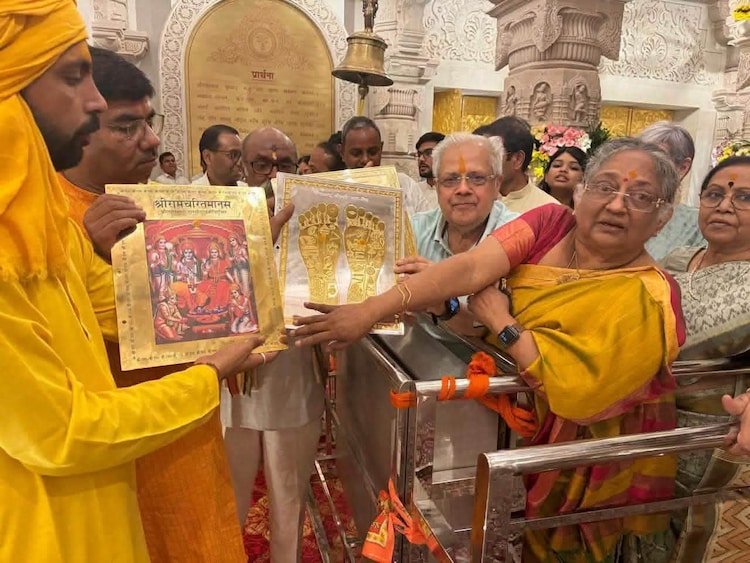
The Ayodhya Ram Temple donation Controversy has taken another turn after former IAS officer S. Lakshminarayanan alleged that a gold-plated copy of the Ramcharitmanas, valued by his family at around ₹5 crore, was removed from public display at the Ram Temple after being donated in 2024. According to the former bureaucrat, the family offered the religious manuscript to the Shri Ram Janmabhoomi Teerth Kshetra Trust as a devotional contribution. He later claimed that the sacred text had been shifted from the temple premises.
The Trust has responded by explaining that every offering received by the temple cannot be displayed permanently because of practical limitations related to space, security, preservation and the sheer volume of donations received from devotees across India and abroad. The issue has attracted attention because it coincides with an ongoing police Investigation into alleged irregularities in the management of Temple Donations, making transparency in the handling of valuable offerings a subject of intense public interest.
WHO raised the allegation? Former IAS officer S. Lakshminarayanan. What is the allegation? That a gold-plated Ramcharitmanas donated by his family was moved from the Ram Temple. When was it donated? April 2024. Where did the controversy arise? At the Shri Ram Janmabhoomi Teerth Kshetra in Ayodhya. Why has it gained significance? Because it comes during an ongoing investigation into alleged embezzlement of temple donations. How has the Trust responded? By stating that every donated item cannot be permanently displayed inside the temple.
What Is the Ramcharitmanas?
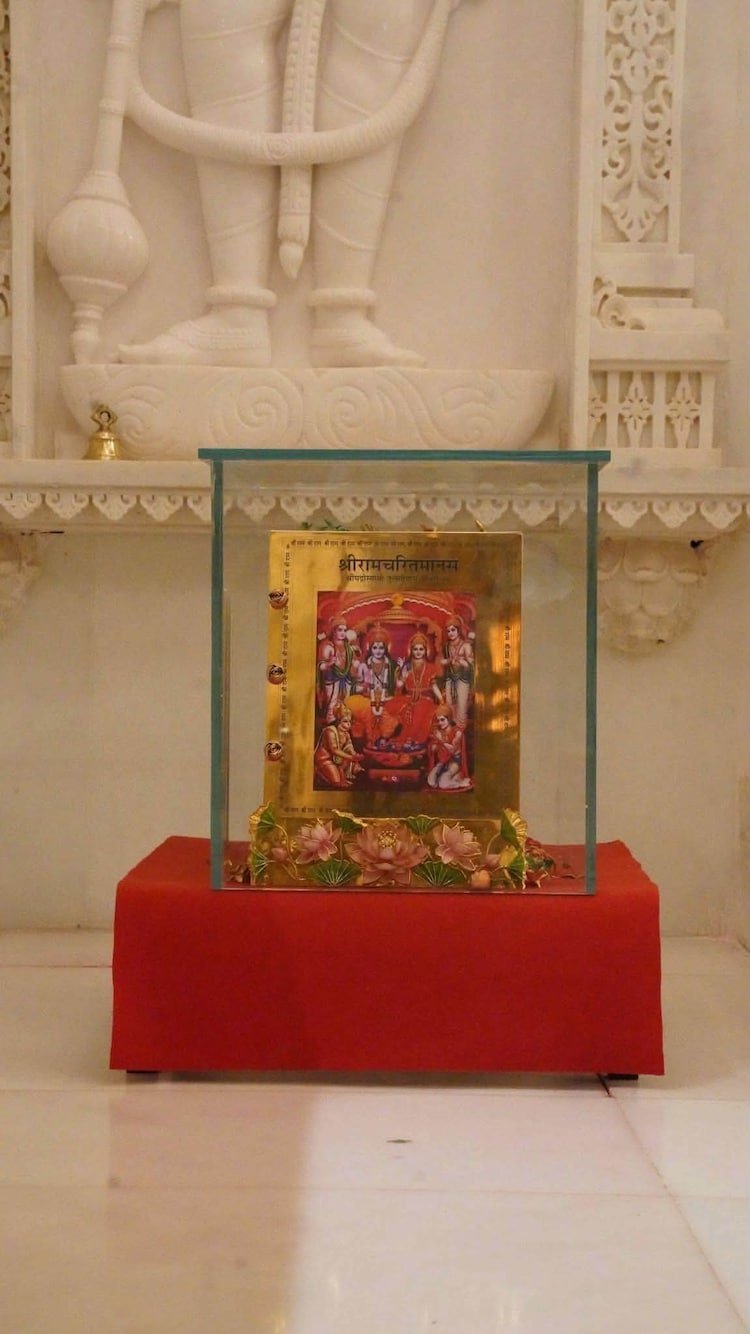
The Ramcharitmanas, composed in the 16th century by Goswami Tulsidas, is among the most revered devotional texts in Hinduism. Written in Awadhi, it narrates the life, ideals and teachings of Lord Ram and has played a profound role in shaping devotional traditions across northern India.
Unlike the Sanskrit Valmiki Ramayana, the Ramcharitmanas was composed in a language accessible to ordinary people, making it one of the most widely read and recited religious works in India.
For millions of devotees, gifting a beautifully crafted copy of the Ramcharitmanas to a temple represents both religious devotion and cultural heritage.
The Allegation Made by the Former IAS Officer
According to Lakshminarayanan, his family donated the gold-plated manuscript to the Shri Ram Janmabhoomi Teerth Kshetra Trust in April 2024.
He has publicly claimed that:
- The manuscript was valued at approximately ₹5 crore.
- It was donated as a religious offering.
- The manuscript was later shifted from the temple.
- He was informed that not all offerings can remain on display.
The allegation concerns the placement of the donated manuscript rather than any confirmed finding that it has been lost or stolen.
Trust’s Explanation: Why Every Donation Cannot Be Displayed
According to Lakshminarayanan, Trust General Secretary Champat Rai explained that the temple receives numerous valuable offerings and that it is not feasible to permanently display every donated item.
Large temples across India commonly receive:
- Gold ornaments.
- Silver articles.
- Precious stones.
- Religious manuscripts.
- Decorative artefacts.
- Cash donations.
Because of space constraints, conservation requirements and security considerations, many such offerings are catalogued and stored rather than publicly exhibited.
How Major Temples Manage Valuable Donations
India’s leading temples generally follow structured systems for handling donated valuables.
| Process | Purpose |
|---|---|
| Documentation | Maintain records of donations. |
| Inventory Management | Track valuable assets. |
| Secure Storage | Protect precious articles. |
| Periodic Audits | Ensure accountability. |
| Selective Display | Manage space and security. |
Many religious institutions rotate exhibits or preserve valuable offerings under controlled conditions to prevent deterioration or theft.
Background: Ongoing Investigation Into Temple Donations
The present controversy has attracted wider attention because it follows an ongoing investigation into alleged irregularities involving donations made at the Ram Temple.
Authorities have initiated investigations into allegations concerning:
- Misappropriation of donations.
- Missing jewellery.
- Gold and silver ornaments.
- Donation counting procedures.
- Security protocols.
The investigation remains ongoing, and legal proceedings are continuing.
The Silver Donation Controversy
Earlier, questions were also raised regarding donated silver bars and bricks reportedly linked to the temple.
Among the donations that drew public attention was a silver brick reportedly donated during the temple construction period.
Subsequently, investigators stated that speculation regarding theft of large quantities of silver had not been substantiated during the investigation.
SIT Investigating Alleged Jewellery Conversion
Investigators are examining whether certain missing gold ornaments may have been melted into Gold Bars or biscuits, potentially making identification more difficult.
This remains part of an active investigation.
Authorities have not announced final conclusions regarding these allegations.
Changes Introduced in Donation Management
Following the emergence of the donation controversy, the Shri Ram Janmabhoomi Teerth Kshetra Trust reportedly strengthened several operational procedures.
These include:
- Enhanced security screening.
- Revised access control.
- Pocketless uniforms for counting staff.
- Improved monitoring procedures.
- Stricter supervision during donation counting.
Such measures are intended to improve transparency and reduce opportunities for misconduct.
Why Transparency Matters for Religious Institutions
Large religious institutions manage donations contributed voluntarily by millions of devotees.
Good governance generally involves:
- Financial accountability.
- Independent audits.
- Clear inventory systems.
- Transparent reporting.
- Robust security.
Maintaining public confidence is especially important when donations include high-value jewellery, precious metals and historically significant religious objects.
Balancing Devotional Sentiment and Practical Administration
For many devotees, donated items carry deep emotional and spiritual significance beyond their monetary value.
Temple administrators, however, must also address practical considerations including:
- Available exhibition space.
- Visitor safety.
- Insurance and security.
- Preservation of delicate artefacts.
- Protection against theft.
These competing priorities sometimes create misunderstandings regarding how donated items are handled after they are received.
Comparison: Donation Management in Major Religious Institutions
| Challenge | Administrative Response |
|---|---|
| High-value donations | Secure vault storage. |
| Large donation volumes | Inventory and cataloguing. |
| Public expectations | Selective display of artefacts. |
| Security risks | Restricted access and surveillance. |
| Preservation needs | Controlled storage conditions. |
A Unique Insight: Public Trust Is Now as Valuable as Precious Donations
The current debate demonstrates that modern religious institutions are expected to uphold governance standards comparable to those of large public organizations. Devotees increasingly seek transparency not because they question their faith, but because they want assurance that sacred offerings are protected responsibly.
In today’s digital age, even isolated allegations can quickly attract national attention. Consequently, maintaining comprehensive documentation, clear communication and regular audits has become essential not only for legal compliance but also for preserving public confidence.
Legal Process and Presumption of Innocence
It is important to distinguish between allegations, investigations and judicial findings.
While multiple arrests have reportedly been made in connection with the alleged donation embezzlement case, investigations are still underway. The legal process will determine individual responsibility based on evidence presented before the courts.
Similarly, the allegation regarding the gold-plated Ramcharitmanas concerns its relocation rather than any confirmed finding of theft or disappearance.
Future Outlook
As investigations continue, the Shri Ram Janmabhoomi Teerth Kshetra Trust is likely to face continued public attention regarding its donation management systems. Greater digitization of inventories, periodic public disclosures and strengthened audit mechanisms could further enhance transparency.
The episode may also encourage major religious institutions across India to review how valuable offerings are documented, preserved and communicated to devotees, especially when donations carry significant religious and financial value.
Conclusion
The Ayodhya Ram Temple donation controversy has expanded beyond questions about a single gold-plated Ramcharitmanas to broader discussions about transparency, governance and the management of religious donations. Former IAS officer S. Lakshminarayanan has alleged that his family’s donated manuscript was moved from the temple, while the Trust maintains that not every offering can remain on public display because of practical constraints.
At the same time, the ongoing investigation into alleged irregularities involving temple donations has heightened public scrutiny of administrative procedures. Regardless of the outcome of individual allegations, the episode underscores the importance of robust inventory management, transparent communication and strong institutional safeguards to preserve both valuable offerings and the confidence of millions of devotees who contribute to one of India’s most significant religious institutions.
For breaking news and live news updates, like us on Facebook or follow us on Twitter and Instagram. Read more on Latest India on thefoxdaily.com.




COMMENTS 0