US President Donald Trump’s decision to waive key provisions of a new law targeting major buyers of Russian energy has provided temporary relief for India, one of the largest importers of Russian crude oil. The move suspends the immediate threat of additional tariffs on countries purchasing Russian energy, giving New Delhi and Indian refiners more room to manage oil supplies amid continuing geopolitical uncertainty.
However, the waiver does not represent a permanent change in Washington’s approach to India’s Russian oil purchases. The Trump administration has retained the authority to reconsider its position, while existing sanctions imposed under separate executive orders remain unaffected. India must therefore balance the short-term benefits of continued Russian crude imports with the longer-term risks of relying heavily on a supplier whose energy trade is closely tied to the Russia-Ukraine war.
The decision also highlights a broader challenge for India’s energy security: maintaining affordable and reliable oil supplies while navigating pressure from major international partners. Although the waiver eases an immediate concern for Indian exporters and refiners, it leaves the underlying uncertainty over US policy unresolved.
Why Trump’s Russia Sanctions Waiver Matters to India
The waiver concerns the Lindsey O. Graham Sanctioning Russia and Iran Act of 2026, which was signed into law by Trump the previous month. The legislation was designed to increase pressure on Russia over its war in Ukraine by authorising tariffs of up to 100% on major purchasers of Russian energy.
For India, the potential consequences were significant. Russian crude has become a major component of the country’s oil import basket, and punitive trade measures could have affected Indian exports to the United States at a sensitive stage in bilateral economic relations.
India had communicated its concerns about the legislation to Washington on several occasions. Analysts had also expected the waiver provisions to become relevant because of the prevailing global energy supply situation and the risk that restrictions on Russian oil could push prices higher.
Trump has now signed an executive order waiving key Russia-related provisions of the law, citing US national interests. The suspension came shortly before the relevant provisions were due to take effect and will remain in place until the administration determines that further action is appropriate.
For New Delhi, the immediate advantage is straightforward: the threat of additional tariffs under the legislation has been suspended. Indian refiners can continue evaluating Russian crude purchases without facing that particular additional penalty, although other sanctions and policy risks remain.
Why the US May Still Pressure India Over Russian Oil
The waiver should not be interpreted as a permanent exemption for India or an unconditional endorsement of its Russian oil purchases. Washington has retained the ability to change its position, and the executive order requires US officials to monitor Russian energy purchases and report circumstances that could justify further action.
Existing sanctions imposed through separate executive orders are also unaffected. Consequently, the suspension of key provisions under the new law does not remove every restriction or compliance risk associated with Russian energy transactions.
The decision also comes against the backdrop of sustained US pressure on India to reduce its purchases of Russian crude. The Trump administration has argued that revenue from Russian energy exports helps Moscow finance its war in Ukraine. New Delhi, meanwhile, has emphasised the importance of protecting its trade and economic interests while securing the energy supplies needed by its economy.
This leaves India in a difficult position. Reducing Russian oil purchases too quickly could increase procurement costs or make it harder to replace supplies in a tight global market. Continuing to buy Russian crude, however, leaves India exposed to the possibility of renewed US pressure if the administration changes its policy.
The temporary nature of the waiver is therefore central to understanding its significance. It reduces immediate uncertainty but does not eliminate the risk that Russian oil could again become a source of friction between New Delhi and Washington.
Why Russian Crude Has Become So Important to India
India is the world’s third-largest consumer of crude oil and depends on imports to meet more than 88% of its crude requirements. Because domestic production cannot satisfy the country’s needs, access to competitively priced international supplies is essential to its energy security.
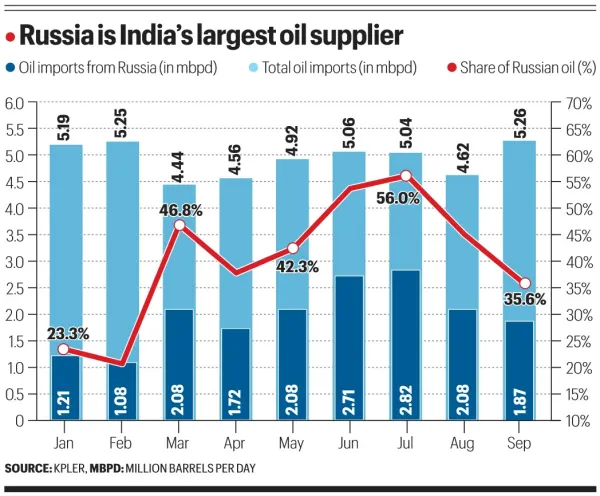
Russia has emerged as India’s largest crude oil supplier since the start of the Russia-Ukraine war in February 2022. After many Western countries reduced their purchases of Russian energy, Moscow offered discounts to attract buyers. Indian refiners took advantage of the opportunity, turning Russia from a relatively peripheral supplier into a major source of crude.
According to tanker data from commodity market analytics firm Kpler cited in the supplied report, India imported approximately 1.9 million barrels per day of Russian crude in September. That represented more than 35% of the country’s total oil imports for the month. Imports had reached an all-time high of 2.8 million barrels per day in July, according to the same data.
The shift benefited both countries. Russia gained access to a major market for crude that had become more difficult to sell in parts of the world, while India gained an additional source of supply at potentially competitive prices.
For Indian refiners, the economics of crude procurement matter considerably. Even a relatively small difference in the price paid for each barrel can influence the overall oil import bill when purchases run into millions of barrels per day. Lower-cost supplies can therefore help refiners manage expenses and give India greater flexibility in meeting its energy requirements.
Russian crude has also proved compatible with the operations of many Indian refineries, which are equipped to process the medium-sour grades that India primarily imports from Russia. Replacing those barrels is not simply a matter of finding another seller; alternative crude must also be commercially competitive, available in sufficient quantities and suitable for refinery requirements.
West Asia Crisis Makes Russian Oil More Valuable
The disruption to energy flows from West Asia has strengthened the importance of alternative suppliers. Before the crisis described in the supplied report, around 40% of India’s crude imports typically passed through the Strait of Hormuz, a critical shipping route for oil exports from the Gulf.
Severely constrained traffic through the waterway has complicated the movement of energy supplies and increased concerns about availability, freight costs and delivery schedules. When a major shipping route becomes difficult to use, buyers may have to seek alternative suppliers or pay more to secure replacement cargoes.
Russian crude has consequently served as an important hedge against disruptions in Gulf supplies. Analysts cited in the report consider it one of the most practical and competitive sources available to Indian refiners under the prevailing market conditions.
That does not mean Russian oil can replace every disrupted shipment or that it is free from logistical and geopolitical risks. Instead, its importance lies in providing another significant source of supply when traditional routes or suppliers face difficulties.
India’s dependence on imported oil makes this flexibility particularly important. A sudden loss of a major supplier can force refiners to compete for replacement cargoes, potentially increasing costs across the supply chain. Higher crude prices can also put pressure on the country’s import bill and complicate domestic fuel-price management.
Against this background, the prospect of US tariffs on countries buying Russian energy created an additional complication. India faced the possibility that efforts to secure affordable oil could expose its wider trade relationship with the United States to punitive measures.
What the Waiver Changes for Indian Oil Imports
The immediate benefit of Trump’s decision is the suspension of the additional tariff threat arising from the relevant provisions of the 2026 legislation. Without the waiver, India could have faced a difficult choice between maintaining Russian crude purchases and limiting the risk of penalties affecting its exports to the US.
Reducing Russian imports could have forced Indian refiners to source more crude from other regions, potentially at higher prices or with less favourable shipping arrangements. Continuing to purchase Russian oil, on the other hand, could have increased the risk of US trade action.
The waiver temporarily removes that specific dilemma. Indian refiners have more room to assess available cargoes according to price, quality, delivery schedules and logistics rather than having to factor in the additional tariff threat under the suspended provisions.
It also gives refiners greater flexibility when planning future purchases. Oil procurement decisions often require coordination between cargo availability, shipping arrangements, refinery requirements and expected market conditions. Uncertainty over possible penalties can complicate those decisions, particularly when the market is already experiencing supply disruptions.
For India, the larger benefit is the ability to preserve options. New Delhi can continue assessing the commercial advantages of Russian crude while expanding its access to supplies from other producers. The waiver creates breathing space, but it does not remove the need to prepare for a possible change in US policy.
Nor does the decision guarantee that India can purchase unlimited quantities of Russian oil without consequences. The monitoring requirements in the executive order and the continuation of other sanctions mean that individual transactions may still need to be assessed against applicable restrictions and compliance requirements.
US Domestic Politics Could Influence Future Sanctions Decisions
The timing of the waiver has also drawn attention to the role of domestic economic considerations in US energy policy. The decision comes ahead of the US midterm elections, when fuel prices and the cost of living can become politically sensitive issues.
A sharp reduction in Russian crude supplies could have tightened the global oil market further, particularly while energy flows through important West Asian routes were already disrupted. If that had pushed crude and fuel prices higher, the effects could have been felt by consumers and businesses in the United States as well as in other importing countries.
The supplied report also points to recent US moves involving Russian diesel exports as evidence that Washington has been willing to adjust restrictions amid energy-market pressures. Such decisions suggest that the administration must weigh its geopolitical objectives against the potential economic consequences of restricting energy supplies.
However, domestic political considerations do not establish what the administration will do after the elections. The waiver’s continuation depends on the administration’s future assessment, and the direction of US policy towards Russia and Ukraine remains uncertain.
India should therefore avoid treating the decision as proof that Washington will permanently prioritise energy-market stability over sanctions enforcement. The current relief may last, but it does not eliminate the possibility of renewed restrictions or additional pressure.
India Should Use the Waiver to Diversify Its Oil Supplies
The waiver gives India an opportunity to strengthen its energy security, but it should not become a reason to deepen dependence on a single supplier. A procurement strategy built around one major source can leave an importing country vulnerable when geopolitical tensions, sanctions or transport disruptions affect that supplier.
India has already been expanding its search for alternative crude supplies as disruptions in West Asia have affected traditional flows. According to the supplied report, refiners have increased diversification towards African, North American and South American barrels to offset reduced supplies from the Gulf.
Continuing that approach would help India preserve flexibility if Russian oil becomes more expensive, less accessible or subject to renewed restrictions. A broader supplier base can also give refiners more options when negotiating prices and arranging cargoes.
Diversification, however, does not mean replacing Russian oil regardless of cost. Alternative grades may carry different prices, freight charges, delivery times and refinery-processing requirements. A sudden shift away from a major supplier could therefore create new costs or logistical difficulties, particularly when global supplies are already constrained.
A more resilient approach would allow refiners to compare Russian crude with available alternatives on commercial and operational grounds while accounting for sanctions exposure and geopolitical risk. The objective should be to maintain reliable supplies at sustainable costs, rather than depending too heavily on any one country or route.
India should also maintain contingency plans for a sudden change in US policy. That includes assessing how quickly alternative cargoes could be secured, identifying potential transport bottlenecks and evaluating the financial implications of replacing Russian barrels under different market conditions.
New Delhi Needs Greater Clarity From Washington
Alongside diversification, India has an interest in obtaining greater predictability from the United States over how its energy purchases will be treated. Sudden changes in sanctions or tariff policy can affect procurement decisions, trade negotiations and the wider economic relationship between the two countries.
Following the enactment of the Lindsey O. Graham Sanctioning Russia and Iran Act of 2026, India’s Ministry of External Affairs said that the issue had been discussed at high levels with US interlocutors in recent months.
“This issue has been discussed at high levels in recent months with various US interlocutors. Its potential implications for not just the bilateral relationship but also the international energy market have been very clearly articulated by the Indian side.”
The ministry also said India was determined to take necessary measures to protect its trade and economic interests and would work with Indian trade and industry bodies to address the implications of developments in Washington.
Engagement continued in subsequent weeks, with External Affairs Minister S. Jaishankar and Foreign Secretary Vikram Misri speaking with senior US officials and lawmakers to convey India’s concerns about the legislation, according to the supplied report.
Such engagement remains important even after the waiver. India needs to understand which restrictions could apply to its energy purchases, what circumstances might trigger further action and how policy changes could affect Indian exporters.
Greater clarity would also help reduce uncertainty in India-US trade negotiations. The suspension of the additional tariff threat removes one immediate source of friction, but it does not settle the broader questions surrounding energy trade and the two countries’ economic relationship.
What the Waiver Means for India-US Trade Relations
Energy policy and trade relations are closely connected in this dispute. The potential use of tariffs against major buyers of Russian energy raised the prospect that India’s crude procurement decisions could affect a much wider range of exports to the United States.
For Indian businesses, the uncertainty was not limited to oil refiners. The possibility of additional penalties could have complicated trade planning and added another point of tension to negotiations over a bilateral trade agreement.
By suspending the relevant provisions, Washington has reduced that immediate risk. The decision gives both sides more room to continue discussions without the threatened tariffs becoming an additional pressure point in the near term.
Still, the underlying disagreement has not disappeared. The United States has continued to frame Russian energy purchases in the context of the Ukraine war, while India has focused on its need to secure affordable and dependable energy supplies. Those priorities may not always align.
The future of the relationship will depend partly on whether both governments can manage that difference without allowing it to disrupt broader economic cooperation. Continued dialogue could help clarify expectations, but India will also need to prepare for the possibility that Washington may again use trade measures to influence its energy decisions.
Conclusion: Temporary Relief, Not a Permanent Guarantee
Trump’s Russia sanctions waiver provides India with immediate breathing space by suspending key provisions that could have exposed major buyers of Russian energy to additional tariffs. For a country heavily dependent on imported crude and facing disruption to traditional supply routes, that relief is significant.
Russian oil remains valuable because of its scale, commercial competitiveness and role in diversifying India’s sources of supply. The waiver allows refiners to continue assessing those benefits without the immediate threat of penalties under the suspended provisions.
But the decision does not remove existing sanctions, guarantee unrestricted purchases or establish a permanent shift in US policy. Washington has retained the option of taking further action, leaving India exposed to renewed uncertainty if geopolitical or domestic political priorities change.
India’s best response is to use the current window to strengthen its negotiating position, maintain engagement with Washington and expand its range of oil suppliers. A diversified procurement strategy would reduce the consequences of any future disruption, whether caused by sanctions, conflict or transport constraints.
The central lesson is that temporary relief from US pressure cannot substitute for long-term energy security. India can continue to benefit from Russian crude, but it must preserve the flexibility to adapt if the political and economic conditions surrounding those imports change again.
For breaking news and live news updates, like us on Facebook or follow us on Twitter and Instagram. Read more on Latest India on thefoxdaily.com.





COMMENTS 0