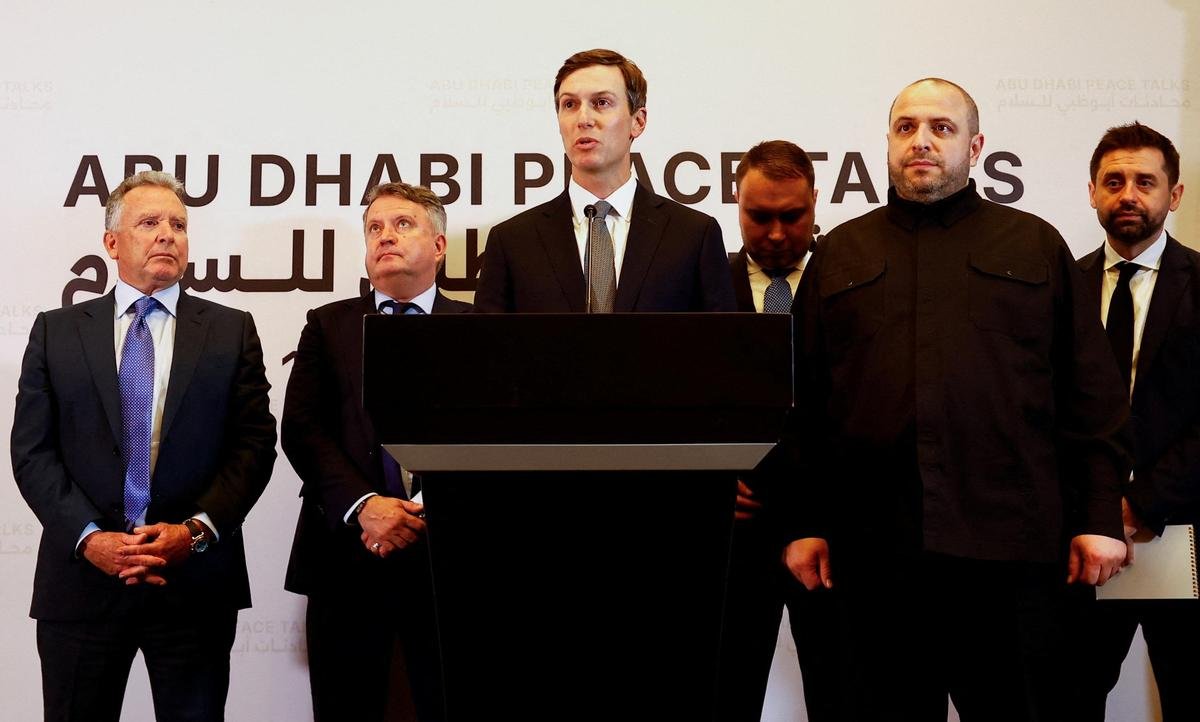
Russia and Ukraine have agreed to a large prisoner-of-war exchange following two days of US-mediated negotiations in Abu Dhabi, offering a humanitarian development in a conflict that has continued for years. However, the agreement has not translated into a breakthrough on ending the war, as both sides remain divided over the conditions for a lasting peace settlement.
The discussions marked the first direct three-way meeting between Russian, Ukrainian and US representatives in nine months. The talks were part of Washington’s renewed effort to bring the two countries closer to an agreement, but the central disagreements over occupied Ukrainian territory, postwar security arrangements and the involvement of European countries remain unresolved.
US envoy Jared Kushner confirmed the prisoner-exchange understanding after the talks concluded on Wednesday. He said the parties had agreed to pursue what could become the largest humanitarian release of prisoners, although the final numbers were still to be confirmed.
Russian delegation head Vladimir Medinsky and Ukraine’s chief negotiator Rustem Umerov also confirmed the planned exchange. Medinsky described the understanding as an agreement “in principle”, indicating that the arrangement still required finalisation.
What Was Agreed During the Abu Dhabi Peace Talks?
The prisoner exchange emerged as the clearest outcome of the negotiations. Both delegations confirmed that they had reached an understanding, but the final number of prisoners and the implementation arrangements had not yet been announced when the talks concluded.
Kushner said the numbers would be finalised on Thursday. The proposed release was described as potentially the largest humanitarian prisoner exchange during the conflict, although its eventual scale will depend on the final agreement between Moscow and Kyiv.
The discussions also covered wider humanitarian issues and the possibility of reducing tensions. However, the negotiators did not announce an agreement on a ceasefire or a framework for ending the war.
The distinction is significant. Prisoner exchanges have taken place during the conflict even when diplomatic negotiations have failed to resolve the larger political and territorial disputes. A successful exchange could provide relief to families and prisoners on both sides, but it would not by itself settle the conditions required for peace.
Kushner and Witkoff to Meet Putin in Moscow Before Travelling to Dublin
Following the Abu Dhabi negotiations, Kushner announced plans to travel to Moscow on Thursday with US envoy Steve Witkoff. The two are expected to meet Russian President Vladimir Putin to discuss the issues raised during the talks and explore possible areas of progress.
They are then scheduled to travel to Dublin, Ireland, for a meeting with Ukrainian President Volodymyr Zelenskyy. The purpose of that meeting is to brief the Ukrainian leader on discussions with Moscow and examine proposals that emerged during the negotiations.
The planned visits indicate that Washington intends to continue discussions directly with both leaders after the latest round of negotiations. However, the meetings are not themselves a confirmed step towards a final peace agreement.
Kushner said the US delegation had identified possible openings on some issues but acknowledged that substantial differences remained. He also indicated that a direct meeting between Putin and Zelenskyy would require further progress in the negotiations.
For now, the immediate diplomatic focus is on maintaining communication, advancing the prisoner exchange and finding areas where the two sides might be able to reach agreement.
Why Is Europe’s Role a Major Disagreement?
One of the most difficult questions in the negotiations is whether European governments should participate directly in discussions about ending the war and shaping the security arrangements that would follow.
European representatives were present in Abu Dhabi during the talks, including officials connected with European governments, the European Union and NATO. However, they did not participate in the main three-way negotiations between Russia, Ukraine and the United States.
Ukraine wanted European partners to be involved in discussions that could affect the continent’s future security. Rustem Umerov said Kyiv’s delegation was expected to meet European representatives separately after the trilateral session.
Moscow has resisted European participation in the direct negotiations. Russian officials have questioned what European representatives could contribute, arguing that their support for Ukraine through financial assistance and military supplies does not indicate a willingness to help advance a settlement on Russia’s terms.
Kremlin spokesperson Dmitry Peskov said European representatives could potentially join the peace process at a later stage. However, he questioned whether their current positions demonstrated an intention to contribute to progress towards peace.
This disagreement creates a diplomatic challenge for Washington. Any settlement involving Ukraine’s long-term security and Europe’s wider defence arrangements would affect countries beyond Russia and Ukraine. Yet Moscow has shown reluctance to include European governments in the central negotiating format.
Security Guarantees Remain a Central Obstacle
Postwar security guarantees are another major issue separating the negotiating positions. Ukraine wants assurances that Russia will not launch another invasion after any future settlement. Kyiv’s concern is that an agreement ending the current fighting would not be sufficient if it failed to prevent another conflict.
European governments have also emphasised the importance of security arrangements. EU officials have indicated that discussions about Europe’s future security structure should begin after a ceasefire, reflecting the view that an end to active fighting would be an important starting point for wider negotiations.
Russia, meanwhile, has its own security demands. President Vladimir Putin has repeatedly described NATO’s eastward expansion as a threat to Russian security, and Moscow has demanded that the alliance withdraw troops from areas near its borders.
These competing positions make it difficult to design an arrangement acceptable to all parties. Ukraine is seeking guarantees against renewed Russian military action, while Moscow wants its concerns about NATO and the European security structure addressed.
Kushner said both Russia and Ukraine needed clarity about postwar security arrangements. He also argued that European governments, the EU and NATO would need to participate in discussions to build agreement on the next steps.
He acknowledged the lack of trust between the countries, describing it as an expected consequence of a prolonged conflict. That lack of confidence makes it harder for negotiators to accept assurances from the opposing side without clear mechanisms to support them.
Russia’s security concerns were also discussed during the Abu Dhabi meetings. Kushner said Moscow had been told that it would need to present different de-escalation measures and proposals if it wanted those concerns to be considered acceptable to European countries.
Territorial Disputes Continue to Block a Peace Settlement
The future of Ukrainian territory occupied by Russia remains one of the most difficult questions in the negotiations. Moscow and Kyiv have maintained sharply different positions on the territories under Russian control, and the latest discussions did not produce a public agreement on the issue.
Territorial questions are particularly difficult because they involve Ukraine’s sovereignty, Russia’s demands and the terms of any eventual political settlement. The negotiators have discussed the issue, but a major decision is likely to require engagement at the highest political level.
Kushner acknowledged that territorial matters would be among the hardest issues to resolve. The lack of progress on this question helps explain why the Abu Dhabi meetings did not produce a broader breakthrough despite the prisoner-exchange understanding.
For Ukraine, accepting a settlement that leaves occupied territory under Russian control would raise serious questions about sovereignty and the country’s future security. For Moscow, territorial demands remain part of its position in negotiations.
Until the two sides find a way to address these competing demands, a comprehensive peace agreement is likely to remain difficult to achieve.
US Peace Efforts Face a Changing Political and Military Situation
The latest negotiations are taking place in a changing political environment. The Trump administration is attempting to revive diplomatic efforts that have so far failed to produce a lasting agreement. At the same time, the political situation in Washington is expected to change following the US midterm elections, with Democrats set to take control of Congress in January.
That change could influence the debate over American support for Ukraine. Democratic lawmakers could push for continued or increased assistance, adding another consideration to the administration’s approach to negotiations.
The military and economic circumstances of the two countries also remain relevant. Russia’s wartime economy is facing considerable pressure, while Ukraine is dealing with the consequences of repeated attacks on its electricity infrastructure.
These pressures form part of the wider background to the negotiations, but neither side has publicly indicated that they are ready to abandon their central demands in order to secure a settlement.
The Abu Dhabi discussions therefore represent another attempt to create diplomatic momentum without resolving the fundamental disagreements that have prolonged the war.
Fighting Continues as Diplomats Negotiate
The negotiations took place while fighting continued across Ukraine. Both countries have continued using long-range missiles and drones, and attacks were reported in several regions during the period of diplomatic discussions.
Russian Attack on a Market in Odesa Region Kills Three
Local authorities said a Russian daytime attack on a market in the southern Odesa region killed three people and injured 11 others. Residential buildings were also damaged, and emergency crews responded to the scene.
Oleh Kiper, head of the regional military administration, reported the casualties and damage. The attack highlighted the continuing risks faced by civilians even as officials were discussing humanitarian measures and possible steps towards de-escalation.
Attacks Reported in Zaporizhzhia and Kharkiv
Overnight Russian strikes also targeted the southern Zaporizhzhia region and the eastern city of Kharkiv, according to Ukrainian officials. The attacks wounded seven civilians and damaged property.
The incidents added to the pressure on Ukrainian communities as negotiations continued. They also illustrated the gap between diplomatic discussions and conditions on the ground, where attacks have not stopped during efforts to revive Peace Talks.
Russia Reports Downing Hundreds of Ukrainian Drones
Russia’s Defence Ministry said its air defences had intercepted 627 Ukrainian drones overnight. According to regional Governor Alexander Drozdenko, 150 of the drones were reported over the region around St Petersburg.
Drozdenko also said drones started a fire at the port of Ust-Luga, a major facility for Russian oil exports. Three workers were injured in the incident, according to the regional governor.
The reported drone activity demonstrates how attacks on infrastructure far from the front line remain part of the conflict. However, the figures and details cited by Russian authorities represent their official account of the incident.
Indonesia Seeks Consular Access to Citizen Arrested in Ukraine
Separately, the Indonesian Embassy in Kyiv was seeking consular access to an Indonesian national who had reportedly been arrested in Ukraine.
Yvonne Mewengkang, a spokesperson for Indonesia’s Ministry of Foreign Affairs, said the government was treating the case seriously and working to ensure the protection of its citizen.
Ukrainian officials had not immediately commented on the matter. Further details about the individual’s identity, the circumstances of the arrest and the reason for the detention were not provided in the available information.
What Happens Next After the Abu Dhabi Talks?
The next stage of the diplomatic effort will depend on whether the prisoner-exchange understanding can be converted into a final arrangement and whether the planned meetings in Moscow and Dublin produce further progress.
The immediate task for negotiators is to confirm the number of prisoners involved and agree on the practical arrangements for their release. The exchange could become an important humanitarian development if both sides complete the process.
Beyond that, the US delegation faces the more complicated task of addressing territorial disputes, security guarantees and the question of European participation. These issues involve different political and military interests, and the latest negotiations showed that the gap between the two sides remains substantial.
Ukraine wants European governments included in discussions about its security and the future of the continent. Russia has questioned their role in direct negotiations, while Washington is seeking a format that could eventually bring them into the process.
The planned meeting between Kushner, Witkoff and Putin in Moscow, followed by discussions with Zelenskyy in Dublin, could provide an opportunity to test whether any of the proposals discussed in Abu Dhabi can move forward. However, no agreement on a ceasefire or comprehensive peace settlement has been announced.
Russia-Ukraine Talks: Key Developments
- Prisoner exchange: Russia and Ukraine agreed in principle to a large humanitarian release, with final numbers expected to be confirmed after the talks.
- No peace breakthrough: The two-day US-mediated negotiations in Abu Dhabi ended without an agreement on ending the war.
- US diplomatic visits: Jared Kushner and Steve Witkoff are scheduled to meet Vladimir Putin in Moscow before travelling to Dublin to meet Volodymyr Zelenskyy.
- European involvement: Ukraine wants European governments, the EU and NATO involved in future discussions, while Moscow has resisted their participation in direct negotiations.
- Unresolved issues: Postwar security guarantees, occupied Ukrainian territory and Russia’s concerns about NATO remain major obstacles.
- Continued attacks: Civilian casualties and infrastructure damage were reported in Ukraine, while Russia also reported a large overnight Ukrainian drone attack.
The Abu Dhabi talks have produced a potentially significant humanitarian agreement but no decisive progress towards ending the war. The planned prisoner exchange offers a concrete area of cooperation, while the disagreements over territory, security and Europe’s role continue to complicate negotiations. The upcoming meetings with Putin and Zelenskyy will be an important next stage in Washington’s effort to keep the diplomatic process moving, but a lasting settlement remains uncertain.
For breaking news and live news updates, like us on Facebook or follow us on Twitter and Instagram. Read more on Latest World on thefoxdaily.com.






COMMENTS 0