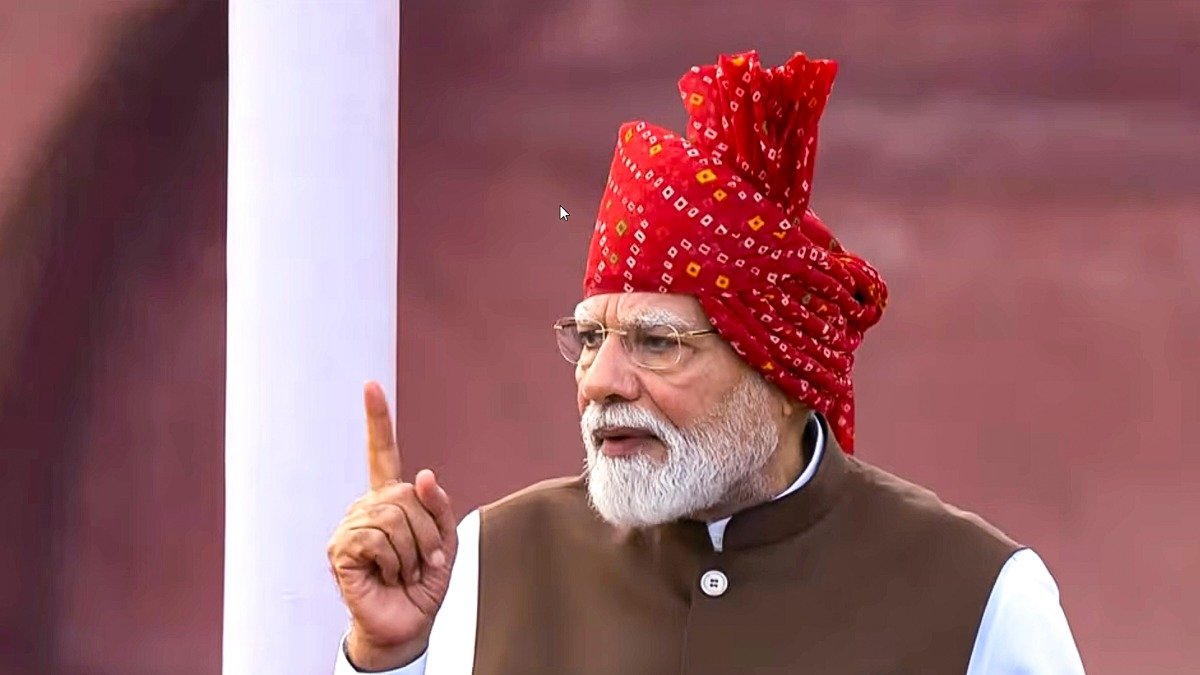
Prime Minister Narendra Modi addressed the nation from the ramparts of Delhi’s Red Fort on Saturday as India celebrated its 80th Independence Day, using his 13th consecutive Independence Day speech to outline a broad vision centred on self-reliance, economic growth, Manufacturing and emerging Technology.
In a speech lasting around one hour and 16 minutes, Modi touched on India’s progress over the past 12 years while emphasising the need to prepare for new economic, technological and security challenges.
The Prime Minister’s address covered several major themes, including Energy Security, Make in India, semiconductor manufacturing, Artificial Intelligence, defence production, digital transactions and Atmanirbhar Bharat.
The ceremony also featured what Modi described as a historic first, with ‘Vande Mataram’ being rendered at the Red Fort complex on Independence Day, followed by the national anthem.
1. Self-reliance and Make in India
A central theme of Modi’s speech was India’s push towards greater self-reliance and reduced dependence on other countries.
He said India’s approach in recent years has been based on strengthening domestic capabilities and protecting the country’s interests through an ‘Atmanirbhar Bharat’ vision.
“India should no longer live in dependence on other nations; we must become self-reliant,” Modi said, stressing the importance of building India’s own capabilities.
He linked the idea directly with initiatives such as Make in India, Swadeshi and Local for Local, presenting domestic manufacturing and consumption as important components of India’s long-term economic strategy.
The message also connected self-reliance with National Security. Modi argued that India’s ability to produce critical goods and technologies domestically would become increasingly important in a world where economic and strategic competition are closely connected.
2. Energy security becomes a national priority
Energy security was another important part of the Prime Minister’s broader warning about emerging threats.
Modi said modern conflicts are no longer restricted to traditional battlefields or national borders. Instead, vulnerabilities can emerge across critical economic Infrastructure and strategic sectors.
“War is no longer just fought along borders; it is now also taking place in sectors like Banking, infrastructure, refineries,” he said.
The remarks placed energy and critical infrastructure within a wider national-security framework. Refineries and other energy facilities can be strategically important because disruption to them can affect transportation, industry and the wider economy.
His comments also reinforced the broader argument that India needs to strengthen domestic capacity in areas that are essential to the functioning of the economy.
3. Semiconductor push and India’s chip ambitions
Semiconductors featured prominently in Modi’s technology and self-reliance message.
The Prime Minister said chips have become indispensable across modern industries, including electronics, medical equipment and transportation systems.
He said India had moved towards greater self-reliance in semiconductor manufacturing and claimed that three major semiconductor plants had already been established, with production beginning for export.
Modi also said that additional semiconductor facilities were expected to begin operations in the coming years.
“In the coming 7–8 years, five to eight additional semiconductor plants are set to commence operations very soon,” he said.
The emphasis reflects the strategic importance of semiconductor manufacturing to India’s broader technology ambitions. Chips sit at the heart of smartphones, computers, automobiles, industrial equipment and many advanced technologies.
Building domestic semiconductor capacity is therefore being positioned not only as an industrial policy but also as part of India’s effort to reduce vulnerabilities in critical technology supply chains.
4. AI and the wider technology landscape
Artificial intelligence and the changing technological environment were also part of the Prime Minister’s message about India’s future.
While discussing chips and digital technology, Modi highlighted the importance of building domestic capabilities in areas that will shape the global economy.
His broader technology message was that India cannot remain dependent on external sources for critical technologies while seeking a larger role in the global digital economy.
The AI push therefore fits into the wider framework of technological self-reliance: developing infrastructure, manufacturing capabilities and domestic expertise while ensuring that India remains competitive in emerging technologies.
5. Defence production has grown fourfold, PM says
Modi also highlighted growth in India’s domestic defence manufacturing as evidence of the country’s progress towards self-reliance.
According to figures cited in his speech, defence production has increased four times over the past 12 years.
He also pointed to growth in other sectors, including Khadi and Gramodyog, electronics manufacturing, mobile-phone production and digital transactions.
“In the last 12 years, defence production has increased by four times; production by Khadi and Gramudyog has increased five times; electronics manufacturing has grown by seven times,” Modi said.
He also cited a 33% increase in mobile phone production and said digital transactions had grown by 100%.
The figures were presented as examples of how India has expanded domestic production and embraced digital infrastructure during the past 12 years.
6. India’s economic transformation since 2014
Modi used his Independence Day address to contrast India’s current trajectory with the economic challenges the country faced in the period before 2014.
He recalled the criticism that India had been placed among the world’s “Fragile Five” economies in 2014.
The Prime Minister argued that India subsequently gained momentum and began moving more rapidly, attributing the change to the determination and efforts of the country’s 1.4 billion citizens.
“We are surging ahead rapidly,” he said, adding that the country’s collective resolve and capabilities could no longer be stopped.
His broader argument was that economic transformation requires ambition rather than an acceptance of incremental progress.
7. Modi calls for bigger national ambitions
Another recurring theme of the speech was the importance of having ambitious national goals.
Modi said a nation achieves its objectives when it moves forward with dreams, determination and its own capabilities.
“Small dreams will no longer suffice. We must dream big,” he said.
He argued that larger ambitions expand the way people think and widen the horizons of national development.
For Modi, this ambition is connected to India’s efforts in manufacturing, technology, defence, energy and other strategic sectors.
8. Warning about new forms of security threats
The Prime Minister also used strong language while discussing threats to India’s security.
He said the country must remain vigilant against what he described as “intellectual Naxals”, even as he declared that armed Naxalism had declined.
“Armed Naxals are gone, but ‘intellectual Naxals’ are still lurking; we must be vigilant,” Modi said.
His comments formed part of a broader warning that threats to national stability can extend beyond conventional armed conflict.
He also argued that modern warfare can target economic and strategic infrastructure, citing banking systems, infrastructure and refineries.
9. Manufacturing and electronics remain key priorities
Electronics manufacturing was another area highlighted by Modi as evidence of India’s changing economic base.
He said electronics manufacturing had increased sevenfold over the past 12 years, while mobile-phone production had also risen significantly.
The emphasis on electronics is closely connected to the semiconductor push. A larger domestic electronics industry creates demand for components, while stronger semiconductor capabilities can help India develop a more integrated technology manufacturing ecosystem.
The combination of Make in India, semiconductor production and electronics manufacturing therefore forms an important part of the government’s broader self-reliance narrative.
10. Vande Mataram rendered at Red Fort for first time
The Independence Day ceremony itself included a notable first.
According to Modi, ‘Vande Mataram’ was rendered from the Red Fort complex for the first time since Independence on the occasion of the 80th Independence Day.
“It is a historic day. After independence, this is the first time when ‘Vande Mataram’ has echoed from the ramparts of the Red Fort,” Modi said.
The rendition was followed by the national anthem at the ceremony.
Modi used the occasion to connect the song with national unity and the country’s Independence Day celebrations, saying the Tricolour and the spirit of Vande Mataram continued to resonate across the country.
11. A message of national resolve
Beyond individual policy areas, Modi’s speech repeatedly returned to the theme of national determination.
He praised citizens across different sections of society, including farmers, workers, young people, women, the middle class, marginalised communities and people from different parts of the country.
He said India’s progress over the past 12 years had been driven by the efforts and determination of its citizens.
“A nation becomes great and achieves its goals when it moves forward driven by its dreams, its resolve, and its inherent strength,” Modi said.
The message was closely tied to his argument that India needs to move beyond an attitude of accepting delays and limitations and instead pursue larger national objectives.
What PM Modi’s Independence Day speech focused on
Overall, Modi’s 2026 Independence Day address combined economic achievements with a forward-looking agenda focused on strategic independence.
- Energy security: Critical infrastructure and energy systems were presented as part of India’s national-security priorities.
- Make in India: Modi called for stronger domestic production and reduced dependence on foreign countries.
- Semiconductors: India is being positioned as an emerging manufacturing base for critical chip technology.
- AI and technology: The government is emphasising domestic capabilities in the technologies expected to shape the future economy.
- Defence production: Modi cited a fourfold increase in defence production over the past 12 years.
- Digital economy: The Prime Minister highlighted rapid growth in digital transactions.
- National ambition: Modi urged Indians to set bigger goals and build the capabilities needed to achieve them.
India’s next phase: self-reliance and technology
The central message of Modi’s Independence Day speech was that India’s next phase of development should be driven by domestic capability, technological strength and greater economic resilience.
From semiconductor plants and electronics manufacturing to defence production and digital transactions, the Prime Minister highlighted sectors where he said India has made significant progress.
At the same time, his emphasis on energy security and critical infrastructure reflected the growing connection between economic capacity and national security.
As India looks towards its longer-term ambitions, the speech presented Atmanirbhar Bharat, Make in India, technology, AI, semiconductor manufacturing and energy security as interconnected parts of the country’s development strategy.
For the government, the next challenge will be converting these ambitions and investments into sustained manufacturing growth, technological capability and greater resilience in an increasingly competitive global environment.
For breaking news and live news updates, like us on Facebook or follow us on Twitter and Instagram. Read more on Latest India on thefoxdaily.com.





COMMENTS 0