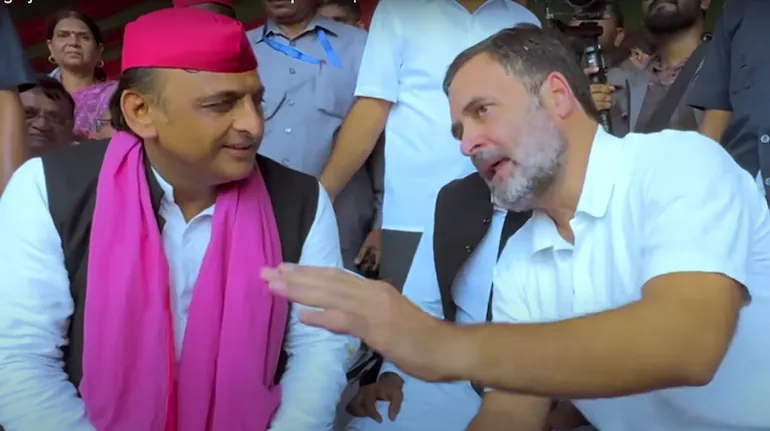
Congress and the Samajwadi Party are facing differences over seat-sharing for the 2027 Uttar Pradesh Assembly elections, with the Congress seeking a significantly larger share of constituencies than the SP has initially indicated it is prepared to offer. The disagreement has emerged during negotiations in New Delhi, where representatives of both parties have begun examining individual seats and their electoral prospects.
According to reports published on November 24 and 25, Congress submitted a list of constituencies it wants to contest, with some accounts putting its demand at 120 seats and others reporting a revised list of approximately 130. The party’s position has created a substantial gap with the Samajwadi Party’s initial proposal of 26 constituencies. No final seat-sharing agreement has been announced. :chatgpt-content-reference{index=”0″}
Congress seeks a larger share in the 403-member Uttar Pradesh Assembly
The Congress is seeking a substantial role in the opposition alliance ahead of the next Uttar Pradesh Assembly election, scheduled for 2027. Its negotiators have argued for a wider selection of constituencies, pointing to the party’s performance in the 2024 Lok Sabha elections and its presence in several parliamentary constituencies across the state.
In the initial stages of discussions, Congress reportedly presented a list of 181 Assembly constituencies. It subsequently reduced its demand, with reports on the negotiations citing figures of 120 and around 130 seats for the revised proposal. The difference in reported numbers appears to reflect separate stages or accounts of the negotiations rather than a publicly confirmed final demand.
Congress leaders have also sought constituencies in districts where the party believes it has an organisational or electoral claim. These reportedly include Assembly segments in Rae Bareli, Amethi, Saharanpur, Barabanki, Sitapur and Allahabad. The party has argued that its recent Lok Sabha performance should be considered while deciding which Assembly constituencies it contests.
The proposed list has also reportedly included seats where the Samajwadi Party has sitting MLAs. That creates a difficult negotiating question: whether constituencies should remain with the party that currently holds them or be reassigned based on the alliance’s assessment of its prospects in the next election.
Saharanpur and Rae Bareli emerge as points of discussion
Constituency allocation in western Uttar Pradesh has become one of the immediate areas of disagreement. Congress reportedly sought two seats in Saharanpur, even as the Samajwadi Party moved ahead with announcing candidates in constituencies that appeared on the Congress wishlist.
The Samajwadi Party announced its first list of five candidates on November 24. The list included candidates for Behat and Saharanpur, adding another complication to the discussions because Congress had also expressed interest in seats in the district.
Rae Bareli and Amethi carry a different kind of political significance for Congress. Both districts have a long association with the Gandhi family and the party’s political history in Uttar Pradesh. Congress’s interest in constituencies in these areas is therefore connected not only to electoral calculations but also to its organisational presence and political legacy.
However, parliamentary constituencies and Assembly constituencies are not interchangeable political units. A party’s strength in a Lok Sabha election does not automatically establish that it has the strongest claim to every Assembly segment within that parliamentary constituency. The Samajwadi Party’s own electoral record and the presence of its sitting legislators are also factors in the negotiations.
Reports have highlighted the competing claims in the Rae Bareli-Amethi region, where Congress’s historical association with the area overlaps with the Samajwadi Party’s Assembly-level representation. The final arrangement will depend on how the two parties assess local candidates, previous results and constituency-level political equations. :chatgpt-content-reference{index=”1″}
Akhilesh Yadav puts candidate winnability at the centre of negotiations
Samajwadi Party president Akhilesh Yadav has repeatedly argued that seat-sharing should be based on electoral winnability rather than a fixed numerical division between alliance partners. His position is that the parties should identify candidates capable of winning individual constituencies and defeating the ruling Bharatiya Janata Party (BJP).
After the latest round of discussions, Yadav said the process had begun with 26 constituencies considered winnable by the Samajwadi Party. In a post on X on November 24, he indicated that negotiations would continue through mutual understanding and cooperation.
The SP’s initial proposal reportedly includes two constituencies where Congress has sitting MLAs, four where Congress finished second in the previous Assembly election and 20 others where the Samajwadi Party believes its own vote base gives the alliance a stronger opportunity. SP leaders have cited past voting figures to explain why they selected these constituencies.
Yadav has also urged Congress to share details of other constituencies it considers promising. The Samajwadi Party has indicated that its own assessment could identify additional seats where Congress candidates might have a realistic chance, including constituencies that may not have featured prominently in the party’s initial list.
In his public remarks, Yadav has stressed the importance of adjustment between alliance partners. He has argued that the objective should be to secure victories rather than allow disagreements over party quotas to weaken the broader opposition arrangement. :chatgpt-content-reference{index=”2″}
What is the PDA framework, and why has it entered the discussion?
Yadav has also referred to the PDA framework while discussing the alliance’s approach to candidate selection. PDA stands for Pichhda, Dalit, Alpsankhyak, referring to backward communities, Dalits and minorities.
The framework is central to the Samajwadi Party’s political messaging and its attempt to bring different social groups into a common electoral coalition. Yadav has suggested that discussions should focus on candidates representing the broader opposition alliance rather than treating every constituency exclusively as a Congress or Samajwadi Party seat.
This approach could influence how the parties evaluate candidates in constituencies where both organisations have a presence. Instead of relying only on the identity of the party that currently holds a seat, negotiators would need to consider local support, community representation, candidate profiles and the possibility of consolidating votes behind a single alliance nominee.
However, the PDA framework does not remove the practical difficulty of deciding which party will contest a particular constituency. Both parties still need to agree on candidates, local leadership roles and campaign responsibilities before a common arrangement can be implemented.
Why the 120-seat demand is significant
Uttar Pradesh has 403 Assembly constituencies, making it India’s largest state legislature. A demand for 120 seats would give Congress the opportunity to contest close to 30 per cent of the constituencies. A proposal of around 130 seats would take that share even higher.
The Samajwadi Party’s initial offer of 26 seats is considerably smaller. The difference between the reported Congress demand and the SP’s proposal illustrates the scale of the negotiations still required before the alliance can settle on a common formula.
The two parties also bring different electoral records to the discussions. In the 2022 Uttar Pradesh Assembly election, the Samajwadi Party won 111 seats, while Congress secured two. In the 2024 Lok Sabha election in the state, Congress won six of the 17 parliamentary constituencies it contested, while the Samajwadi Party won 37 seats.
These results provide different reference points for the negotiations. Congress can point to its improved performance in the 2024 general election, while the Samajwadi Party can refer to its larger Assembly presence and its performance across the state. Neither set of results alone settles the question of how the 403 constituencies should be divided.
The parties must also account for the fact that parliamentary voting patterns do not always translate directly into Assembly-level outcomes. Local candidates, community alignments, party organisation and constituency-specific issues can influence results independently of a party’s statewide performance.
Can the Congress-SP alliance reach a seat-sharing agreement?
The latest round of discussions has not produced a final agreement, but leaders from both sides have indicated that negotiations will continue. Reports suggest that the parties discussed constituencies individually and examined electoral data rather than limiting the conversation to an overall seat count.
Congress leaders have publicly described the discussions as cordial and expressed confidence that an understanding can be reached. Samajwadi Party representatives have also indicated that the process remains open, although the party has maintained that candidate winnability should guide the final allocation.
The announcement of candidates by the Samajwadi Party in some constituencies sought by Congress adds pressure to the negotiations. If the parties eventually agree to a common candidate in those seats, they may have to reconsider earlier announcements or find another arrangement that accommodates both sides.
For Congress, accepting a significantly smaller number of seats could raise questions about its organisational role and political space in the alliance. For the Samajwadi Party, allocating a large number of constituencies to its partner would require it to make room for Congress in seats where the SP may already have local leaders or sitting legislators.
What happens next in the 2027 Uttar Pradesh election talks?
The immediate challenge is to narrow the gap between the Congress’s proposed list and the Samajwadi Party’s initial offer. That will require the two sides to evaluate individual constituencies, settle overlapping claims and decide whether the alliance should prioritise existing legislators, previous election results or a fresh assessment of candidate strength.
The reported 120-seat demand should therefore be understood as part of an ongoing negotiation, not as a settled agreement or a final allocation. Similarly, the SP’s initial offer of 26 constituencies does not necessarily represent the final number Congress will receive.
Both parties face a decision about how to balance their individual political interests with the objective of contesting the election through a coordinated opposition alliance. Their ability to resolve disagreements over constituencies such as those in Saharanpur, Rae Bareli and Amethi will offer an indication of how the broader arrangement is taking shape.
Until a formal agreement is announced, the number of seats Congress will contest, the constituencies allocated to each partner and the final candidate-selection formula remain unsettled. The negotiations are still underway, with winnability, local political strength and mutual accommodation at the centre of the discussions.
For breaking news and live news updates, like us on Facebook or follow us on Twitter and Instagram. Read more on Latest India on thefoxdaily.com.



COMMENTS 0