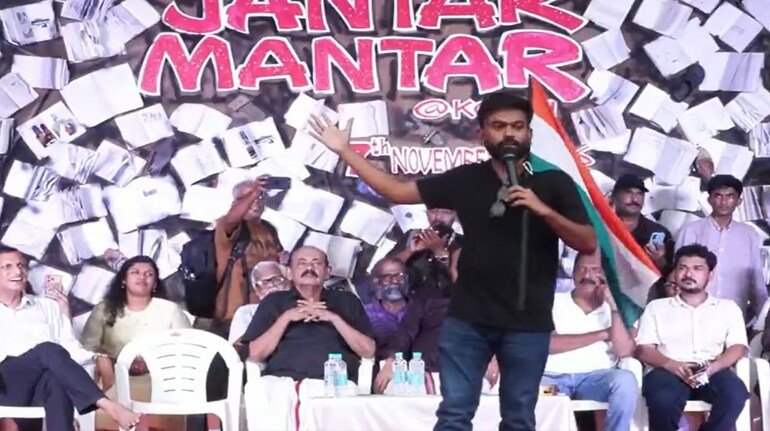
The Cockroach Janta Party (CJP) brought its campaign against the Election Commission of India’s Special Intensive Revision (SIR) of electoral rolls to Kochi on Saturday, November 7, with founder Abhijeet Dipke launching a sharp attack on Prime Minister Narendra Modi and the BJP. Addressing protesters at Rajendra Maidan, Dipke accused the government of compromising India’s interests in its dealings with US President Donald Trump and questioned Modi’s standing in comparison with Mahatma Gandhi, Dr BR Ambedkar and Jawaharlal Nehru.
The demonstration, titled ‘Jantar Mantar at Kochi’, was organised as part of the CJP’s demand for the cancellation of SIR and the resignation of Chief Election Commissioner Gyanesh Kumar. Actor-activist Prakash Raj joined the march from Marine Drive to Rajendra Maidan, where hundreds of young people, civil rights activists and other citizens gathered.
The Kochi mobilisation also marked an important public demonstration for the CJP outside Delhi after several of its leaders faced detention and arrest during protests in the national capital last month.
Abhijeet Dipke accuses Modi government of compromising India’s interests
Speaking at the Kochi gathering, Dipke criticised the Prime Minister over India’s relationship with the United States and the trade and energy issues discussed between the two countries.
He questioned the government’s position on Russian oil purchases and the terms of India’s trade negotiations with Washington. Dipke argued that the government had accepted arrangements that, in his view, placed India at a disadvantage while serving American interests.
According to a statement reported by ANI, Dipke said the CJP was being accused of receiving support from external forces to destabilise India, but he challenged those making the allegations to examine the government’s own decisions in its dealings with Trump.
He specifically referred to claims about India agreeing to stop purchasing Russian oil at the US President’s behest and accepting an 18% tariff on Indian goods while imposing a zero per cent tariff in return. Dipke described these alleged terms as a surrender of national interests.
His remarks were political accusations directed at the Modi government. They should be distinguished from the actual terms of trade arrangements and energy policy decisions, which require assessment through official announcements and agreements. The speech did not itself establish that India had formally accepted every arrangement he described.
The comments also brought international trade and energy policy into a protest primarily organised around electoral rolls. By linking the two issues, Dipke sought to broaden his criticism of the central government beyond the Election Commission’s revision exercise.
Dipke invokes Gandhi, Ambedkar and Nehru to challenge Modi
One of the most prominent parts of Dipke’s speech was his comparison of Modi with three major figures associated with India’s freedom movement and constitutional development: Mahatma Gandhi, Dr BR Ambedkar and Jawaharlal Nehru.
Dipke described Gandhi as the soul of India, Ambedkar as its backbone and Nehru as its mind. He used the comparison to argue that the Prime Minister could not attain the historical stature of these leaders, regardless of how long he remained in office.
He said that even if Modi continued as Prime Minister for another 120 years, he would never become greater than Gandhi, Ambedkar or Nehru. The statement was a political attack intended to contrast the legacy of the three historical figures with the current government’s leadership.
The references carried different historical meanings. Gandhi became a central figure in India’s independence movement through his advocacy of non-violent resistance and mass mobilisation. Ambedkar chaired the Constitution’s Drafting Committee and played a defining role in shaping its framework of rights, equality and social justice. Nehru became independent India’s first Prime Minister and helped establish many of the country’s early democratic and institutional structures.
By invoking all three, Dipke placed the CJP’s criticism within a broader argument about the values and political traditions on which modern India was built.
Dipke criticises organisation associated with Modi
The CJP founder also targeted the organisation from which Modi comes, accusing it of failing to contribute to India’s freedom struggle. Dipke alleged that its members had sided with colonial rulers rather than participating in the movement for independence.
His remarks reflect a long-running political dispute over the historical role of the Rashtriya Swayamsevak Sangh (RSS), the organisation with which Modi has been associated since his early political years.
The RSS’s role during the freedom movement has been a subject of debate among political parties, historians and commentators. Critics have questioned its participation in the broader anti-colonial struggle, while the organisation and its supporters have offered their own accounts of its historical activities and ideological contribution.
Dipke’s statement was part of his wider criticism of the BJP and its ideological background. It was not a detailed historical examination of the organisation’s activities, but a political argument delivered during an anti-SIR demonstration.
Why CJP organised ‘Jantar Mantar at Kochi’
The central purpose of the Kochi demonstration was opposition to the Election Commission’s Special Intensive Revision of electoral rolls. The CJP has argued that the exercise could undermine voting rights and has demanded that it be withdrawn.
The event began with a march from Marine Drive at around 4 pm and proceeded towards Rajendra Maidan. Protesters carried national flags and raised slogans calling for the cancellation of SIR and the resignation of Chief Election Commissioner Gyanesh Kumar.
Organisers described the gathering as a public campaign to protect democracy and voting rights. The event was designed to bring together young people, activists and citizens concerned about the way electoral rolls are being revised.
Actor-activist Prakash Raj joined the march and participated in the public mobilisation. His presence brought additional public attention to the demonstration, which also involved CJP national secretary Aafreen Nawaz and its South India representative Vijay Reddy Mallangi.
The rally attracted around 500 participants, according to a PTI report citing organisers. Police personnel were deployed along the route to regulate traffic and prevent road blockages.
What is the Special Intensive Revision of electoral rolls?
The Special Intensive Revision is an exercise undertaken by the Election Commission of India to review and update electoral rolls. Its stated purpose is to improve the accuracy of voter lists by checking entries and ensuring that eligible citizens are included while ineligible or outdated entries are addressed according to election rules.
Electoral rolls are fundamental to the voting process because they determine who is registered to vote in a particular constituency. Errors can affect both the inclusion of eligible voters and the removal of entries that no longer meet the requirements for registration.
Intensive revision exercises can involve verification of voter details, scrutiny of existing entries and the opportunity for citizens to submit claims or objections. The precise procedures, documentation requirements and timelines depend on the Election Commission’s instructions for the relevant exercise.
The process has generated political controversy because critics have questioned whether the scale and implementation of revisions could create difficulties for vulnerable voters. Migrant workers, people who have moved homes, elderly citizens and individuals with limited access to documentation or administrative support can face particular challenges when their details require verification.
Opponents have also raised concerns about transparency, the possibility of wrongful deletions and whether adequate opportunities are available to challenge errors. They argue that even an administrative exercise intended to improve electoral records must include strong safeguards to prevent eligible citizens from losing their voting rights.
The Election Commission’s position is that electoral rolls must be maintained accurately and that revision is part of its responsibility to ensure credible elections. The central debate is therefore not simply whether voter lists should be updated, but how the exercise is conducted and how citizens can protect their registration if an error occurs.
Why the CJP wants SIR cancelled
The CJP has made the cancellation of SIR a central demand of its campaign. Its leaders argue that the exercise raises concerns about the fairness and independence of the electoral process, particularly when large numbers of voter records are being reviewed.
The party has also criticised Chief Election Commissioner Gyanesh Kumar, accusing the Election Commission under his leadership of failing to maintain public confidence in the electoral system. At Kochi, Dipke said the campaign would continue until the organisation believed an independent and impartial election system had been established.
He also claimed that Kerala accounted for the largest number of registered CJP members, using the assertion to underline the party’s growing presence in the state.
However, allegations that electoral revisions are being used to benefit a particular political party require evidence and examination of the relevant electoral data, procedures and decisions. Political criticism of the exercise does not, by itself, establish that the Election Commission has acted with partisan intent.
The wider issue is how the Election Commission can maintain accurate voter records while ensuring that the revision process remains accessible, transparent and fair to every eligible citizen.
Prakash Raj joins the anti-SIR march in Kochi
Actor and activist Prakash Raj was among the prominent participants in the Kochi demonstration. He joined the march from Marine Drive towards Rajendra Maidan and later attended the public meeting.
His participation gave the campaign a visible public face beyond the CJP’s organisational leadership. Raj has previously spoken on political and social issues, including questions involving democratic institutions, public accountability and freedom of expression.
At the Kochi event, protesters carried national flags and displayed banners demanding the withdrawal of SIR. The demonstration also called for Gyanesh Kumar’s resignation, making the Election Commission’s leadership a central focus of the gathering.
Several civil rights activists and young participants took part in the mobilisation. The involvement of people beyond the party’s own leadership was significant for organisers seeking to present the protest as a wider public campaign rather than an internal political event.
CJP leaders faced arrests and detention during Delhi protests
The Kochi demonstration followed a series of confrontations between CJP members and Delhi Police during protests in October. The party had planned demonstrations at Jantar Mantar against the Election Commission and the SIR exercise.
On October 10, CJP founder Abhijeet Dipke, along with leaders Ashutosh Ranka and Saurav Das, was detained by Delhi Police after arriving in the national capital. The leaders had travelled to Delhi to participate in the party’s planned protest against Chief Election Commissioner Gyanesh Kumar.
The dispute escalated on October 13, when CJP members entered the Jantar Mantar area despite restrictions and raised slogans while displaying the national flag. Delhi Police detained several participants. Ranka and Das were subsequently arrested and sent to judicial custody.
The action followed the Delhi Police’s decision to denotify Jantar Mantar as a designated protest site. Authorities identified alternative locations for demonstrations, including Ramlila Ground, Burari Ground and CBD Ground in east Delhi.
The CJP criticised the decision, arguing that removing Jantar Mantar’s designated status restricted the ability of citizens to organise demonstrations at a prominent protest location. The party used the slogan that resistance could not be denotified to challenge the restrictions.
Ranka and Das were released on October 21 after an undertaking before a Special Executive Magistrate that they would not call for further protests at Jantar Mantar while the location remained denotified. Dipke had also faced detention ahead of a planned Tiranga March in Delhi.
Delhi Police maintained that action was taken because the protesters did not have the necessary permission and because of concerns about violations of the applicable restrictions. The CJP, on the other hand, portrayed the detentions as an attempt to prevent its campaign from continuing.
Why Kochi became an important location for the campaign
Taking the protest to Kochi allowed the CJP to extend its anti-SIR campaign beyond Delhi and reach a new group of supporters in southern India. The choice of a public march followed by a meeting also gave organisers an opportunity to connect the issue of electoral rolls with broader concerns about democratic participation.
The event was described by the organisation as a major public mobilisation outside the national capital. It came at a time when several political parties and civil society groups were raising questions about the SIR exercise and the Election Commission’s handling of electoral matters.
The CJP also sought to maintain an independent political identity. Although it expressed support for the INDIA bloc’s November 1 ‘Chalo Dilli’ march, it did not participate in the opposition rally at Ramlila Maidan against alleged vote theft. Dipke said the organisation wanted to retain its separate identity rather than become part of another political platform.
This approach suggests that the party is attempting to build its campaign around its own organisational structure and public mobilisation, even while sharing some concerns raised by opposition parties.
What the Kochi protest means for the SIR debate
The ‘Jantar Mantar at Kochi’ demonstration has added another public event to the growing debate over electoral roll revisions in India. It brought together criticism of the Election Commission, demands for the withdrawal of SIR and wider political attacks on the central government.
Dipke’s remarks about Modi, Trump and India’s trade interests gave the gathering a broader political character. His invocation of Gandhi, Ambedkar and Nehru also connected the protest to competing interpretations of India’s political history and constitutional values.
However, the most consequential issue remains the integrity of electoral rolls. Accurate voter lists are essential for credible elections, but the process of revising them must also protect eligible citizens from wrongful exclusion. Public trust depends on transparent procedures, accessible correction mechanisms and clear explanations for decisions affecting voter registration.
For the CJP, the Kochi rally represents an effort to sustain pressure on the Election Commission after the confrontations in Delhi. The organisation has indicated that its campaign will continue until its demands for an independent electoral system are addressed.
Whether the demonstration leads to any change in the Election Commission’s approach remains uncertain. The debate over SIR is likely to continue through political protests, public statements and scrutiny of the revision process. The central question for voters and authorities alike will be whether electoral roll updates can be carried out without compromising the right of eligible citizens to participate in India’s democratic process.
For breaking news and live news updates, like us on Facebook or follow us on Twitter and Instagram. Read more on Latest India on thefoxdaily.com.




COMMENTS 0