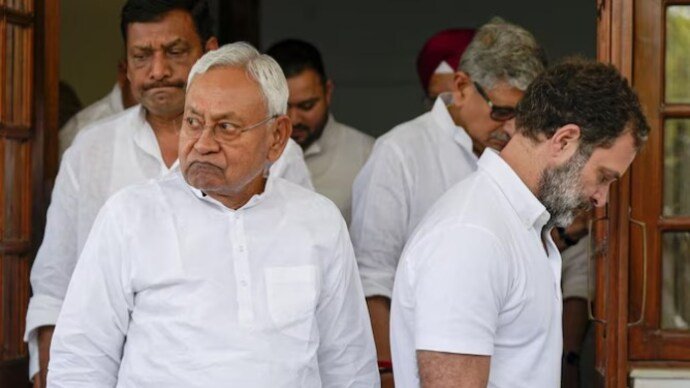
The Janata Dal (United) has challenged Congress leader Sonia Gandhi’s account of Nitish Kumar’s departure from the opposition INDIA Bloc, insisting that the Bihar leader was instrumental in bringing opposition parties together and was not looking for an opportunity to leave the alliance.
The disagreement follows the publication of Gandhi’s memoir, Belonging: A Journey of Love, in which she discusses Kumar’s political position within the opposition alliance and his eventual return to the National Democratic Alliance (NDA) in early 2024. The JDU has objected to the way the episode has been presented, arguing that it overlooks Kumar’s role in the formation of the INDIA bloc.
The exchange has brought renewed attention to the political negotiations behind the opposition alliance, the circumstances surrounding Kumar’s departure and the differing explanations offered by the Congress and the JDU.
JDU Rejects Sonia Gandhi’s Account of Nitish Kumar’s Exit
JDU national spokesperson Rajeev Ranjan Prasad expressed the party’s dissatisfaction with the description of Kumar in Gandhi’s memoir. He argued that Kumar was not simply a participant in the INDIA bloc but one of the principal figures responsible for bringing its constituent parties together.
In a video statement reported by the Press Trust of India, Prasad said the party was deeply aggrieved by the way Kumar had been mentioned in the book in connection with the opposition alliance.
He maintained that Kumar was the architect and driving force behind the INDIA bloc, which is currently led by Sonia Gandhi and Rahul Gandhi. The JDU spokesperson also questioned the suggestion that the former Bihar chief minister had been waiting for an opportunity to leave the alliance.
According to Prasad, the memoir’s account does not adequately reflect the political efforts Kumar made before the alliance took shape. The JDU believes that his contribution to opposition unity should be recognised when discussing the origins and subsequent political difficulties of the bloc.
What Sonia Gandhi Wrote About Nitish Kumar
In Belonging: A Journey of Love, Sonia Gandhi has written that Kumar was looking for an opportunity to leave the INDIA bloc and was under the influence of the BJP.
Her account also refers to Kumar’s decision to return to the NDA in early 2024. The move marked a major political shift in Bihar, where the JDU leader had previously been part of the opposition alliance-building process.
The memoir’s portrayal has now become the subject of a public disagreement between the two political camps. While Gandhi’s account focuses on Kumar’s eventual departure and his political positioning, the JDU has emphasised his earlier role in bringing opposition parties onto a common platform.
The competing accounts reflect different interpretations of the same political episode. Gandhi’s description presents Kumar as someone who was looking for an exit, while the JDU argues that he helped establish the alliance before concluding that it could not function effectively.
How Nitish Kumar Helped Bring Opposition Parties Together
Prasad said several regional parties were initially reluctant to join an opposition arrangement that included the Congress. According to him, Kumar played an important role in persuading these parties to participate in a broader coalition against the NDA.
The JDU spokesperson pointed to the first meeting of opposition parties in Patna as an important step in the process. He said Kumar’s efforts helped make the meeting successful and created the foundation for further discussions among opposition leaders.
The Patna meeting was significant because opposition parties with different political priorities and regional interests were attempting to explore a common strategy. Their participation required negotiations among leaders who often competed against one another in state-level elections.
For the JDU, Kumar’s involvement in those discussions is central to understanding the INDIA bloc’s formation. The party argues that his efforts helped overcome initial resistance among regional parties and brought the Congress into the broader opposition framework.
However, bringing parties together was only the first stage of the alliance-building process. Maintaining coordination, resolving disagreements over seats and establishing a common political approach presented separate challenges for the opposition grouping.
Why JDU Says Nitish Kumar Left the INDIA Bloc
Prasad offered a different explanation for Kumar’s departure from the opposition alliance. He said the former Bihar chief minister eventually concluded that the INDIA bloc would not be able to function as an effective political alternative to the NDA.
According to the JDU spokesperson, differences among the Congress and its allies, particularly their regional political interests and ambitions, created difficulties for the alliance. He argued that these competing priorities prevented the opposition parties from developing the collective strength needed to challenge the ruling coalition.
Prasad said Kumar left after realising that the alliance lacked the capacity to take on the NDA effectively. The JDU has consistently presented this as the reason behind his decision to return to the BJP-led coalition.
This explanation places the emphasis on disagreements within the opposition grouping rather than on an alleged search by Kumar for an opportunity to change political sides.
It is important to distinguish the JDU’s position from an independently established explanation of Kumar’s motives. Prasad’s remarks represent the party’s interpretation of the events, while Gandhi’s memoir offers a different account of the political circumstances surrounding the departure.
INDIA Bloc’s Formation and the Challenge of Opposition Unity
The disagreement also highlights the difficulties involved in building a national opposition alliance from parties with different ideological positions, leadership structures and regional priorities.
Regional parties often have strong political interests in their respective states. Their relationship with the Congress can vary depending on local electoral competition, leadership arrangements and the distribution of constituencies. A party that cooperates with the Congress at the national level may still compete directly against it in state elections.
Such differences can make it difficult for an alliance to agree on seat-sharing arrangements and a common political strategy. They can also create disagreements over which leaders should guide the coalition and how decisions should be made.
The JDU’s latest response points to these challenges as part of its explanation for Kumar’s exit. By emphasising the ambitions and regional interests of the Congress and its allies, the party is arguing that the opposition alliance struggled to reconcile the priorities of its members.
At the same time, the dispute over the memoir shows that disagreements about the alliance extend beyond electoral arrangements. Political parties also have competing accounts of who initiated opposition unity, who contributed to its formation and who was responsible for its subsequent difficulties.
Why the Disagreement Matters for Congress and JDU
The exchange is significant because Nitish Kumar’s political role connects two major phases of the INDIA bloc’s history: its formation and the departure of one of its early supporters.
For the JDU, highlighting Kumar’s contribution allows the party to challenge a portrayal that it considers incomplete. Its argument is that the former Bihar chief minister helped persuade regional parties to work with the Congress and should not be remembered primarily for leaving the alliance.
For the Congress, Gandhi’s memoir provides her account of the political developments surrounding Kumar’s departure. The disagreement demonstrates how the same episode can be interpreted differently by leaders and parties that were once part of the same political arrangement.
The controversy also raises broader questions about the INDIA bloc’s internal coordination. An alliance built around opposition unity must manage differences among parties that have their own electoral calculations and regional priorities. Disagreements over past decisions can add another layer of difficulty to those relationships.
Competing Political Narratives Over Nitish Kumar’s Role
The JDU’s response has turned a passage in Sonia Gandhi’s memoir into a wider political debate over the origins and functioning of the INDIA bloc.
Prasad’s central argument is that Kumar was a key architect of the alliance and that his eventual departure followed concerns about its ability to challenge the NDA. Gandhi’s account, as described in the memoir, suggests that Kumar was already looking for an opportunity to leave and was influenced by the BJP.
These contrasting versions underline the continuing political significance of Kumar’s decision to return to the NDA in early 2024. They also show how the history of opposition unity remains contested among parties that once attempted to work together.
For now, the JDU has made its position clear: it rejects the suggestion that Nitish Kumar was merely waiting to exit the INDIA bloc and insists that his contribution to bringing opposition parties together deserves recognition.
For breaking news and live news updates, like us on Facebook or follow us on Twitter and Instagram. Read more on Latest India on thefoxdaily.com.



COMMENTS 0