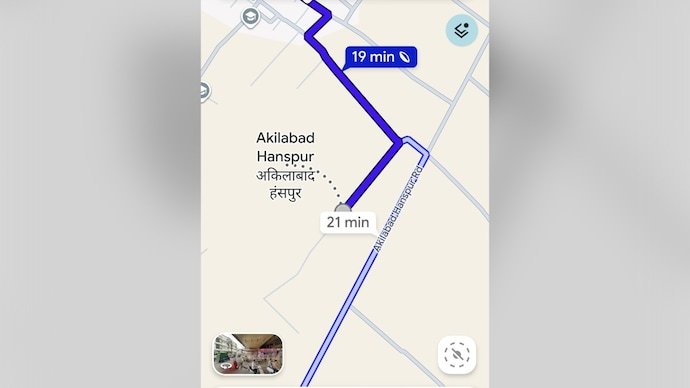
India’s rapid digital transformation has made online databases, location intelligence, and digital identity systems central to Governance. But a recent dispute involving a village in Uttar Pradesh’s Firozabad district demonstrates how even a small spelling error can create outsized consequences. Residents of Akalabad Hasanpur claim that Google Maps incorrectly identifies their village as “Akilabad Hanspur,” creating confusion in government records and affecting access to essential public services.
The issue raises important questions about the growing dependence on digital platforms for administrative functions. WHO is responsible when digital location data differs from official government records? What happens when a private technology platform becomes a de facto source of geographic information for public administration? Why do such discrepancies matter in an era where governance increasingly relies on digital verification systems? And how can authorities ensure that technology improves service delivery without creating new bureaucratic barriers?
The case of Akalabad Hasanpur may appear minor on the surface, but it offers a valuable lesson about the intersection of technology, governance, and citizen welfare in Digital India.
Understanding the Akalabad Hasanpur-Google Maps Dispute
The controversy centers around a spelling discrepancy. According to residents and official local records, the village is named Akalabad Hasanpur. However, Google Maps reportedly displays the location as Akilabad Hanspur. While the difference may seem insignificant to outsiders, residents argue that the mismatch has created practical difficulties across multiple government-related processes.
As government agencies increasingly integrate digital tools into service delivery, location names have become critical identifiers. Whether applying for welfare schemes, updating identity documents, processing certificates, or verifying addresses, consistency across databases is essential.
Villagers allege that whenever official documents use the government-recognized village name while digital systems rely on Google’s version, discrepancies emerge that complicate verification procedures.
The local administration has acknowledged the issue. Authorities have indicated that a formal request will be sent to Google seeking correction of the village name.
Why Accurate Geographic Data Matters More Than Ever
India is undergoing one of the world’s largest digital governance transformations. Services that once depended entirely on paper records now operate through interconnected databases. Aadhaar-linked services, land records, voter databases, Banking verification systems, property registration platforms, and welfare distribution mechanisms increasingly rely on accurate geographic information.
In this environment, a village name is more than a label it functions as a critical data point connecting multiple government systems.
When geographic information differs across platforms, several challenges can arise:
- Address verification delays
- Document processing complications
- Errors in beneficiary identification
- Administrative confusion during field verification
- Difficulties in emergency response and public service delivery
- Challenges in census and demographic record maintenance
The Akalabad Hasanpur situation highlights how digital governance depends not only on technology Infrastructure but also on data accuracy.
The Rise of Digital Mapping in Government Operations
Over the past decade, digital maps have become deeply embedded in governance systems worldwide. Government departments increasingly use geospatial technology for planning, monitoring, service delivery, infrastructure development, and disaster management.
In India, digital mapping supports numerous public-sector functions:
- Rural road development projects
- Land record modernization
- Smart city initiatives
- Agricultural planning
- Healthcare outreach programs
- Public distribution system monitoring
- Emergency and disaster response
- Election management
As reliance on digital maps grows, inaccuracies can have cascading effects across multiple administrative functions.
How Mapping Errors Affect Ordinary Citizens
For residents of large cities, a map spelling mistake may simply be an inconvenience. For rural communities, however, such errors can affect access to essential services.
Many government schemes require accurate documentation linking an individual to a specific location. When names differ across databases, additional verification may become necessary.
Citizens often bear the burden of resolving inconsistencies that originate in digital systems they neither control nor understand.
Potential impacts include:
- Delays in processing government benefits
- Complications in updating identity documents
- Challenges in obtaining certificates
- Difficulties during property-related transactions
- Increased administrative visits and paperwork
- Higher costs associated with repeated applications
For economically vulnerable households, these delays can have significant consequences.
A Broader Digital Governance Challenge
The issue extends beyond a single village. Across India, localities often have multiple spellings due to historical records, linguistic differences, transliteration practices, and administrative changes.
Names originally written in Hindi, Urdu, Bengali, Tamil, Telugu, Marathi, Punjabi, or other regional languages may be translated into English in different ways.
For example, a village’s official spelling in revenue records may differ from its spelling on maps, transportation systems, postal databases, or local signage.
This creates a complex challenge for digital governance because computers require exact matches, while humans can easily recognize similar spellings.
Why These Errors Occur
Digital mapping platforms gather information from multiple sources, including satellite imagery, public databases, user contributions, local authorities, and geographic datasets.
Several factors can contribute to naming discrepancies:
- Historical spelling variations
- Translation and transliteration errors
- Legacy database inaccuracies
- User-submitted changes
- Administrative boundary revisions
- Differences between local and official usage
In multilingual countries such as India, transliteration remains a major challenge. A place name written in Devanagari script may have several acceptable English spellings, increasing the likelihood of inconsistencies.
Digital India and the Importance of Data Integrity
India’s Digital India initiative has significantly expanded access to online public services. Citizens can now apply for documents, access welfare schemes, make payments, and interact with government agencies through digital platforms.
However, digital transformation depends on one critical factor: trust in data.
When records across systems fail to align, confidence in digital governance can weaken. Citizens expect technology to simplify interactions with government, not create additional hurdles.
The Akalabad Hasanpur case demonstrates that successful digital governance requires continuous maintenance and verification of foundational datasets, including geographic information.
Comparison: Traditional Administration vs Digital Administration
| Aspect | Traditional Administration | Digital Administration |
|---|---|---|
| Location Verification | Manual verification by officials | Database-driven verification |
| Error Detection | Human interpretation possible | Requires exact matching |
| Processing Speed | Slower | Faster when data is accurate |
| Impact of Name Mismatch | Usually manageable | Can trigger system conflicts |
| Citizen Burden | Physical paperwork | Digital corrections and validation |
The comparison illustrates why seemingly small discrepancies can become major administrative issues in a digitized environment.
What Government Agencies Can Learn from This Incident
The Akalabad Hasanpur dispute provides valuable lessons for policymakers and administrators.
First, official government records should remain the primary source of truth for geographic names. Digital platforms can support administration, but they should not automatically override verified government documentation.
Second, stronger coordination is needed between mapping providers and government agencies. Establishing mechanisms for rapid correction of verified errors can help prevent disruptions.
Third, public officials should be trained to recognize that digital platforms may occasionally contain inaccuracies and should verify information using official records when discrepancies arise.
The Global Challenge of Digital Mapping Accuracy
India is not alone in facing these issues. Around the world, governments, businesses, and citizens increasingly depend on digital maps.
Errors in mapping systems have previously affected emergency response operations, logistics networks, property records, navigation services, and Business listings in multiple countries.
As digital maps become foundational infrastructure for modern economies, maintaining accuracy becomes a matter of public importance rather than simple convenience.
The challenge is particularly significant in developing economies where digital transformation is occurring rapidly and administrative systems are evolving simultaneously.
The Missing Conversation: Who Owns Digital Truth?
One important aspect often overlooked in discussions about mapping errors is the concept of digital authority.
When a private technology platform displays information that differs from government records, which version should citizens trust?
This question is becoming increasingly relevant as digital platforms play larger roles in daily life.
The Akalabad Hasanpur case highlights the need for clearer frameworks governing how official geographic information is maintained, verified, and updated across public and private systems.
Future governance models may require stronger integration between official databases and mapping platforms to ensure consistency.
Expert Insight: Small Data Errors Can Create Large Systemic Problems
Technology experts often emphasize that digital systems are only as reliable as the data they contain. A single incorrect entry may seem insignificant, but when that information is connected to multiple databases, the impact can multiply rapidly.
This phenomenon is known as the “garbage in, garbage out” principle. Even sophisticated digital platforms cannot compensate for inaccurate foundational data.
The situation in Firozabad serves as a real-world example of how data quality directly affects governance outcomes.
What Happens Next?
Local authorities have indicated that they will formally approach Google regarding the naming discrepancy. If the correction is approved and implemented, the immediate issue may be resolved.
However, the broader challenge remains. Similar inconsistencies may exist elsewhere across India, particularly in rural regions where official records, local usage, and digital databases have evolved separately over time.
The incident could encourage governments to conduct broader reviews of digital geographic records and strengthen verification mechanisms.
Future Outlook: Building a More Reliable Digital Governance Framework
As India advances toward a more digitally connected governance ecosystem, accurate location data will become increasingly important. Emerging technologies such as Artificial Intelligence, geospatial analytics, digital public infrastructure, and automated service delivery systems will rely heavily on precise geographic information.
The future likely lies in stronger collaboration between government agencies, mapping providers, and local communities. Citizens themselves may play a greater role in identifying and correcting geographic inaccuracies through structured verification processes.
In the long term, the Akalabad Hasanpur dispute may be remembered not merely as a spelling mistake but as a reminder that digital transformation succeeds only when technology, governance, and data integrity work together.
Conclusion
The controversy surrounding the naming of Akalabad Hasanpur in Uttar Pradesh underscores a critical reality of the digital age: even small data errors can have significant real-world consequences. As governments increasingly depend on digital systems for service delivery, geographic accuracy becomes essential for ensuring smooth administration and citizen access to benefits.
Beyond the immediate issue, this incident exposes a larger challenge facing modern governance the need to maintain trustworthy, synchronized, and verified digital records. The lesson is clear: successful digital governance is not just about technology adoption; it is about ensuring that the data powering that technology remains accurate, accountable, and aligned with reality on the ground.
For breaking news and live news updates, like us on Facebook or follow us on Twitter and Instagram. Read more on Latest India on thefoxdaily.com.






COMMENTS 0