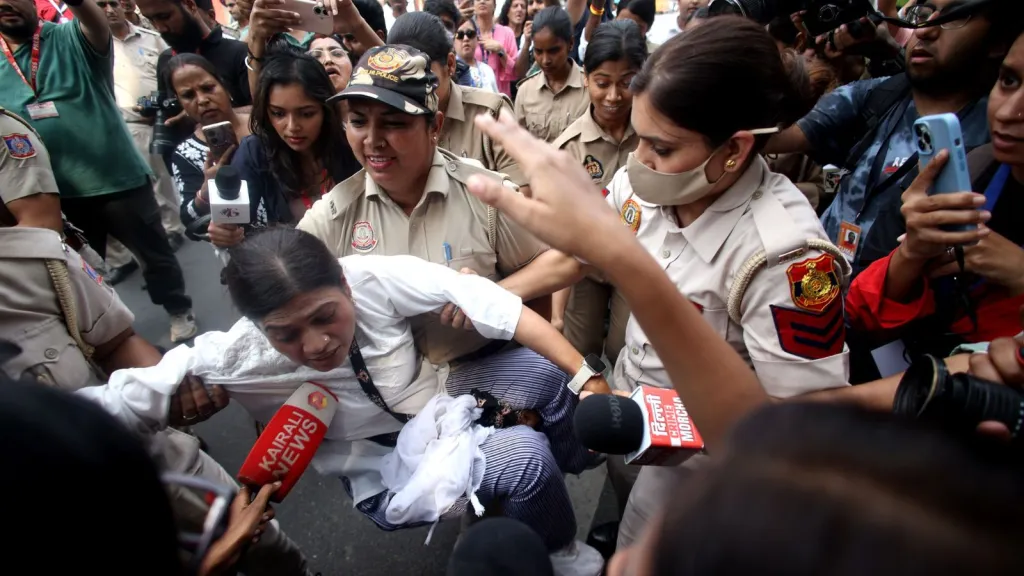
India has rejected concerns raised by the United Nations Human Rights Office over the reported mass detention of protesters, civil society members, lawyers and journalists in New Delhi, describing the remarks as unwarranted interference in the country’s internal affairs.
On Sunday, October 11, the Ministry of External Affairs (MEA) defended the actions of Indian law enforcement authorities and accused the Office of the United Nations High Commissioner for Human Rights (OHCHR) of applying double standards when responding to protests and police actions in different countries.
The diplomatic exchange followed a statement by the UN Human Rights Office expressing concern over reports of mass detentions during large-scale demonstrations in Delhi. The UN body called on Indian authorities to respect the right to peaceful assembly and ensure that restrictions on protests meet strict standards of necessity and proportionality.
The disagreement has brought attention to competing positions on public order, peaceful protest, law enforcement and international scrutiny of human rights practices.
Why India Rejected the UN Human Rights Office’s Remarks
India’s response came a day after the UN Human Rights Office expressed concern about reports of mass detentions involving demonstrators and other individuals in Delhi.
MEA spokesperson Randhir Jaiswal said the government’s concerns about the UN statement centred on what India described as interference in its domestic affairs.
In his response, Jaiswal highlighted India’s status as the world’s largest democracy and said the right to peaceful assembly was guaranteed by the Constitution. He also pointed to the country’s institutions, including the judiciary and media, as safeguards for democratic rights.
According to the MEA spokesperson, citizens exercise their right to assemble subject to requirements relating to public order and safety. He maintained that law enforcement authorities act in accordance with the law and that courts remain available to address grievances.
India argued that these protections made the UN office’s concerns unwarranted. The government therefore rejected the statement as an unacceptable intervention in matters it considers part of its domestic jurisdiction.
The response represents India’s official position on the reported detentions. The UN office, meanwhile, has emphasised the need to protect peaceful assembly and ensure that restrictions on demonstrations comply with human rights standards.
India Accuses UN Rights Office of ‘Extreme Selectivity’
Alongside rejecting the UN statement, India accused the OHCHR of applying inconsistent standards when commenting on protests and law enforcement actions in different countries.
Jaiswal said the UN office demonstrated what he described as “extreme selectivity” in its public statements. He argued that violent responses to protests in neighbouring countries and law enforcement actions closer to the UN office had not received comparable commentary.
The remarks referred to police and law enforcement actions in Pakistan and France. India presented these examples as evidence of what it considers an uneven approach to international human rights scrutiny.
The MEA spokesperson argued that such double standards weaken the credibility of the UN office and contribute to declining confidence in multilateralism.
India’s criticism reflects a broader diplomatic disagreement over how international institutions should address alleged human rights violations while respecting national sovereignty. Governments and international organisations can differ over when public criticism is justified and how consistently concerns should be raised across countries.
However, India’s allegations of selective scrutiny represent the government’s assessment of the UN office’s conduct. The supplied statements do not independently establish whether the organisation applied different standards in the cases cited.
India Had Already Responded to the UN Statement in Geneva
The MEA’s Sunday response was the second Indian government reaction to the UN Human Rights Office’s remarks within approximately 12 hours.
Earlier, India’s permanent mission in Geneva had described the concerns as misplaced and objected to what it considered interference in the country’s internal affairs.
The subsequent statement by Jaiswal reiterated India’s position and expanded the criticism to include allegations of selective attention to protests and police responses in different countries.
The repeated responses indicate that the government wanted to make its position clear following the UN office’s public intervention.
The exchange also highlights a familiar tension in international relations: governments may view external criticism of domestic policing as an intrusion on sovereignty, while international human rights bodies maintain that states have obligations to protect fundamental rights.
What Did the UN Human Rights Office Say About Delhi Protests?
The UN Human Rights Office expressed concern about reports that Indian authorities had detained large numbers of people before and during large-scale demonstrations in New Delhi.
UN Human Rights spokesperson Thameen Al-Kheetan said the reported detentions involved demonstrators, protest leaders, members of civil society organisations, lawyers and journalists.
The statement called on Indian authorities to ensure that the right to peaceful assembly was fully respected and fulfilled. It also stressed that restrictions on peaceful protests must satisfy strict tests of necessity and proportionality.
The UN office urged law enforcement personnel to exercise the utmost restraint when responding to peaceful protesters, referring to India’s democratic traditions and human rights obligations.
It also called for the immediate and unconditional release of anyone arbitrarily detained and encouraged authorities to engage in meaningful dialogue to address the concerns expressed by demonstrators.
The UN statement focused on the reported detentions and the standards that should govern restrictions on peaceful assembly. It did not remove the need to establish the circumstances of individual detentions or determine whether particular law enforcement actions complied with applicable law.
Peaceful Assembly and Public Order: The Central Disagreement
The dispute between India and the UN Human Rights Office centres partly on how authorities should balance the right to peaceful protest with public order and safety.
India’s position, as expressed by the MEA, is that peaceful assembly is constitutionally protected but must be exercised subject to public order and safety requirements. The government has also defended the role of law enforcement authorities and the availability of judicial remedies.
The UN office has emphasised that restrictions on peaceful demonstrations must meet strict standards of necessity and proportionality. It has also called for restraint by law enforcement personnel and the release of people detained arbitrarily.
These positions address related but distinct questions. Governments are responsible for maintaining public order, while human rights standards require restrictions on peaceful assembly to be justified and proportionate to legitimate aims.
Assessing a particular detention or restriction requires information about the circumstances, the legal basis for the action and the conduct of the individuals involved. The statements supplied do not provide enough detail to independently assess every detention reported during the Delhi demonstrations.
Why the Dispute Matters for India’s International Relations
The exchange matters because it places India’s domestic handling of demonstrations within a wider international discussion about civil liberties, public order and the role of human rights institutions.
India has emphasised its democratic institutions, constitutional protections and judicial system in responding to the UN criticism. The government has also argued that international scrutiny should be applied consistently rather than selectively.
The UN Human Rights Office has focused on the reported detentions and the need to safeguard peaceful assembly. Its position reflects the importance of ensuring that law enforcement responses to demonstrations remain consistent with human rights obligations.
The disagreement also illustrates the limits of diplomatic consensus on human rights issues. States may disagree with international assessments of their domestic actions, particularly when those assessments concern policing, demonstrations or the treatment of political and civil society participants.
For international observers, the central questions include whether restrictions on protests are justified, whether detained individuals have access to legal remedies and whether authorities respond proportionately to peaceful demonstrations.
For India, the dispute also raises the question of how to respond to international criticism while maintaining engagement with multilateral institutions.
What Happens Next?
The immediate dispute has centred on the exchange of public statements between the Indian government and the UN Human Rights Office.
India has rejected the UN body’s concerns and defended its law enforcement authorities, while the UN office has called for the protection of peaceful assembly, restraint by police and the release of anyone arbitrarily detained.
Further developments may depend on additional information about the demonstrations, the number and circumstances of the reported detentions, and any subsequent action by the authorities.
The supplied statements do not establish whether the Indian government intends to take additional steps in response to the UN remarks or whether further formal discussions between the two sides are planned.
The key issue remains how authorities address public demonstrations while meeting their legal obligations and protecting the rights of individuals involved.
Conclusion
India has rejected the UN Human Rights Office’s concerns over reported mass detentions during Delhi Protests, describing the remarks as unwarranted interference in its internal affairs. The MEA has defended the country’s constitutional protections and law enforcement institutions while accusing the UN body of applying double standards to protests and policing in different countries.
The UN office, meanwhile, has called for peaceful assembly to be respected, restrictions to meet strict tests of necessity and proportionality, and anyone arbitrarily detained to be released immediately and unconditionally.
The dispute highlights the continuing tension between national sovereignty, public order and international human rights scrutiny. Its broader significance will depend on how the concerns surrounding the Delhi demonstrations are addressed and whether the competing positions lead to further diplomatic engagement.
For breaking news and live news updates, like us on Facebook or follow us on Twitter and Instagram. Read more on Latest India on thefoxdaily.com.




COMMENTS 0