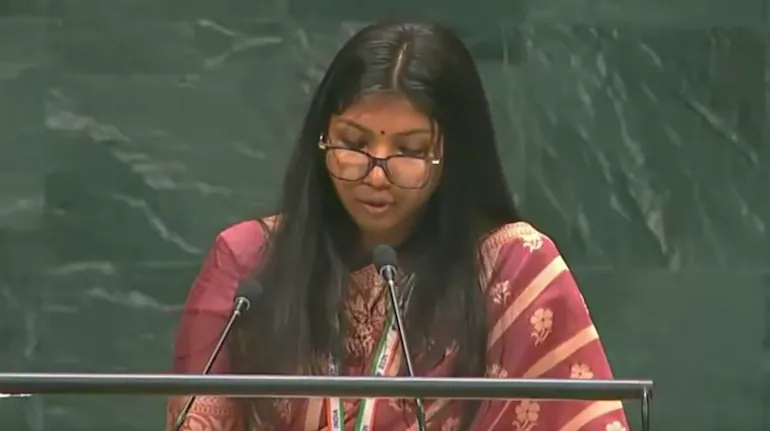
India has called for advancing Human Rights through dialogue, capacity-building and genuine partnerships, warning against what it described as politicisation, selectivity and double standards in the functioning of the United Nations Human Rights Council. Addressing a debate on the Council’s report at the United Nations General Assembly (UNGA), India’s First Secretary Bhavika Mangalanandan said the body’s credibility depended on even-handedness, equal treatment of countries and a balanced approach to different categories of human rights.
Mangalanandan presented four observations on the Council’s functioning, covering country-specific mandates, the equal importance of different human rights, technical assistance and capacity-building, and the use of resources. She also raised concerns about overlapping work between the Human Rights Council in Geneva and the UN General Assembly in New York, while calling for sustained attention to terrorism as a threat to fundamental rights, particularly the right to life. Her remarks were delivered during the UNGA debate on Friday, October 30, local time. :chatgpt-content-reference{index=”0″}
India Says Human Rights Should Not Become a Tool of Political Pressure
Opening her address, Mangalanandan thanked the President of the Human Rights Council for briefing the General Assembly and leading the Council’s work. She recalled that 2026 marks 20 years since the General Assembly established the Human Rights Council through Resolution 60/251 and 60 years since the adoption of the two International Covenants on Human Rights.
She reiterated India’s position that cooperation and constructive engagement are more effective ways to promote human rights than political confrontation or selective criticism of individual countries.
“Human rights are best advanced through dialogue, capacity-building, and genuine partnerships, and not by politicisation, selectivity, or double standards,” Mangalanandan said.
She argued that this approach was important for maintaining the Council’s credibility and enabling it to speak with a common voice. India has repeatedly raised concerns about what it describes as the politicisation and weaponisation of human rights mechanisms, particularly when country-specific scrutiny is pursued without the involvement of the country concerned.
The Permanent Mission of India to the UN also highlighted the statement on its official social media account, describing the intervention as part of India’s position against the politicisation and weaponisation of human rights. :chatgpt-content-reference{index=”1″}
First Observation: Country-Specific Mandates Should Involve the Countries Concerned
In her first observation, Mangalanandan questioned the effectiveness of country-specific mandates when they are pursued without engagement with the governments concerned. She said such approaches rarely improve conditions on the ground and can deepen divisions within the Human Rights Council.
“Country-specific mandates, pursued without the engagement of the country concerned, seldom improve the situation on the ground. On the contrary, they deepen divisions within the Council,” she said.
India argued that the Universal Periodic Review (UPR) remains the appropriate mechanism for assessing the human rights records of UN member states. The UPR is a peer-review process under which every UN member state undergoes an examination of its human rights situation. Other countries can make recommendations, and the state under review can respond to them.
Unlike mechanisms focused on particular countries, the UPR applies to all UN member states under the same broad framework. It is intended to encourage dialogue, cooperation and the sharing of recommendations rather than treating countries differently based on political considerations.
Mangalanandan said the mechanism’s emphasis on equal treatment and engagement made it an appropriate platform for addressing human rights concerns.
The debate over country-specific mandates reflects a wider disagreement about how international human rights institutions should respond to serious violations. Supporters of such mandates argue that independent scrutiny can draw attention to abuses and help establish accountability when domestic institutions are unable or unwilling to act. India’s position places greater emphasis on cooperation with the state concerned and questions whether scrutiny without its participation can produce practical improvements.
Second Observation: Economic and Social Rights Deserve Equal Attention
India’s second observation focused on the need to give equal importance to all categories of human rights. Mangalanandan said economic, social and cultural rights should receive the same attention as civil and political rights.
These categories cover different but interconnected aspects of human dignity. Civil and political rights include protections such as freedom of expression, freedom of association, political participation and the right to a fair trial. Economic, social and cultural rights include access to education, healthcare, adequate living conditions, social security and participation in cultural life.
Mangalanandan argued that the international human rights system should not give disproportionate attention to one category while overlooking the conditions that prevent people in developing countries from enjoying basic rights.
“Economic, social, and cultural rights and the right to development deserve the same attention as civil and political rights,” she said.
She identified poverty, debt and limited access to financing and technology as major obstacles to the enjoyment of human rights in much of the developing world. According to her statement, these challenges require international cooperation rather than coercive approaches.
The argument places development concerns within the broader human rights debate. For developing countries, limited public resources can affect the ability of governments to expand healthcare, improve education, provide social protection and build essential infrastructure. Access to affordable finance and technology can also influence how quickly these services become available.
India said it supported the Human Rights Council’s resolution on enhancing international cooperation in the field of human rights. The position reflects its emphasis on partnerships, development assistance and the exchange of expertise as part of efforts to improve human rights conditions.
Third Observation: Technical Assistance Must Be Based on Consent
Mangalanandan’s third observation concerned technical assistance and capacity-building. She said support offered by the Human Rights Council should be extended at the request of, and with the consent of, the state concerned.
Technical assistance can include support for strengthening legal institutions, improving public administration, training officials, developing human rights monitoring systems and implementing international obligations. Capacity-building programmes may also help governments improve access to justice and strengthen institutions responsible for protecting vulnerable groups.
India’s position is that such assistance should be based on cooperation with the country receiving it rather than being imposed without its agreement.
During her address, Mangalanandan referred to the Council’s work supporting South Sudan, Mali and Haiti. She also highlighted initiatives concerning women’s access to education and employment in digital and cybersecurity-related fields.
These examples illustrated areas in which international cooperation can help countries and communities address practical challenges. Education and access to digital-sector employment, for instance, can expand economic opportunities for women, while institutional support can help governments strengthen their ability to protect human rights.
The emphasis on consent also reflects the principle of national ownership in development and institutional reform. Under this approach, governments identify their needs and work with international organisations to design assistance suited to local conditions.
Fourth Observation: Human Rights Council Must Use Resources Transparently
India’s fourth observation focused on the Human Rights Council’s workload, funding and use of available resources. Mangalanandan said the Council must fulfil its mandate within the resources available to it and ensure that efforts to improve efficiency remain transparent and member-driven.
She referred to efficiency measures outlined in the Council President’s statement of December 8, 2025, including a three-year programme of work and the voluntary rationalisation of initiatives.
India said any effort to reduce duplication or streamline the Council’s activities should not disproportionately affect mandates dealing with development and economic, social and cultural rights.
“Rationalisation should remain member-driven and transparent. It should not fall disproportionately on mandates that address development and economic, social, and cultural rights,” Mangalanandan said.
She also called for adequate and predictable funding for the UN’s human rights pillar through the regular budget. India argued that relying heavily on earmarked voluntary contributions could influence which priorities receive attention.
Regular budget funding is determined through the UN’s established budgetary processes, while voluntary contributions may be directed by donors towards particular activities or programmes. India’s concern is that predictable institutional funding would help ensure that the Council’s work is guided by its agreed mandate rather than the availability of contributions for specific initiatives.
India Calls for Better Coordination Between Geneva and New York
Beyond the four observations, Mangalanandan called for closer coordination between the Human Rights Council in Geneva and the UN General Assembly in New York. She said greater coherence was needed to avoid duplication of resolutions and initiatives dealing with similar subjects.
The Human Rights Council is based in Geneva and is responsible for promoting and protecting human rights globally. The General Assembly, headquartered in New York, considers a wide range of international issues, including human rights through its Third Committee, which deals with social, humanitarian and cultural matters.
India argued that both bodies should coordinate their work more effectively when addressing similar issues. Mangalanandan suggested that mechanisms should be considered to prevent the adoption of resolutions and initiatives covering the same subject in substantially similar ways in both forums.
She also expressed concern over what she described as an increasing tendency for the Council to dictate reporting to the General Assembly’s Third Committee, including reports prepared by Special Rapporteurs.
According to India, such overlap raises questions about the need to maintain specialised responsibilities within the UN system. The country called for clearer coordination so that the two bodies can carry out their respective mandates without unnecessary duplication.
The issue is linked to wider discussions about the efficiency of the UN system. Multiple bodies can examine related human rights questions from different institutional perspectives, but overlapping reporting requirements and initiatives can place additional demands on member states and UN resources.
India Highlights Terrorism as a Threat to Human Rights
Mangalanandan also raised the issue of terrorism, describing it as one of the gravest threats to the enjoyment of human rights. She particularly highlighted the right to life, which is protected under international human rights law.
“Terrorism remains among the gravest threats to the enjoyment of human rights, above all, the right to life,” she told the General Assembly.
She said the Human Rights Council had recognised the threat in its resolution on international cooperation adopted during the year and urged the body to give the issue sustained attention on the basis of zero tolerance.
Terrorist attacks can directly violate fundamental rights by killing or injuring civilians, threatening public safety and disrupting access to essential services. They can also affect education, healthcare, economic activity and the ability of communities to live without fear.
India has consistently raised terrorism as a major concern in international forums and has called for stronger cooperation to prevent attacks, disrupt financing and address cross-border networks. Its statement at the UNGA placed the issue within the broader discussion of human rights protection.
The challenge for international institutions is to address terrorism while ensuring that counterterrorism measures themselves comply with human rights obligations. International human rights standards apply to states’ responses to security threats, including requirements concerning legality, necessity and accountability.
India Says It Is Ready to Bridge Divisions at the Council
Concluding her remarks, Mangalanandan said India brought a pluralistic and balanced perspective to the Human Rights Council and remained willing to work with all member states and observers.
She said India was prepared to help bridge differences and support cooperation within the Council. The statement reinforced the central message of her address: human rights institutions should focus on constructive engagement, equal treatment and practical outcomes.
India’s position comes as the Human Rights Council continues to manage a wide range of country-specific and thematic issues. The Council concluded its 63rd regular session on October 7, 2026, after adopting 34 resolutions, two decisions and one presidential statement. Its work during the session included discussions on the right to development, migrants’ rights, access to food, artificial intelligence and human rights, and technical assistance to individual countries. :chatgpt-content-reference{index=”2″}
The Council also extended several country-specific and thematic mandates, demonstrating the breadth of issues addressed through its mechanisms. The debate at the General Assembly therefore took place against the background of an extensive programme of work and continuing discussions over how international human rights scrutiny should be organised.
India Had Raised Concerns Over Selective Human Rights Scrutiny on October 20
The latest intervention follows another Indian statement at the UN General Assembly’s Third Committee on October 20. During a discussion concerning the Working Group on Enforced or Involuntary Disappearances, Ministry of External Affairs Deputy Secretary Barkha Tamrakar said human rights should not be used as an instrument of political pressure or selective country targeting.
Tamrakar highlighted India’s constitutional and institutional safeguards for addressing allegations of human rights violations. She referred to Article 21 of the Constitution, which protects the right to life and personal liberty, along with judicial remedies, human rights commissions, independent media and civil society.
She described these institutions as important channels for transparency, accountability and redressal. Her statement also presented India as a democracy anchored in the rule of law and emphasised the role of constitutional protections in addressing allegations of enforced disappearances.
The October 20 remarks and Mangalanandan’s October 30 address share a common theme: India’s opposition to what it views as selective or politically motivated approaches to human rights issues. Both statements also emphasised institutional safeguards, cooperation and accountability as important elements of human rights protection.
Why India’s Position on the Human Rights Council Matters
India’s intervention highlights a continuing debate about the role and methods of international human rights institutions. The Human Rights Council is expected to examine violations, encourage compliance with international standards and support countries seeking to strengthen their institutions. However, member states differ over how country-specific scrutiny should be conducted and how the Council should balance monitoring with cooperation.
India’s approach gives priority to dialogue, consent-based technical assistance and the Universal Periodic Review. It also argues that development-related rights should receive equal attention and that the Council should operate with predictable funding and clear institutional responsibilities.
Other governments and human rights organisations have emphasised that country-specific investigations and independent monitoring can be important when serious allegations arise. Such mechanisms can document violations, preserve evidence and bring international attention to situations where domestic accountability is limited. The debate is therefore not simply about whether human rights should be promoted, but also about which methods are most effective in protecting people and securing accountability.
The Universal Periodic Review provides a common process through which all UN member states are examined, but it operates alongside other mechanisms, including Special Rapporteurs, commissions of inquiry and country-specific mandates. These mechanisms have different responsibilities and are not necessarily interchangeable.
India’s call for even-handedness and cooperation adds to discussions about how these different tools should work together. Its emphasis on the right to development also reflects concerns shared by many developing countries about poverty, debt, technology gaps and unequal access to resources.
Ultimately, the effectiveness of the Human Rights Council depends on whether its work contributes to tangible improvements in people’s lives. Dialogue and international partnerships can support institutional reform, while independent scrutiny can help identify violations and encourage accountability. The challenge for the Council is to maintain credibility, apply standards consistently and ensure that its mechanisms remain focused on protecting human rights across all countries.
For breaking news and live news updates, like us on Facebook or follow us on Twitter and Instagram. Read more on Latest India on thefoxdaily.com.






COMMENTS 0