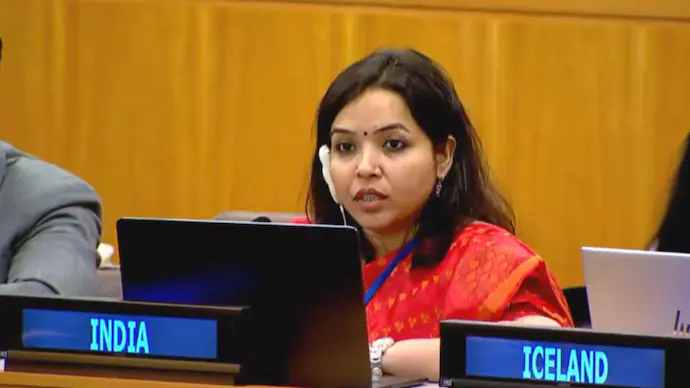
India has strongly criticised a United Nations report on the Human Rights of migrants, describing references to the country as “imprecise and unsupported” and raising concerns about geographical terminology, sourcing and the interpretation of legal obligations. During an interactive dialogue with the UN Special Rapporteur on the Human Rights of Migrants, India called for greater accuracy in country-specific claims and clearer distinctions between allegations, judicial findings and policy recommendations.
Delivering India’s statement, Barkha Tamrakar, Deputy Secretary in the Ministry of External Affairs, challenged aspects of a report prepared by Gehad Madi, the UN Special Rapporteur. She argued that unverified allegations, advocacy submissions and broad policy recommendations should not be presented as established findings of the United Nations.
India also questioned the report’s interpretation of children’s rights under international law, particularly the application of the Convention on the Rights of the Child in matters involving migration and immigration enforcement. New Delhi maintained that protecting children must go hand in hand with due process, cooperation between states and the lawful exercise of government responsibilities.
India Flags Geographical Inaccuracy in UN Migrant Rights Report
One of India’s principal objections concerned a reference in paragraph 27, footnote 32, of the report, which states: “For instance, in Assan and Northern India.” Tamrakar described the wording as a significant inaccuracy because it did not identify a specific case, legal proceeding, authority, date, law or source to support the reference.
She questioned the use of the term “Assan”, pointing out that it is not the name of an Indian state or a recognised jurisdiction. If the intended reference was Assam, she said, the report should identify the state correctly.
Tamrakar also objected to the expression “Northern India”, arguing that it does not identify a specific legal or administrative jurisdiction. In India’s view, a country-specific allegation should not rely on an apparent typographical error and an undefined geographical description.
“India must place on record a serious concern about the report’s treatment of law, evidence, and state responsibility,” Tamrakar said, emphasising the need for accuracy when the United Nations addresses the conduct or policies of individual countries.
India rejected the reference as “imprecise and unsupported” in its present form. The objection centred not only on the wording itself but also on the absence of information that would allow the claim to be identified, assessed and answered.
According to Tamrakar, if the Special Rapporteur intended to refer to citizenship-related processes in Assam, the report should have identified the precise process under discussion. It should also have distinguished between an allegation, an expert concern, an administrative decision and a judicial finding.
She stressed that these categories are not interchangeable. An allegation does not automatically establish that an event occurred, an administrative decision is not necessarily a judicial finding, and an expert concern should not be presented as a definitive legal conclusion without adequate support.
India further argued that country-specific assertions should be properly sourced and that the state concerned should have an opportunity to respond. The position reflects New Delhi’s broader concern that international human rights assessments should clearly identify the evidence supporting their conclusions.
India Challenges the Report’s Interpretation of Children’s Rights
India also raised objections to the report’s treatment of children’s rights in the context of migration. Tamrakar noted that India is a state party to the Convention on the Rights of the Child and supports the application of Articles 3, 9 and 10 in their proper legal context.
Article 3 establishes that the best interests of the child must be a primary consideration in actions concerning children. However, India argued that this principle should not automatically be treated as the only consideration in every case or as overriding all other lawful government responsibilities.
Tamrakar said the interpretation of children’s rights must account for the wider legal context, including public order, border management, criminal conduct, nationality and immigration status. India’s position was that the best interests of a child remain important but must be considered alongside the applicable legal framework and the circumstances of each case.
“India cannot accept the report’s categorical propositions as though they were universally binding legal treaty rules,” she said.
The statement challenged what India viewed as an overly broad interpretation of international treaty obligations. New Delhi argued that recommendations made by an independent mandate holder should not be treated as equivalent to binding legal rules unless they are supported by the relevant treaty provisions and applicable law.
The issue is particularly significant in migration-related cases involving children, where questions of family unity, protection, immigration status and government authority may intersect. India’s statement emphasised that legal assessments should recognise these complexities rather than apply general propositions without considering the circumstances involved.
At the same time, India reaffirmed its support for humane and lawful migration governance. Its objection was directed at what it described as an approach that treats irregular migration exclusively through the lens of vulnerability without acknowledging that it can also constitute a breach of immigration law.
The Indian position, as presented during the dialogue, was that human rights protections and the enforcement of immigration laws should be addressed within the same legal framework. It argued against treating either children’s welfare or the responsibilities of the state as automatically excluding consideration of the other.
India Calls for Three Key Corrections in the Report
Outlining India’s concerns, Tamrakar called for three key corrections in the report’s treatment of migration, legal obligations and child protection. The proposed changes focused on accuracy, clarity about the legal status of recommendations and the practical application of safeguards for children.
1. Accurate and Verifiable Country References
India’s first demand was that references to individual countries, regions and legal processes should be accurate, specific and verifiable. Tamrakar argued that geographical terminology must clearly identify the place concerned and that allegations should be supported by sufficient information to establish what is being discussed.
In the case of the reference to “Assan and Northern India”, India said the report should identify the intended location and specify the relevant case, proceeding or authority. Without such details, the government argued, it becomes difficult to assess the basis of an allegation or respond to it meaningfully.
The demand also reflects India’s insistence that international reports distinguish between information that has been verified and claims that remain unsubstantiated. Tamrakar maintained that a country-specific assessment should not rely on vague descriptions or unclear references.
2. A Clear Distinction Between Treaty Obligations and Recommendations
The second demand was for a clearer distinction between binding treaty obligations, the recommendations of an independent mandate holder and broader policy preferences. India argued that these categories should not be presented as though they carry the same legal status.
While acknowledging the importance of international human rights principles, Tamrakar objected to what she described as categorical propositions being treated as universally binding treaty rules without sufficient legal justification.
India’s position was that the report should explain the legal basis for its conclusions and identify when a statement represents a recommendation rather than a binding obligation. Such distinctions, it argued, are necessary for accurate legal analysis and constructive engagement between governments and UN human rights mechanisms.
3. Child Protection Through Due Process and Cooperation
The third demand concerned the protection of children affected by migration. India called for child protection measures grounded in due process, family-sensitive procedures and cooperation between states and child protection authorities.
Tamrakar also highlighted the importance of safe and regular migration pathways. India argued that efforts to protect children should not require governments to abandon legitimate state functions or accept generalised allegations without adequate evidence.
The approach presented by India seeks to place child welfare within a framework that also recognises the responsibilities of immigration authorities and the role of applicable law. The statement emphasised that the interests of children should be addressed through procedures that take account of family circumstances and involve the relevant authorities.
India said it would continue to engage constructively with the United Nations and other states in pursuit of these objectives.
India Emphasises Evidence, Legal Clarity and State Sovereignty
Beyond its specific objections to the report, India used the dialogue to underline the importance of evidence-based human rights assessments. Tamrakar argued that reports addressing individual countries should rely on verifiable information, accurately describe applicable law and allow the governments concerned to respond to country-specific claims.
India’s criticism focused on the distinction between documenting an allegation and establishing it as a finding. The government maintained that thematic reports should not convert unverified claims, advocacy submissions or broad policy preferences into settled conclusions attributed to the United Nations.
The statement also highlighted the relationship between international human rights engagement and the sovereign equality of states. India argued that cooperation becomes more effective when reports use accurate terminology, provide clear legal reasoning and respect the responsibilities of the countries they discuss.
Tamrakar stressed that cooperation is strengthened by accuracy and that human rights advocacy gains credibility when it is grounded in verifiable facts and applicable law.
The position does not amount to a rejection of international engagement on migrant rights. Instead, India’s statement presented its objections as a call for greater precision in how the issues are documented and how international legal principles are interpreted.
What India’s Objections Mean for the UN Migrant Rights Debate
India’s response brings several questions into focus in the broader debate over migration and human rights: how country-specific allegations should be substantiated, how treaty obligations should be distinguished from recommendations, and how child protection should be balanced with immigration enforcement and other government responsibilities.
For India, the reference to “Assan and Northern India” illustrated the need for greater geographical and legal precision. Its objection was that a report should identify the relevant jurisdiction and provide enough information for the country concerned to understand and respond to the claim.
The disagreement over children’s rights reflects a separate concern about how international legal principles are applied. India reaffirmed its support for the Convention on the Rights of the Child while arguing that its provisions should be interpreted within their proper context and should not automatically override every other lawful consideration.
India also stressed that the recommendations of an independent UN mandate holder should be clearly differentiated from binding treaty obligations. That distinction, according to the statement, is necessary to ensure that human rights assessments accurately reflect the status of the legal principles they invoke.
The report’s treatment of migration and child protection therefore became the subject of a wider discussion about evidence, legal interpretation and the responsibilities of states. India’s intervention called for an approach that combines safeguards for vulnerable people with accurate reporting, due process and respect for applicable law.
India said it would continue to engage constructively with the United Nations and other countries. Its central message was that credible human rights advocacy depends on verifiable facts, clear legal distinctions and country references that can be substantiated.
For breaking news and live news updates, like us on Facebook or follow us on Twitter and Instagram. Read more on Latest India on thefoxdaily.com.






COMMENTS 0