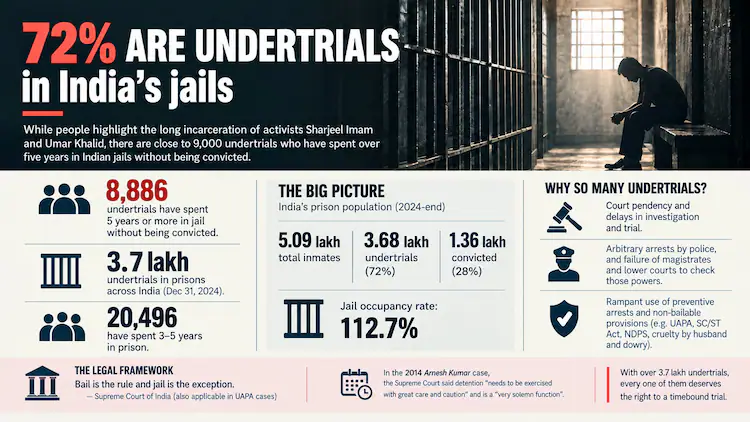
More than 8,800 undertrial prisoners in India had spent over five years in jail without being convicted of a crime as of December 31, 2024, highlighting concerns over prolonged detention, delays in criminal trials and the protection of personal liberty. According to the latest National Crime Records Bureau (NCRB) data cited in the report, nearly 72% of prisoners in India were undertrials who had not been found guilty.
The prolonged incarceration of activists Sharjeel Imam and Umar Khalid in the 2020 Delhi riots larger-conspiracy case has brought renewed attention to the issue. Both have spent around six years in jail after being arrested under the Unlawful Activities (Prevention) Act (UAPA), with their trial yet to progress as described in the source material.
However, their cases represent a much wider problem affecting thousands of people across India’s criminal-justice system. The figures show that prolonged undertrial detention extends far beyond high-profile cases, raising questions about the pace of investigations, court proceedings, bail decisions and the exercise of arrest powers.
Over 8,800 Undertrials Have Spent Five Years or More in Prison
According to NCRB data for December 31, 2024, India had approximately 3.7 lakh undertrial prisoners. Of these, 8,886 had spent five years or longer in prison without being convicted. Another 20,496 undertrials had been incarcerated for between three and five years.
These figures illustrate the scale of prolonged detention among people whose cases have not resulted in convictions. An undertrial prisoner is someone who is in custody while their criminal case remains pending, rather than someone who has been convicted and sentenced.
The report argues that focusing only on prominent cases risks overlooking the thousands of other prisoners facing similar delays. While the cases of Sharjeel Imam and Umar Khalid have become prominent in public debate, the wider undertrial population faces the same fundamental question: how long should a person remain imprisoned before their guilt is established through a trial?
After a recent interview involving Imam sparked criticism and counterarguments, graffiti reading ‘Free Sharjeel Imam’ and ‘Free Umar Khalid’ appeared at Jamia Millia Islamia and Jawaharlal Nehru University, respectively. The debate has included criticism of Imam’s views as well as concerns about the length of his incarceration and the progress of the proceedings against him.
72% of India’s Prisoners Were Undertrials in 2024
The NCRB figures cited in the report show that India’s prisons held approximately 5.09 lakh inmates at the end of 2024. Of these, around 3.68 lakh were undertrials, while approximately 1.36 lakh had been convicted of crimes.
This means that undertrials accounted for roughly 72% of the prison population. The figures also point to continuing pressure on an already overcrowded prison system.
According to the NCRB statistics cited in the report, Indian prisons operated at an occupancy rate of 112.7% in 2024, meaning the number of inmates exceeded their reported capacity.
There has been some improvement in the proportion of undertrials in recent years. Undertrials accounted for around 77% of prisoners in 2021, compared with 72% in 2024. However, the proportion remains high, leaving a substantial number of people in custody without a conviction.
How Court Delays Contribute to Prolonged Undertrial Detention
Delays in investigations and court proceedings are important contributors to prolonged undertrial detention, according to Naveed Mehmood Ahmad, Senior Resident Fellow and Lead with the Crime and Punishment Team at the Vidhi Centre for Legal Policy.
Ahmad told the publication that delays alone do not address the central question of whether detention is necessary in the first place and under what circumstances it should be authorised.
“Delays in trial should not automatically translate into prolonged detention. We must question this assumption and it is intrinsically linked with powers of arrest, the law on remand etc,” Ahmad said.
His comments highlight the relationship between the length of criminal proceedings and decisions made at the time of arrest and remand. Even when a trial takes years to conclude, detention does not automatically have to continue for the same period, according to the legal-policy expert.
Ahmad also cited NCRB data indicating that murder, offences under the Narcotic Drugs and Psychotropic Substances (NDPS) Act, attempted murder and rape accounted for almost half of all undertrial prisoners at the end of 2024.
Why Bail Becomes a Critical Issue for Undertrial Prisoners
In a criminal case, bail can determine whether an accused person remains in custody while proceedings continue. When investigations and trials take a long time, securing release becomes an immediate concern for defendants and their families.
Ahmad explained that delays often push both the prosecution and the defence to focus on immediate procedural milestones, making bail one of the most important issues during a prolonged case.
He also pointed to the reluctance of trial courts to grant bail in some cases and questioned whether certain bail tests and conditions require reconsideration. Under special laws that impose stringent conditions, obtaining bail can be particularly difficult because courts may have to make a preliminary assessment of the case against an accused person.
In July 2024, then Chief Justice of India DY Chandrachud criticised what he described as a tendency among trial judges to avoid granting bail in cases involving serious offences.
The report highlights the consequences of this approach: some undertrials may spend more time in prison awaiting trial than the sentence they might have received if convicted. Such cases raise concerns about the practical impact of prolonged detention before guilt has been established.
Supreme Court Principles on Personal Liberty and Arrests
The Supreme Court of India has repeatedly stated that bail should generally be the rule and imprisonment the exception, a principle associated with the constitutional protection of personal liberty under Article 21.
The report notes that this principle has also been invoked in cases involving the UAPA, a law used in certain cases involving alleged unlawful and terrorist activities. However, critics argue that the practical application of bail principles can differ from their stated judicial emphasis, particularly when stringent legal provisions apply.
Article 21 of the Constitution protects life and personal liberty. Article 22 provides safeguards relating to arrest and detention, while Article 32 provides a constitutional remedy for enforcing fundamental rights before the Supreme Court.
These provisions form part of India’s constitutional framework for protecting individual freedoms. The report argues that their practical effectiveness depends in part on how arrest powers are exercised and how carefully courts examine requests for detention.
Supreme Court Warning on Routine Detention Orders
The report points to the Supreme Court’s 2014 judgment in Arnesh Kumar v. State of Bihar, which emphasised the responsibility of judges and magistrates when authorising detention.
The court described the power to authorise detention as a serious responsibility requiring careful consideration. It also warned that detention was being authorised routinely in some cases.
“In many of the cases, detention is authorised in a routine, casual and cavalier manner,” the Supreme Court said.
The report argues that the first judicial decision following an arrest can have far-reaching consequences. If detention is authorised and bail is subsequently denied, the accused may spend an extended period in prison while the case moves slowly through the system.
India records around 50 lakh arrests annually, according to the report. This places significant responsibility on the magistrates and judges who initially review detention requests and determine whether custody should continue.
Why Some Undertrials Remain in Jail for Years
The report identifies several factors that can contribute to prolonged undertrial detention:
- Delays in investigations and trials: Cases can remain pending for extended periods, leaving accused people in custody while proceedings continue.
- Arrest and remand decisions: The use of arrest powers and the decisions made when detention is authorised can affect how long an accused person remains in prison.
- Challenges in obtaining bail: Courts may be reluctant to grant bail, while stringent legal tests and conditions can make release more difficult.
- Special laws with restrictive bail provisions: Certain laws, including the UAPA, contain provisions that can make securing bail particularly challenging.
- Preventive detention and arrest practices: The report argues that the use of preventive measures and potentially arbitrary arrests adds to the wider problem.
The report also points to non-bailable provisions under several laws, including those concerning cruelty by husbands and dowry, the Scheduled Castes and Scheduled Tribes (Prevention of Atrocities) Act, and the UAPA. It argues that the application of such provisions requires scrutiny to prevent misuse and unnecessary detention.
Legal Provisions for Releasing Eligible Undertrial Prisoners
Indian law contains provisions intended to help certain undertrial prisoners obtain release after spending a substantial part of the maximum possible sentence in custody. The report notes that eligible prisoners who have served half the prison term they would receive if convicted can benefit from such provisions, subject to the applicable legal requirements and exceptions.
In 2014, the government also undertook an effort to release eligible prisoners without making release dependent on the progress of their trials, according to the source material.
However, the continued presence of thousands of undertrials who have spent years in prison indicates that legal safeguards do not eliminate the problem. Their effectiveness depends on identifying eligible prisoners and ensuring that the relevant legal provisions are applied.
Why the Cases of Sharjeel Imam and Umar Khalid Matter
Sharjeel Imam and Umar Khalid have become prominent examples in discussions about prolonged undertrial detention because of the time they have spent in custody in connection with the 2020 Delhi riots larger-conspiracy case.
Both were arrested under the UAPA and, according to the report, have spent around six years in jail while their trial has yet to progress as expected. Their cases have prompted public debate over the relationship between allegations of serious offences, national security laws, bail and the right to a timely trial.
The debate surrounding their incarceration has also revealed a broader issue. The concern is not limited to whether a particular accused person should be released, but extends to the treatment of people across the criminal-justice system who remain in prison without conviction.
The report argues that prolonged detention should be examined through consistent legal principles rather than attention being concentrated on a handful of high-profile cases. The 8,886 undertrials who had spent at least five years in prison by the end of 2024 represent a much wider challenge for India’s courts, police and prison authorities.
Conclusion: India’s Undertrial Crisis Needs Systemic Attention
The figures cited in the report show that prolonged undertrial detention remains a significant challenge in India. With nearly 3.7 lakh undertrials in prison at the end of 2024 and 8,886 having spent five years or longer behind bars without conviction, the issue extends well beyond individual cases.
Court delays are part of the problem, but the report also points to arrest practices, remand decisions, bail restrictions and the use of special laws as factors requiring attention. The role of magistrates and trial courts is particularly important because early detention decisions can shape the course of a case for years.
The constitutional protection of personal liberty and the principle that bail should generally be the rule are central to the debate. Addressing prolonged detention requires attention to the rights of accused people, the seriousness of the allegations involved and the need for timely judicial proceedings.
The cases of Sharjeel Imam and Umar Khalid have drawn public attention to these questions. The wider figures, however, show why the issue cannot be confined to two individuals: thousands of undertrial prisoners have spent years in custody without being convicted, making the functioning of the criminal-justice system a matter of broader concern.
About the Author
Yudhajit Shankar Das
Yudhajit Shankar Das is a journalist with 18 years of experience. He writes about news and current affairs and enjoys cycling in Delhi and travelling away from the city. Northeast India remains a particular source of inspiration for him.
For breaking news and live news updates, like us on Facebook or follow us on Twitter and Instagram. Read more on Latest India on thefoxdaily.com.






COMMENTS 0