‘Bhaag Neha Bhaag, Jantar Mantar Chalo’: Delhi Protests Inspire Online Games Featuring Protesters and Police
Demonstrations at Delhi’s Jantar Mantar have inspired a series of free online games that allow players to take on the roles of protesters and police personnel. From dodging barricades and tear gas to collecting virtual points for democracy and accountability, the games transform recent political developments into interactive, satirical experiences.
Protests at Jantar Mantar in New Delhi have found an unexpected new platform: online video games. Developers have created free browser-based gaming experiences inspired by demonstrations in the national capital, allowing players to participate in virtual versions of confrontations between protesters and police.
The games draw on scenes, personalities and events associated with recent demonstrations. Players can organise crowds, march towards protest sites, avoid police action or attempt to detain demonstrators, depending on the game and the role they select.
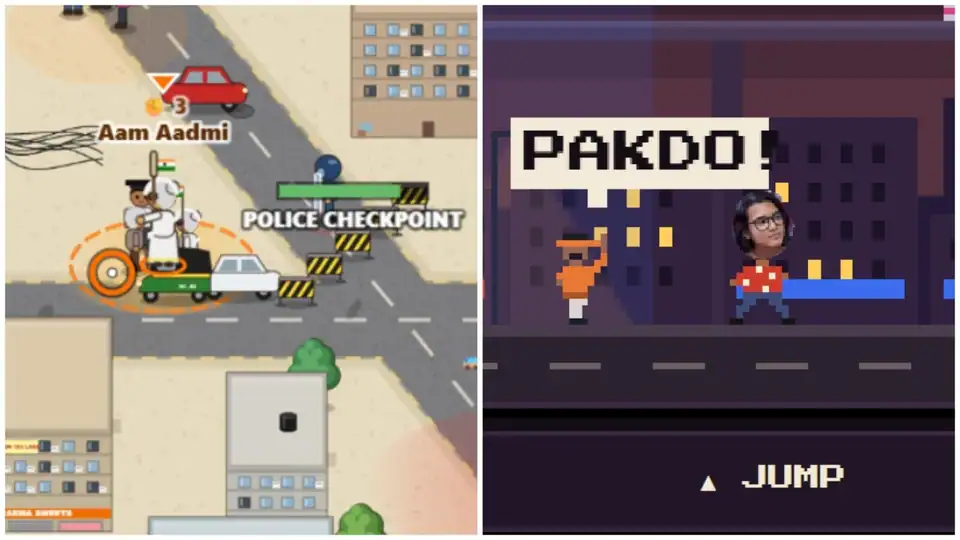
Among the titles attracting attention are ‘Jantar Mantar Chalo’, ‘Bhaag Neha Bhaag’ and ‘Jantar Mantar to Jail’. Each takes a different approach to turning political developments into interactive entertainment, combining satire, familiar public figures and gameplay inspired by demonstrations.
The games have also highlighted how political events can quickly move beyond traditional news coverage and social media discussions to inspire digital content. For their creators, the demonstrations provided material for projects that blend gaming, humour and commentary on public affairs.
‘Bhaag Neha Bhaag’ draws inspiration from repeated detentions
One of the games, ‘Bhaag Neha Bhaag’, was created by 30-year-old screenwriter and filmmaker Anav Nayar. He co-founded Wizloop Studios with his brother, Akshay Nayar. According to PTI, the company focuses on content strategy, intellectual property for brands and the creative use of artificial intelligence.
Nayar said the idea emerged as he followed reports about Neha Bora, identified in the supplied report as the national president of the All India Students’ Association (AISA), and other protesters attempting to reach Jantar Mantar.
According to Nayar, the repeated attempts to reach the protest site, followed by detentions and renewed efforts to return, prompted the brothers to consider how those events could be translated into a game.
“We were following how Neha Bora and other protesters were trying to reach Jantar Mantar. They were detained but the very next day, they were back at the spot. My brother Akshay asked me how they were managing to do it, and that got me thinking about creating a game around it,” Nayar told PTI.
The brothers named the game ‘Bhaag Neha Bhaag’, drawing inspiration from the 1998 German film Run Lola Run, which they count among their favourite films.
The title and concept turn the challenge of reaching a demonstration into the central idea of the gaming experience. Rather than simply reproducing a news report, the game uses a familiar video-game format to reinterpret events that have circulated through news coverage and social media.
The project reflects a broader creative approach in which current affairs become the starting point for short, accessible digital experiences. In this case, repeated attempts to reach a protest site provide the narrative framework for a game built around movement, obstacles and the determination to reach a destination.
‘Jantar Mantar Chalo’ lets players choose sides
Another game, ‘Jantar Mantar Chalo’, was developed by Suraj Kushwah, a 27-year-old resident of Bareilly who works at a cloud gaming company. He told PTI that the idea came to him while watching news coverage of the demonstrations.
“I was watching the news and, out of sarcasm, thought of making a game around it,” Kushwah told PTI.
Kushwah, who has an interest in technology and gaming, used artificial intelligence tools alongside his knowledge of game development to build the project in approximately a day and a half.
The game gives players a choice between two opposing roles: protesters attempting to gather people and march towards Jantar Mantar, or Delhi Police personnel trying to detain demonstrators.
Players who choose the protester role must build up a crowd and move towards the demonstration site. As the crowd grows, the player becomes more powerful within the game’s mechanics. Those playing as police personnel have a different objective: detaining as many protesters as possible.
This two-sided format places the player inside a simplified virtual version of the confrontations associated with demonstrations. Instead of watching events unfold from the outside, users actively influence the game’s progression through their decisions and actions.
Tear gas, water cannons and media coverage shape gameplay
‘Jantar Mantar Chalo’ incorporates several elements associated with crowd-control operations and public demonstrations. Tear gas slows down protesters, while water cannons create additional obstacles for players trying to move towards their destination.
The game also introduces more unusual interactions. Players can dance in front of water cannons and engage with media personnel through interviews, adding a satirical dimension to the virtual protest environment.
Media coverage is another part of the game’s mechanics. Interviews can increase a protester’s influence and help attract more people to the gathering. In this way, the game treats publicity as a resource that can affect the size and strength of a demonstration.
The virtual map includes several recognisable locations, including police stations, detention centres, India Gate and the Badarpur border. These locations help establish the setting and provide a digital backdrop for the player’s progress.
By combining crowd-building, movement, obstacles and media interactions, the game turns elements of protest management into a series of objectives. The mechanics are presented through a satirical lens rather than as a detailed simulation of real police procedures or demonstrations.
Kushwah initially developed the game as a sarcastic response to the news coverage. However, the attention it received encouraged him to consider further development.
“I made it as a sarcastic take, but now that it is getting so much attention; I am looking at updating it further,” he said.
His comments suggest that the game’s development may continue beyond its initial version as its creator responds to audience interest.
‘Jantar Mantar to Jail’ turns political satire into a game
The Nayar brothers also developed ‘Jantar Mantar to Jail’, another game inspired by the demonstrations. It features Cockroach Janta Party (CJP) members Abhijeet Dipke, Saurav Das and Ashutosh Ranka.
Players can choose one of the three characters and attempt to navigate a series of obstacles. These include falling jail bars and police personnel dressed in orange kurtas, creating a challenge centred on avoiding capture and progressing through the game.
The game also uses coins representing “accountability” and “democracy” as collectibles. These items give the gameplay a political theme, turning abstract public values into rewards that players can gather while avoiding obstacles.
Its title establishes a satirical connection between a protest site and the possibility of detention. The combination of recognisable personalities, exaggerated obstacles and symbolic collectibles gives the game a style distinct from conventional action or adventure titles.
Like the other projects, ‘Jantar Mantar to Jail’ draws its central idea from political developments and public demonstrations. Rather than focusing on realistic graphics or complex gameplay systems, it uses humour and familiar political references to communicate its theme.
Another game features Chief Election Commissioner Gyanesh Kumar
The wave of protest-inspired gaming has extended beyond the demonstrations at Jantar Mantar themselves. Another game linked to the protests features Chief Election Commissioner Gyanesh Kumar and turns a satirical act involving a tap on his head into a scoring mechanic.
The game adds another example of how political figures and moments from public debate can be incorporated into interactive digital experiences. As with the other titles, the concept relies on the audience recognising the personalities and events that inspired the gameplay.
Together, these projects show the range of formats developers can use when responding to current affairs. Some focus on reaching a protest site, others on avoiding detention, while another builds its central mechanic around a satirical reference to a public figure.
What protests inspired the games?
The games emerged against the backdrop of demonstrations involving student groups, political organisations and other protesters in Delhi. According to the supplied report, protests in June and July included a march towards Parliament on July 20, with demonstrators demanding the resignation of Union Education Minister Dharmendra Pradhan over recurring examination paper leaks and student suicides.
The report states that Pradhan was forced to resign more than a month later. The demonstrations formed part of a wider debate over examination security, student welfare and accountability in the education system.
The groups returned to the streets in October, joining opposition parties and student organisations in protests seeking the resignation of Chief Election Commissioner Gyanesh Kumar. The demonstrators raised allegations concerning the functioning of the Election Commission and the Special Intensive Revision (SIR) of electoral rolls.
The allegations and demands became part of the political debate surrounding the protests. The gaming projects subsequently drew on the images, videos and online discussions generated by the demonstrations.
The games do not replace the underlying political disputes or establish the merits of the claims raised by demonstrators. Instead, they transform elements of the events into interactive formats that depend on satire, public recognition and simplified gameplay.
How current affairs are becoming interactive entertainment
The popularity of protest-inspired games illustrates how quickly news events can become material for online entertainment. Social media already allows images, short videos and commentary to circulate widely; browser-based games add another format through which audiences can engage with events.
In these projects, the connection to current affairs is built directly into the gameplay. Players do not merely read about demonstrations or watch footage of police and protesters. They can take on virtual roles, navigate obstacles and influence the outcome of a simplified scenario.
Artificial intelligence tools may also make it easier for individual developers to experiment with game concepts and produce early versions quickly. Kushwah said he used AI tools and his gaming knowledge to develop ‘Jantar Mantar Chalo’ in about a day and a half.
However, the speed of development does not necessarily make these games comprehensive accounts of the events that inspire them. Their emphasis is on satire and entertainment, and their mechanics reduce complex political and legal questions to objectives, obstacles and rewards.
For audiences familiar with the demonstrations, the references can make the games immediately recognisable. For others, understanding the jokes and characters may require familiarity with the protests and the political debates surrounding them.
Political satire finds a new digital format
From ‘Bhaag Neha Bhaag’ to ‘Jantar Mantar Chalo’ and ‘Jantar Mantar to Jail’, the games demonstrate how developers are using digital platforms to respond creatively to political events. Each project takes a different part of the protest narrative and adapts it into a playable experience.
The titles combine recognisable locations, references to public figures, police-related obstacles and satirical objectives. Their development also highlights how independent creators can use existing gaming knowledge and emerging AI tools to turn a topical idea into an online project in a short period.
The demonstrations at Jantar Mantar generated extensive public discussion, and that attention has now extended into gaming. The resulting projects offer a distinctive form of Political Satire, transforming the familiar language of protests, detentions and public accountability into interactive digital experiences.
For breaking news and live news updates, like us on Facebook or follow us on Twitter and Instagram. Read more on Latest India on thefoxdaily.com.






COMMENTS 0