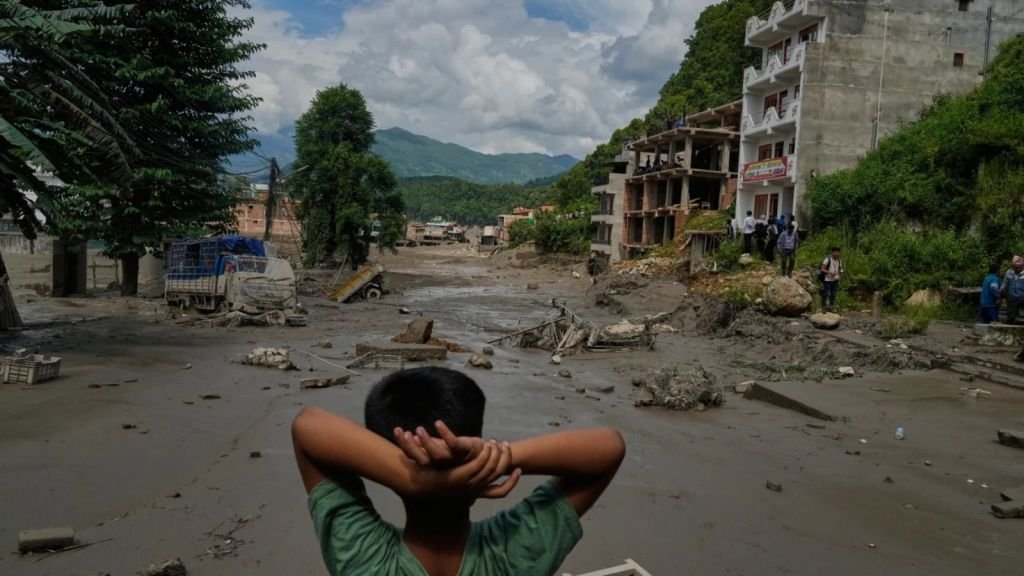
India’s news agenda on Thursday, August 27, 2026, stretches from a devastating Natural Disaster along the Nepal-Tibet border to questions about who represents young Indians in Politics. The Nepal floods have put the increasingly popular Rasuwa route to Kailash Mansarovar under scrutiny, while families continue to wait for information about missing pilgrims.
At home, another set of stories raises questions about institutions and accountability. A Mumbai Metro viaduct built at a reported cost of around Rs 250 crore could face demolition following a construction error. The Maharashtra Public Service Commission has cancelled its Drug Inspector recruitment process after an alleged question-paper leak, while the BJP faces questions about organisational fatigue and its relationship with younger voters.
Beyond politics and infrastructure, the day’s developments also include an extraordinary insolvency case involving creditors of Subhash Chandra, a major Test Cricket performance by Manav Suthar, continuing debate around Yash’s Toxic, and fresh conversations around casting, cinema and military history.
Nepal floods put the Rasuwa Kailash Mansarovar route under the spotlight
The most urgent story remains the devastation caused by flash floods in Nepal’s northern border region. The disaster has also highlighted the growing importance of the Rasuwa-Rasuwagadhi route, which has emerged as a popular private gateway for pilgrims travelling towards Kailash Mansarovar.
The route’s popularity is closely connected to the geography of the pilgrimage. Travellers crossing through the region face difficult mountain terrain and high-altitude conditions before reaching the Kailash Mansarovar area. The journey itself can be physically demanding, with altitude reducing the amount of oxygen available to the body and making even routine movement considerably harder.
For Indian pilgrims, the current disaster has transformed what was a pilgrimage route into a crisis corridor. Families are trying to establish the whereabouts of travellers who were caught in the floods, while the scale of the disruption has renewed attention on the risks associated with increasingly popular private Travel routes.
Missing pilgrims add a human dimension to the disaster
Several groups of Indian travellers were in the region when floodwaters surged through the area. The disappearance of pilgrims who had reached the Immigration centre shortly before the flooding has left families waiting for information.
The crisis has also prompted appeals for access to the affected area from people connected to the pilgrimage groups. The immediate priority remains locating missing people and supporting those who have survived, while authorities deal with damaged roads, difficult terrain and disrupted connectivity.
The disaster illustrates a broader problem with high-altitude travel: a route that may appear manageable under normal conditions can become extremely dangerous when flash floods, landslides or sudden changes in mountain weather occur.
India’s young population, but an older political class
Another story highlighted by the day’s news agenda concerns the representation of young Indians in elected politics. India has one of the world’s youngest populations, yet relatively few of its MPs and MLAs are aged 40 or below.
According to the data highlighted in the report, only 384 MPs and MLAs across the country fall into that age group. The figure raises a basic question: how closely does India’s political class reflect the generation that makes up a large part of the country’s population?
The issue is not simply about age. Political representation also reflects the ability of younger people to enter established parties, raise campaign resources, build organisations and secure nominations. Family connections can provide an advantage, and the report notes that roughly one in three young legislators comes from a political family.
Why the Gen Z disconnect matters
The gap between the age profile of voters and elected representatives can have consequences for political communication. Younger voters are more likely to encounter politics through social media, short-form video and digital platforms, while political organisations still depend heavily on established structures and older leadership networks.
That does not automatically mean younger politicians would produce better governance. Experience can matter, particularly in complex areas such as administration, lawmaking and economic policy. But a legislature with relatively few younger members can still create a perception that political institutions are distant from the concerns of younger citizens.
The bigger challenge is therefore not simply bringing down the average age of politicians. It is creating credible pathways through which young people without established political backgrounds can enter public life.
BJP faces questions over organisation, fatigue and younger voters
The generational question is also relevant to the BJP, which has dominated national politics for more than a decade. The party is confronting questions around organisational changes, internal expectations and signs of fatigue as it prepares for future electoral contests.
Electoral strength does not automatically eliminate the need for organisational renewal. Parties that remain in power for long periods must continually manage leadership expectations, local organisations and relationships with different voter groups.
The challenge becomes particularly significant when younger voters begin looking for political identities and issues that are different from those that shaped previous electoral cycles. Reconnecting with this group requires more than campaign messaging; it also involves understanding how younger Indians experience employment, education, technology, social mobility and political participation.
A Rs 250-crore Mumbai Metro mistake could lead to demolition
One of the day’s most striking infrastructure stories concerns an elevated section of Mumbai Metro 7A that could face demolition because of a construction error.
The reported cost of the affected viaduct is around Rs 250 crore, making the possibility of dismantling and rebuilding the structure more than an engineering problem. It raises questions about planning, supervision, quality control and the financial consequences of correcting mistakes after major public infrastructure has already been built.
Large transport projects involve multiple stages of design, approval, construction and inspection. An error that survives several stages of that process can become dramatically more expensive to correct once a structure has been completed.
Why demolition is more than a construction issue
If a major Metro structure has to be removed, the consequences extend beyond the cost of rebuilding it. Construction schedules can be affected, surrounding works may have to be modified and public confidence in project oversight can take a hit.
The episode also illustrates why infrastructure projects need robust checks before construction reaches an irreversible stage. Spending money to correct an error after completion is fundamentally different from identifying the same problem during design or early construction.
Maharashtra Drug Inspector exam scam takes an unusual turn
The Maharashtra Public Service Commission’s Drug Inspector recruitment controversy has developed into a wider investigation following allegations of a leaked question paper.
The case took an unusual turn after a relationship between a woman candidate and a man who later became a whistleblower reportedly broke down. Investigators are examining claims that the candidate obtained the question paper before the examination and subsequently shared it with her boyfriend.
The allegations also involve a coaching-class operator who is accused of being part of the chain through which the paper was obtained. Six people have reportedly been arrested, including an MPSC Additional Secretary and other officials.
The investigation expanded after questions were raised about the examination results and interview-selection process. Authorities are examining digital evidence and the circumstances surrounding competing claims made by people connected to the alleged leak.
MPSC cancels the recruitment process
The MPSC has cancelled the entire recruitment process for Group-B Drug Inspector posts under the Food and Drug Administration. A fresh examination is expected to be held.
Candidates who applied for the original examination will not have to submit new applications or pay another examination fee, according to the information provided. The re-examination date has not yet been announced.
The episode demonstrates how a recruitment examination can be damaged even before questions about individual candidates are finally resolved. Once the integrity of the examination process is challenged, authorities must establish not only whether a leak occurred but also how far the alleged leak travelled and whether the final selection process was compromised.
How creditors ended up with a 99.97% haircut in the Subhash Chandra case
An extraordinary financial story concerns the insolvency proceedings involving businessman Subhash Chandra. Creditors had claims running into tens of thousands of crores, yet the approved resolution left them with only a tiny fraction of the amount they had sought to recover.
The reported 99.97% haircut illustrates the difference between the value of a claim and the amount that can actually be recovered through insolvency proceedings. A creditor may have a legally recognised claim worth thousands of crores, but that does not mean the underlying assets can generate an equivalent recovery.
Such cases are particularly significant because they show how insolvency processes distribute losses when a heavily indebted Business cannot meet its obligations. The outcome can be shaped by asset values, competing claims, the viability of the business and the terms of the resolution plan.
Lucknow’s unfinished Rs 800-crore project raises another infrastructure question
Another public-project story focuses on a development in Lucknow that has reportedly seen around Rs 800 crore spent while remaining unfinished.
The case raises a familiar question for large infrastructure and urban-development projects: what happens when substantial public money has already been spent but the original objective has not been completed?
For citizens, unfinished projects can represent more than wasted construction. They can mean land that remains underused, delayed public benefits and additional expenditure if authorities later decide to revive, redesign or complete the project.
Manav Suthar’s 10 wickets come with a lesson from Colombo
In cricket, Manav Suthar’s 10-wicket haul in Galle marked an important performance from a young bowler. But his more difficult outing in Colombo offers a different lesson about Test Cricket.
A breakthrough performance can establish a player’s potential, but the ability to respond when conditions become less favourable is what ultimately tests a cricketer. For a young spinner, adaptation can involve changes in pace, trajectory, length and tactical approach depending on the pitch and opposition.
The contrast between the two outings therefore makes the Colombo performance relevant in its own way. Ten wickets can announce a talent; learning from a less successful match can help determine how that talent develops.
Why Yash’s Toxic is facing a rating controversy
The discussion around Yash’s Toxic has extended beyond the film’s reception into a debate about its BookMyShow rating and the visibility of audience response online.
Social media users have questioned the disappearance of the rating and debated whether the level of support surrounding the film accurately reflects organic audience sentiment. Such debates can become almost as prominent as the film itself when a major release attracts an intensely engaged fan base.
The broader issue is that online ratings are increasingly treated as shorthand for public opinion, even though they can be affected by timing, review volume, platform practices and organised activity. A rating can offer a useful snapshot, but it should not automatically be treated as a definitive measurement of a film’s long-term reception.
Mukesh Khanna draws a line over Shaktimaan casting
Actor Mukesh Khanna has again spoken about who should play the iconic superhero Shaktimaan, saying that he does not believe Ranveer Singh is suited to the title role. Khanna has instead suggested that Singh could be better suited to playing a villain.
The debate reflects how strongly audiences associate established characters with the actors who originally portrayed them. For filmmakers, rebooting a beloved property involves balancing nostalgia with the need to introduce the character to a new generation.
The casting discussion is therefore about more than one actor. It highlights the difficulty of remaking characters whose identities have become deeply connected to a particular performer.
Shah Rukh Khan and the story behind Deool Band 2
The makers of Deool Band 2 have said Shah Rukh Khan stepped in at an important stage in the film’s journey. The film later crossed the Rs 100-crore mark, after which its makers decided to donate the entire profit.
The episode adds an unusual philanthropic dimension to the film’s commercial story. It also demonstrates how support from an established figure can become significant for a project during a difficult phase, particularly when the intervention comes at a critical point.
A Kargil memory recalls the danger behind Operation Safed Sagar
A recollection from the Kargil War revisits the experiences of Indian Air Force pilots during Operation Safed Sagar, including the use of MiG-21 aircraft and the dangers faced during combat sorties.
Small operational details can sometimes reveal the intensity of military operations more clearly than broad descriptions. Memories of aircraft, missions and the physical hazards faced by pilots help connect the historical record of the conflict with the experiences of those who participated in it.
Other stories drawing attention
Several other developments are also shaping the day’s news cycle.
- Maharashtra has given non-Marathi auto and taxi drivers a year to learn Marathi following protests and concerns over immediate language compliance.
- A viral confrontation in Greater Noida has led to allegations of caste abuse and police action.
- The Bombay High Court has ruled in favour of elderly parents seeking possession of their Pune home from their adult son, highlighting the importance of their right to live peacefully in their property.
- A controversy involving a Rajasthan judge has gained another dimension after lawyers reportedly sought his removal shortly before serious allegations became public.
- A model was found stabbed to death at her West Delhi home, with a gym trainer arrested in connection with the investigation.
What connects these stories?
At first glance, the day’s headlines have little in common. A flood in Nepal, young politicians in India, a Metro construction error, an examination scam, an insolvency case and a cricket match belong to entirely different worlds.
Yet many of them revolve around the same underlying questions: accountability, preparedness and trust.
The Nepal disaster has highlighted the vulnerability of travellers in difficult terrain and the importance of reliable information during emergencies. The MPSC controversy raises questions about whether competitive examinations can be protected from leaks. The Mumbai Metro episode puts project oversight under the microscope, while the Subhash Chandra insolvency case demonstrates how dramatically financial claims can shrink when recoveries are determined by the actual value of available assets.
The political stories point to another form of trust: whether institutions and parties can keep pace with a changing electorate. India may have a young population, but its political representation remains considerably older and frequently connected to established political families.
Taken together, the day’s stories offer a snapshot of a country and region dealing simultaneously with natural disasters, institutional failures, political change, infrastructure challenges and rapidly evolving public expectations. The details differ from one headline to another, but the consequences ultimately come back to the same issue: how effectively institutions respond when people depend on them most.
For breaking news and live news updates, like us on Facebook or follow us on Twitter and Instagram. Read more on Latest World on thefoxdaily.com.






COMMENTS 0