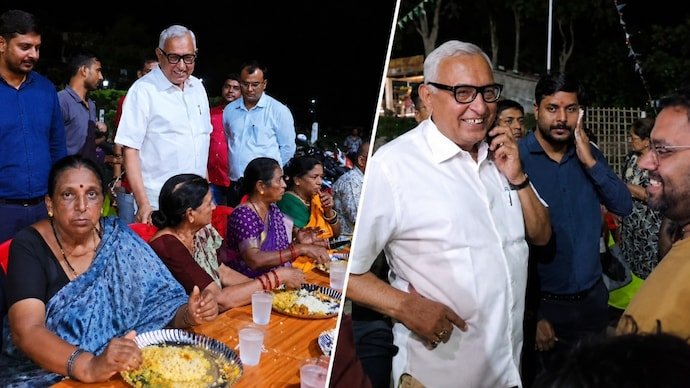
A video of Sitamarhi MP Devesh Chandra Thakur speaking fluent Marathi while helping Maharashtra pilgrims returning from flood-hit Nepal has gone viral, drawing attention not only to the Bihar politician’s command of the language but also to the circumstances behind it.
Thakur, a Janata Dal (United) Lok Sabha MP from Sitamarhi, was involved in arrangements for 106 pilgrims from Maharashtra who entered Bihar after fleeing the devastating floods in Nepal. The pilgrims were provided food, shelter and medical assistance before arrangements were made for their onward journey to Maharashtra.
In one widely shared video, Thakur is seen interacting with the pilgrims and responding in Marathi as they praised the food prepared for them. In another, he spoke to Maharashtra Chief Minister Devendra Fadnavis over the phone in Marathi while discussing arrangements to help the group travel onward.
The videos attracted attention because Thakur is a Bihar politician speaking the language of Maharashtra with considerable ease. But his fluency is not a recent political performance or a language learned for the occasion. It is rooted in several decades of his personal, educational, professional and political connections with Maharashtra.
Who is Devesh Chandra Thakur?
Devesh Chandra Thakur was born in Sitamarhi in Bihar but spent an important part of his formative years in Maharashtra.
He studied at Sainik School in Nashik before moving to Pune for higher education. He completed his BA Honours from Fergusson College and later obtained a law degree from ILS Law College in Pune.
His connection with Maharashtra was not limited to education. Thakur entered student politics in Pune and contested a students’ union election at the then University of Pune, now known as Savitribai Phule Pune University.
His political involvement subsequently expanded into Maharashtra’s Congress organisation. According to his public profiles, he served on the Maharashtra State Youth Congress Committee during the 1970s and later became associated with the Maharashtra State Congress Committee.
He also served as vice-president of the Maharashtra Pradesh Youth Congress and developed political relationships with prominent Maharashtra leaders, including former chief ministers Vilasrao Deshmukh and Sushilkumar Shinde.
Those years help explain why Marathi appears to come naturally to Thakur. His familiarity with the language developed through prolonged exposure to Maharashtra rather than through a short-term attempt to appeal to a particular audience.
Why Thakur was speaking Marathi to Maharashtra pilgrims
The immediate reason for the viral videos was a humanitarian situation.
The 106 pilgrims were among travellers affected by the devastating floods and landslides in Nepal. After crossing into Bihar through the Sitamarhi region, they needed a safe place to rest before continuing their journey home.
The district administration arranged accommodation and food and provided medical assistance. Officials also worked on transportation arrangements to help the pilgrims reach Nagpur.
Thakur became involved in facilitating the arrangements, putting him directly in contact with people from Maharashtra who had just experienced a frightening journey.
In that setting, speaking Marathi had a practical value. It allowed the MP to communicate with the pilgrims in the language they were most comfortable using and helped establish an immediate sense of familiarity.
One of the viral videos showed a woman praising the Maharashtrian food provided to the group. Thakur responded to her comments, reinforcing the idea that the food had been prepared with care.
Another video showed Thakur speaking to Fadnavis in Marathi while discussing the pilgrims’ onward journey and efforts to arrange additional railway accommodation.
The exchanges were simple, but their emotional impact was much larger because they occurred at a moment when the pilgrims were far from home and had just escaped a Natural Disaster.
Thakur’s Maharashtra connection goes back decades
The explanation for Thakur’s Marathi fluency is found in his biography.
He spent his school and college years in Maharashtra, lived in Pune and became involved in local student politics. His political career also included years of engagement with Maharashtra’s Congress organisation.
That history created the kind of everyday exposure to Marathi that cannot easily be acquired through formal language lessons alone.
His long-standing connections with Maharashtra also continued after he shifted his political base to Bihar.
In 2024, a Times of India profile described the unusual perception surrounding Thakur: people in Bihar could see him as having strong Maharashtrian connections, while people in Mumbai and Pune could regard him as distinctly Bihari.
That dual familiarity is significant because language is often closely tied to identity. Thakur’s career illustrates that linguistic identity in India does not necessarily follow state borders.
From Maharashtra politics to Bihar’s political landscape
Thakur’s political career eventually became firmly rooted in Bihar.
He entered the Bihar Legislative Council in 2002 and later served as chairman of the council from August 2022 until he moved to national politics.
He subsequently entered the Lok Sabha from Sitamarhi, becoming a national-level representative of his home state.
Yet his earlier years in Maharashtra remained part of his personal history. His ability to speak Marathi is therefore better understood as a reflection of that long connection than as a political gesture designed for Social Media.
That background became relevant when he found himself helping Maharashtra residents during an emergency.
The Nepal floods created a humanitarian challenge
The pilgrims arrived in Bihar after a major disaster in Nepal that struck on August 26 near the Nepal-Tibet border.
The catastrophe involved powerful flows of water, mud, rock and debris and caused widespread destruction in parts of the region. The disaster disrupted transport and left travellers attempting to find safe routes out of affected areas.
For the Maharashtra pilgrims who eventually crossed into Bihar, reaching Indian territory was only one part of the journey. They still needed accommodation, food, medical attention and reliable transportation to return home.
Sitamarhi’s proximity to the Nepal border made Bihar an important transit point for people leaving the affected areas.
The disaster also raised concerns in Bihar because several rivers originating or flowing through Nepal feed into the state. Rivers including the Gandak, Bagmati, Kamla Balan and Kosi are closely connected to rainfall and water conditions across the border.
Bihar authorities consequently remained alert in vulnerable northern districts. The National Disaster Response Force reported no major adverse impact in Bihar directly attributable to the Nepal floods, but the situation underscored the importance of cross-border disaster monitoring.
Why the videos struck a political chord
The videos emerged at a particularly sensitive time in India’s debate over language.
Maharashtra has periodically witnessed political disputes over the use and status of Marathi, particularly in Mumbai and other urban areas where migrants from across India live and work.
Questions about whether workers, shopkeepers, drivers and other service providers should use Marathi have repeatedly generated political controversy.
A recent directive concerning the language skills of autorickshaw and taxi drivers in Mumbai also triggered debate, with the state government subsequently giving drivers additional time to learn Marathi.
Against this backdrop, footage of a Bihar MP speaking fluent Marathi naturally attracted attention online.
For some social media users, the videos represented linguistic harmony: a politician from Bihar communicating effortlessly in the language associated with Maharashtra while helping Maharashtrian citizens.
Others focused on the contrast with episodes in which migrants from Bihar and other states have faced political pressure over language and identity in Maharashtra.
That contrast helped turn an ordinary humanitarian interaction into a broader conversation about how language is used in Indian Politics.
Language as identity versus language as connection
India’s linguistic diversity can sometimes become a source of political tension, but it is equally capable of creating connections between communities.
Thakur’s story provides an example of the latter.
He is a politician from Bihar who spent formative years in Maharashtra, became involved in the state’s student politics and learned Marathi through everyday life. Decades later, that knowledge became useful while helping people from Maharashtra during an emergency.
There is an important distinction between demanding that someone speak a particular language and choosing to speak another language out of familiarity, respect or empathy.
In the case of the pilgrims, Marathi was not being used as a test of identity. It was being used as a bridge.
For people who had just escaped a disaster in a foreign country and were temporarily dependent on officials in another Indian state, hearing their own language from someone helping them could provide reassurance.
The emotional power of speaking someone’s language
Language has a practical function, but during a crisis it can also have an emotional one.
A person who is frightened, exhausted or uncertain about what happens next is likely to feel more comfortable when communication takes place in a familiar language. Even a short conversation can reduce the sense of distance between strangers.
That appears to be part of what made the videos resonate.
The story was not simply that a Bihar MP knew Marathi. It was that the language was being used at a moment when people needed reassurance and practical assistance.
The pilgrims were not visiting Maharashtra or attending a political event. They were trying to get home after escaping a natural disaster.
In that context, Thakur’s ability to speak Marathi became an expression of familiarity rather than a political slogan.
What the episode says about India’s multilingual society
India’s political boundaries and linguistic boundaries rarely align perfectly. Millions of people study, work, conduct business and build families outside the states where their mother tongues are traditionally spoken.
That movement creates multilingual communities across the country.
A person born in Bihar can grow up in Maharashtra. Someone from Maharashtra can build a career in Delhi. A person from Tamil Nadu can spend decades working in Gujarat. Over time, languages travel with people, and individuals often acquire languages that are not their mother tongues.
Thakur’s biography is an example of that process.
His command of Marathi is not unusual when viewed through the lens of his personal history. What is unusual is that his language skills became visible to a national social media audience during a humanitarian incident.
Beyond the viral moment
Social media often turns small moments into symbols of larger debates. The videos involving Thakur and the Maharashtra pilgrims have done exactly that.
One interpretation focuses on the contrast between linguistic politics and linguistic solidarity. Another sees the episode simply as an example of a public representative using a language he knows to help people who needed assistance.
Both interpretations point to the same underlying reality: language can be political, but it can also be deeply personal.
For Thakur, Marathi is connected to his school years, education, student politics and professional relationships in Maharashtra. For the pilgrims, it was the language they carried with them while travelling home from a disaster.
The significance of the episode therefore lies less in the fact that a Bihar MP can speak Marathi and more in how that ability was used.
When Marathi became a language of reassurance
The 106 Maharashtra pilgrims needed something far more immediate than a political argument about language. They needed food, shelter, medical support and a safe route home.
Bihar’s administration helped provide those basic necessities, while Thakur became one of the public figures associated with their assistance and onward travel arrangements.
His use of Marathi added another layer to that interaction.
At a time when language can easily become a marker of division, the videos offered a different image: an elected representative from Bihar speaking the language of people from Maharashtra because he knew it, had lived around it and could use it to make them feel at ease.
That may be why the moment resonated far beyond the original group of pilgrims.
India’s linguistic diversity does not have to mean linguistic isolation. A language can be a marker of identity without becoming a barrier to belonging.
For the Maharashtra pilgrims who had crossed into Bihar after a traumatic journey, Marathi was not imposed and it was not resisted. It was simply spoken to them in a moment when they needed reassurance.
And in that moment, a language associated with one state became a bridge between two states.
For breaking news and live news updates, like us on Facebook or follow us on Twitter and Instagram. Read more on Latest India on thefoxdaily.com.





COMMENTS 0