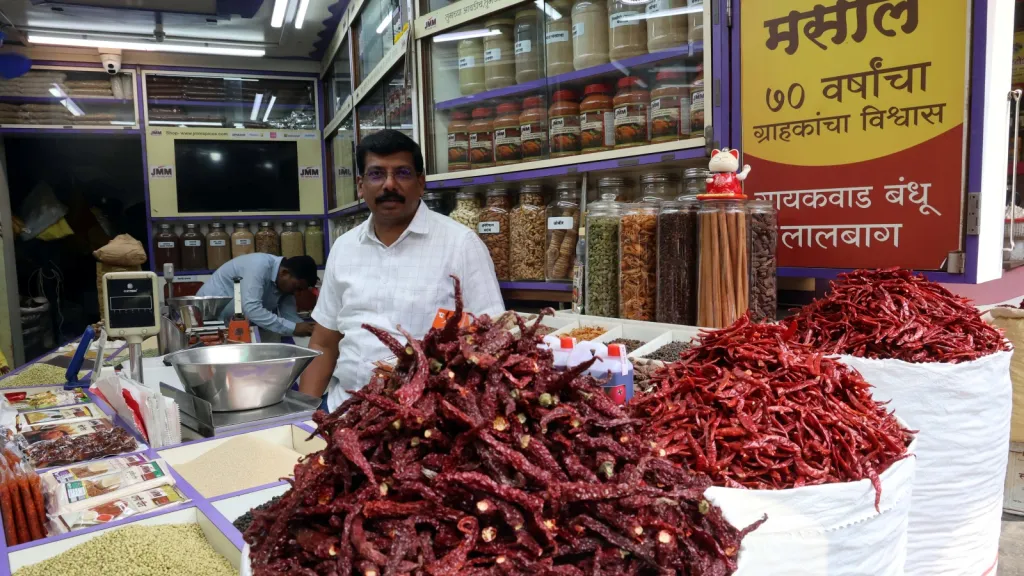
Maharashtra’s decision to ban the sale of loose, unpackaged spice powders has sparked debate among traders at Mumbai’s century-old Lalbaug spice market, where generations of families have relied on traditional shops for their daily masala needs. While some merchants welcome the move as a way to reduce adulteration and improve Food Safety, others fear that packaging requirements will increase costs, push up prices and disrupt long-established businesses.
The Maharashtra Food and Drug Administration (FDA) issued an order on October 15 prohibiting the sale of spice powders and mixed spices in loose, unpackaged form. Under the new requirements, spices must be packed and sealed at the place of production before they are distributed and sold.
For Lalbaug’s merchants, the decision raises questions about how traditional retail practices can adapt to stricter food safety rules without undermining the trust that has sustained their businesses for decades.
Traders Support Food Safety but Seek Clarity
Ajit Gaikwad, president of the New Lalbaug Markets Merchants Association, said traders supported the government’s objective of eliminating adulteration but wanted clarity on how the rules would work in practice.
One major concern is the difficulty of serving customers who buy spices in very small quantities. Many shoppers visit traditional markets to purchase precisely measured amounts for specific recipes, rather than buying larger packets that may remain unused for extended periods.
“If the government wants to eliminate adulteration, this is a good system,” Gaikwad said, while highlighting the practical challenge of serving customers who need only 10 grams when packaged products may be available in quantities of 50 grams or more.
Packaging would require additional spending on cleaning, processing, sealing and labelling, he explained. However, he also acknowledged that the changes could improve transparency and encourage established spice companies to enter the market.
The New Lalbaug Markets Merchants Association has around 150 registered spice merchants, along with an estimated 100 unregistered traders. The association has begun discussing implementation concerns with the local food inspector.
Small Spice Shops Fear Higher Costs
Not all traders believe the new rules will benefit the market. Several shopkeepers fear that the additional requirements could make their products more expensive and reduce the appeal of traditional spice shops, where customers can buy small quantities according to their needs.
Naresh Rathod of H B Rathod Masala said packaging every product and including the required information on each packet would increase costs for consumers. He also noted that freshly ground spices could last around a year when stored in airtight conditions.
Rathod questioned whether packaged spices were necessarily safer than loose products, arguing that regulators should also examine contamination concerns involving branded spices.
For traditional merchants, the debate is not simply about packaging. It also concerns whether the new requirements will create a fair system that addresses adulteration across the industry without placing a disproportionate burden on smaller sellers.
Generations of Customer Trust at Risk
At Gulab Traders, 80-year-old owner Yusuf Kapasi described packaging every item as practically impossible for his business. He argued that enforcement should focus on sellers who deliberately adulterate spices with harmful chemicals and artificial colours.
Kapasi said customers travel from across Maharashtra to purchase spices from his shop, reflecting the reputation established through years of business and personal relationships.
One customer from Pune, who had visited Mumbai to stock up on spices for his family, said his connection with the store went back generations.
“It is about quality and trust,” the customer said, explaining that his mother had bought spices from the shop and that his wife continued to encourage him to shop there whenever he visited Mumbai.
For customers like him, traditional spice shopping involves more than buying an ingredient. Familiarity with a shopkeeper, confidence in the products and the ability to purchase the exact quantity required all contribute to the experience.
Traditional Retailers Defend Freshly Ground Spices
Vivek Stores, which has a history of around 100 years, is among the businesses concerned about the impact of the new rules. Shopkeeper Chandrakant Jadhav said the spices sold at his store were ground and stored in airtight jars under hygienic conditions.
Jadhav argued that packaged products could limit customers’ ability to assess spices before buying them. In traditional markets, shoppers often rely on their own judgment and experience when selecting ingredients.
“If we package everything, customers will be forced to buy packets. Once spices are packaged, people cannot assess the quality for themselves in the same way,” he said.
The new requirements could therefore change the relationship between sellers and customers, particularly for shoppers accustomed to inspecting loose spices and purchasing small quantities.
Small Manufacturers Face Packaging and Labelling Expenses
The financial implications extend beyond retailers to small-scale spice manufacturers. Sachin Shinde of Shindraj Masala, a business operating since 1962, said compliance would require additional workers and spending on packaging and labelling.
For smaller businesses, these expenses could be difficult to absorb without raising prices. Unlike larger manufacturers, small producers may have fewer resources to invest in new packaging equipment, processing arrangements and distribution systems.
The transition could be particularly challenging for vendors who depend on selling modest quantities throughout the day.
A pushcart vendor selling powdered spices in Dadar described the uncertainty facing small traders, saying the business was the family’s only source of income and that losing it would leave them unsure how to survive in Mumbai.
Such concerns highlight the potential economic consequences of implementing food safety requirements without sufficient clarity or practical support for small businesses.
What Maharashtra’s New Spice Rules Require
The FDA’s October 15 order prohibits the sale of spice powders and mixed spices in loose, unpackaged form. It requires spices to be packed and sealed at the place of production before distribution and sale.
The rules also address hygiene during the drying, handling and storage of spices. According to State FDA Commissioner Tukaram Mundhe, spices must not be dried on public roads, near drains or close to cattle sheds. Storage premises must remain clean, and products must be protected from contamination.
These measures are intended to improve hygiene and reduce the risk of contamination throughout the supply chain. Proper handling and storage are important because spices can be exposed to environmental contaminants during drying, processing, transport and sale.
However, traders say the practical details of compliance will determine how significantly the new rules affect daily operations, especially for businesses that traditionally grind, store and sell spices in small quantities.
Balancing Consumer Safety With Traditional Businesses
Maharashtra’s ban has exposed a difficult balance between strengthening food safety and protecting small businesses that form an important part of traditional markets. While packaging and sealing requirements could improve traceability and help consumers identify products, traders fear that additional expenses could make their goods less affordable.
The transition may also change shopping habits in Lalbaug, where customers have long valued freshly ground spices, flexible quantities and personal relationships with shopkeepers.
For traders, the priority is to understand how the requirements will be enforced and whether practical arrangements can accommodate small retailers and manufacturers. They want action against adulteration without placing unnecessary pressure on businesses that already maintain hygienic handling and storage practices.
As discussions with local officials continue, the future of Lalbaug’s traditional spice trade will depend partly on how effectively food safety objectives can be reconciled with the realities of small-scale retail. The challenge is to improve consumer protection while preserving the affordability, choice and customer trust that have made the historic market a destination for generations.
For breaking news and live news updates, like us on Facebook or follow us on Twitter and Instagram. Read more on Latest Business on thefoxdaily.com.






COMMENTS 0