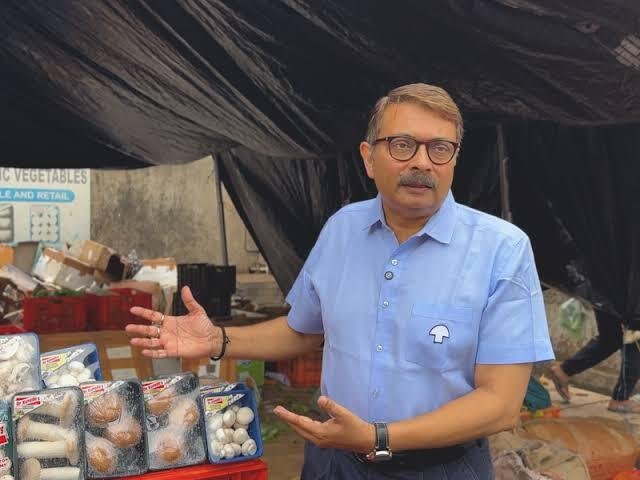
What started as a small mushroom cultivation venture in Goa in 1994 has grown into a business generating Rs 117 crore in annual revenue. Dr Sangam Kurade, popularly known as the Mushroom Man of India, built his enterprise by combining food science, controlled farming techniques and a long-term vision for India’s mushroom industry.
When Kurade entered the business, mushrooms were still unfamiliar to many Indian consumers. Finding customers was as challenging as cultivating the product. Vendors were hesitant to stock fresh mushrooms, and the company had to create demand from the ground up.
More than three decades later, his privately held business, Dr Kurade’s, has developed into a vertically integrated mushroom operation covering cultivation, processing and distribution. Its financial growth and expanding product range demonstrate how specialised agricultural production can develop into a large commercial enterprise.
Key Highlights
- Dr Sangam Kurade began commercial mushroom cultivation in Goa in 1994 with five growing rooms.
- His business, Dr Kurade’s, reported Rs 117 crore in consolidated revenue in FY25, according to Tracxn data.
- The company reportedly harvests around 28,000 kg of mushrooms daily.
- A major flood in 2009 destroyed its facility, but operations restarted within three months.
- Its product portfolio includes button, shiitake, portobello and king oyster mushrooms.
Who Is Dr Sangam Kurade, the Mushroom Man of India?
Dr Sangam Kurade is an entrepreneur who turned mushroom cultivation into a large-scale business in Goa. His academic background in food science and technology helped him understand the potential of mushrooms as a commercial food product.
His interest in mushrooms developed while studying the subject for his father, who was also involved in food technology. His research eventually convinced him that mushroom cultivation could become a year-round agricultural business that relied less on conventional farming conditions.
In 1994, Kurade began commercial cultivation with just five growing rooms. However, he soon realised that producing mushrooms was only one part of the challenge. He also needed to educate consumers, establish distribution channels and persuade retailers to sell a product that was not yet widely accepted.
From Five Growing Rooms to a Mushroom Business
Kurade’s early business journey involved learning cultivation techniques, training workers and developing a reliable production process. His understanding of food technology provided a foundation, but running a commercial operation required practical experience and persistence.
He initially took fresh mushrooms to Mapusa market in Goa and approached vendors individually. Many were reluctant to stock the produce because consumer demand was limited. On some days, unsold mushrooms had to be brought back and offered again the following day.
Describing the difficulties of those early years, Kurade said in an interview, “When you don’t know how to grow a mushroom, forget about selling the mushroom.”
The business gradually gained momentum with support from a USAID grant of approximately Rs 1 crore to Rs 1.25 crore. The funding helped Kurade improve cultivation methods and establish the commercial viability of mushroom farming.
How Dr Kurade’s Became a Recognised Brand
The business initially sold its mushrooms under the name White Pearls. However, customers increasingly began referring to the products as Dr Kurade’s mushrooms. That customer association eventually became the identity of the commercial brand.
Building the brand required more than producing a consistent supply. The company also had to make mushrooms more familiar to consumers and develop a market for fresh produce that was not a regular feature of many Indian kitchens.
By bringing cultivation, processing and distribution under one business, Kurade developed a more integrated operating model. This helped the enterprise build its presence across different stages of the mushroom supply chain.
The 2009 Flood That Nearly Destroyed the Business
One of the biggest challenges in Kurade’s entrepreneurial journey came on October 2, 2009. Flooding along the Talpona river in Goa destroyed the company’s mushroom facility, which was producing approximately one tonne of mushrooms every day.
The disaster threatened to undo more than 15 years of work. Instead of abandoning the business, Kurade decided to rebuild. He returned to Goa and set a target of restarting production within three months.
The facility resumed operations within that deadline. The experience also influenced the company’s future expansion plans, including shifting more operations to a larger facility at Usgao, away from the flood-prone location.
The recovery demonstrated the importance of operational resilience in agricultural businesses, where infrastructure damage can directly affect production and supply.
What Is Kurade’s ‘Agrifacture’ Business Model?
Kurade’s expansion has been built around an approach he describes as ‘agrifacture’, which combines agricultural production with factory-style precision and standardised processes.
Unlike traditional outdoor farming, mushroom cultivation takes place in controlled indoor environments. Temperature, humidity, compost quality and growing conditions must be carefully managed to maintain consistent production.
This approach allows cultivation to operate with greater control over environmental conditions. It also makes standardisation and quality management important parts of the business model.
According to the company’s website, its growing area covers approximately 1.2 lakh square metres, with daily mushroom harvesting of around 28,000 kg. The company also lists three levels of quality checks across its operations.
What Mushrooms Does Dr Kurade’s Produce?
The company’s product portfolio extends beyond the commonly consumed button mushroom. It also offers several varieties aimed at consumers looking for different flavours, textures and culinary applications.
Its range includes:
- Button mushrooms: A widely used variety found in everyday cooking.
- Shiitake mushrooms: An edible variety popular in several Asian cuisines.
- Portobello mushrooms: A larger mushroom variety often used in grilling and other dishes.
- King oyster mushrooms: Known for their thick stems and distinctive texture.
Offering multiple varieties allows the business to serve different consumer preferences and expand beyond the traditional fresh mushroom market.
Dr Kurade’s Financial Growth: Revenue Reaches Rs 117 Crore in FY25
The company’s financial performance reflects its expansion over the years. According to Tracxn data, Zuari Foods and Farms Private Limited, the entity associated with the Dr Kurade’s business, reported consolidated revenue of approximately Rs 6.10 crore in FY14.
Revenue subsequently increased to Rs 19.48 crore in FY17, Rs 28.85 crore in FY18 and Rs 33.23 crore in FY19. The business later experienced a challenging period before returning to growth.
In FY21, consolidated revenue reached Rs 51.09 crore, while net profit stood at Rs 9.46 crore. Revenue continued to rise in the following years, reaching Rs 74.91 crore in FY23 and Rs 85.29 crore in FY24.
FY25 became the strongest financial year in the available series, with consolidated revenue climbing to Rs 117 crore. This represented growth of approximately 37% compared with the previous financial year’s Rs 85.29 crore.
Revenue and Profit Growth at a Glance
| Financial Year | Consolidated Revenue | Net Profit |
|---|---|---|
| FY14 | Rs 6.10 crore | Not specified |
| FY17 | Rs 19.48 crore | Not specified |
| FY18 | Rs 28.85 crore | Not specified |
| FY19 | Rs 33.23 crore | Not specified |
| FY21 | Rs 51.09 crore | Rs 9.46 crore |
| FY23 | Rs 74.91 crore | Not specified |
| FY24 | Rs 85.29 crore | Rs 13.25 crore |
| FY25 | Rs 117 crore | Rs 20.21 crore |
Profitability improved alongside revenue. EBITDA increased from Rs 20.71 crore in FY24 to Rs 29.42 crore in FY25. Net profit rose from Rs 13.25 crore to Rs 20.21 crore, representing growth of approximately 53%.
The figures indicate that the company expanded its revenue while also improving its reported profitability during FY25. However, these financial results should be viewed separately from the company’s broader operational scale and future expansion ambitions.
What Lies Ahead for Dr Sangam Kurade’s Mushroom Business?
After establishing a sizeable mushroom cultivation operation, Kurade is looking to explore applications beyond fresh mushroom sales. This could take the business into additional areas of mushroom processing and value-added products.
The company’s existing combination of cultivation, processing and distribution provides a foundation for exploring such opportunities. Its experience with different mushroom varieties may also support the development of products for a wider range of consumers.
However, the next phase will depend on how successfully the business develops new applications while maintaining production quality and operational efficiency.
Conclusion
Dr Sangam Kurade’s journey from five mushroom-growing rooms in Goa to a business reporting Rs 117 crore in FY25 revenue is an example of how specialised agriculture can develop into a substantial enterprise.
His progress was shaped by consumer education, technical knowledge, financial support and the ability to recover from a devastating flood. By combining farming with controlled production methods, Kurade built a business that goes beyond conventional mushroom cultivation.
Known as the Mushroom Man of India, his story highlights the commercial possibilities of agricultural innovation and the role of persistence in building a long-term business.
For breaking news and live news updates, like us on Facebook or follow us on Twitter and Instagram. Read more on Latest Business on thefoxdaily.com.





COMMENTS 0