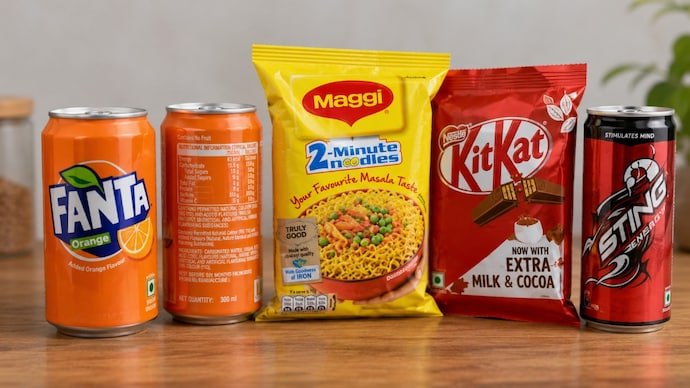
India’s fight over food labelling is no longer just about whether a packet of chips or a bottle of soft drink carries the right information. It is increasingly about how easily consumers can understand that information before they buy the product.
The Food Safety and Standards Authority of India (FSSAI) had considered stronger front-of-pack warnings that could make high levels of sugar, salt and fat immediately visible to shoppers. But the regulator later backed away from the colour-coded approach, saying India’s dietary patterns and stronger flavours made comparisons with international labelling systems difficult.
The decision has triggered a wider debate involving public-health campaigners, food companies, regulators and the Supreme Court. At the centre of the dispute is a simple question: is a detailed nutrition table on the back of a package enough, or should potentially unhealthy levels of nutrients be clearly flagged on the front?
The issue matters in a country where Packaged Food and beverages have become an increasingly important part of everyday consumption, while concerns about obesity and diet-related health problems are growing.
Why India’s front-of-pack food labelling debate matters
Most packaged foods sold in India already carry nutritional information. Consumers can find details such as calories, sugar, fat and salt on packaging, along with ingredient lists.
The problem, public-health advocates argue, is that having information available is not necessarily the same as making it easy to understand.
A shopper standing in a supermarket aisle may compare dozens of products in a matter of seconds. A large, colour-coded symbol indicating that a product contains a high level of sugar, salt or fat is designed to communicate that information immediately.
That is the principle behind front-of-pack labelling, an approach used in different forms in a number of countries.
Interpretive labels go beyond simply listing numbers. They attempt to translate nutritional information into an easier visual message, such as a red warning for a high level of a particular nutrient or a green indication for a comparatively lower level.
Supporters say this can help consumers make faster comparisons, particularly when they do not have the time or knowledge to interpret detailed nutrition panels.
What happened to FSSAI’s proposed warning system?
Indian regulators have considered stronger front-of-pack nutrition labelling for years. Proposals have included colour-coded warnings and other systems intended to make the nutritional quality of packaged products more visible.
But the process has faced opposition from sections of the food and beverage industry.
According to material reviewed for the report, industry representatives argued during a March meeting with regulators that warning symbols could confuse consumers and would not necessarily change eating behaviour.
Coca-Cola India executive Mili Bhattacharya questioned whether consumers WHO do not already read ingredient lists would substantially change their diets simply because a symbol appeared on a package.
The industry also argued that policymakers should pay greater attention to portion control rather than relying primarily on warning labels.
After the meeting, FSSAI moved away from the earlier emphasis on interpretive colour-coded warnings. In August, it told the Supreme Court that matching international approaches to packaging was difficult and proposed a black-and-white nutritional table showing information such as sugar, fat and salt instead.
The Supreme Court has been examining the issue following a petition by public-health activists. The court has also urged regulators to consider stronger warning systems, including looking at approaches used in countries such as Israel.
Why food companies oppose prominent warnings
The industry’s objection is partly about how consumers interpret a warning.
A prominent red or similar warning can change the way a shopper perceives a product before they even look at its brand, price or marketing claims. That can make the label commercially significant for manufacturers.
Food companies, however, argue that nutrition is more complicated than simply identifying a product as “high” or “low” in a particular nutrient.
One concern raised by the Indian Food & Beverage Association is that products containing naturally occurring sugar could potentially be caught by broad definitions of high sugar. The association has pointed to coconut water as an example of a product that could raise questions under certain labelling approaches.
There is therefore a genuine regulatory challenge: a warning system needs to be simple enough for consumers to understand without becoming so broad that it treats very different products as nutritionally equivalent.
But simplicity is also the point of front-of-pack warnings. If consumers need a nutrition degree to interpret the label, its practical value at the point of purchase is limited.
The Fanta comparison highlights the larger issue
The debate has gained attention partly because multinational food and beverage companies often sell products with different formulations in different markets.
A striking example is Fanta. The same global brand can have substantially different nutritional characteristics depending on the country where it is sold.
The difference is not necessarily evidence that a company is violating local rules. Manufacturers commonly alter recipes to comply with national regulations, local consumer preferences, ingredient availability and price expectations.
But these differences raise questions about transparency when consumers compare products sold under the same international brand.
In the case highlighted by the report, a can of Fanta sold in London contains 63 calories, while the Indian version contains considerably more sugar. The Indian product also contains an artificial colourant whose use is accompanied by a more prominent warning approach in some European markets.
The contrast illustrates why campaigners want consumers to see nutritional and ingredient information before buying rather than having to discover differences by closely examining the back of the package.
India is not the only market where recipes differ
Different formulations are common across the global food industry.
Companies may adjust recipes because ingredients cost different amounts in different countries, local regulations impose different requirements, or consumers have different preferences.
Price and affordability can be especially important in emerging markets, where manufacturers may design products for different consumer budgets.
However, the controversy becomes sharper when consumers believe that products sold in their country contain cheaper or less desirable ingredients than comparable versions sold elsewhere.
The report points to several examples involving popular products.
Indian versions of KitKat, for instance, have a substantially lower stated cocoa-solids content than the milk chocolate used in the Australian version. Many Maggi instant noodle variants sold in India use palm oil, while versions sold in Britain can use sunflower oil.
These differences do not automatically establish that one product is unsafe or that one market is being deliberately treated unfairly. Recipes can be legally and commercially tailored to individual countries.
What they do demonstrate is why ingredient transparency has become an increasingly important consumer issue.
Why front-of-pack labels can be different from nutrition tables
A nutrition table and a warning label perform different functions.
The conventional nutrition panel gives consumers detailed information. It is useful for people who want to compare exact quantities or monitor particular nutrients.
A front-of-pack warning is intended to work faster. It acts as a screening mechanism, telling shoppers that they may want to look more closely at the product.
That distinction is particularly important for products marketed to children and young consumers, who may respond more strongly to branding, packaging and advertising than to small-print nutritional information.
The debate is therefore not necessarily about choosing between detailed information and warnings. A well-designed system could potentially provide both: an easy-to-see front label for quick decisions and a detailed nutrition panel for consumers who want more information.
India’s growing concern over packaged food
The labelling debate comes as health concerns surrounding highly processed and packaged foods receive greater public attention.
Industry estimates cited in the report suggest that a large majority of products in India’s packaged food and beverage market could be classified as high in fat, sugar and salt. The industry has argued that this could result in large numbers of products carrying warnings under a strict colour-coded system.
That objection itself illustrates the scale of the regulatory challenge. If a substantial proportion of packaged foods would receive warnings, regulators must determine whether the thresholds are appropriate and whether the system gives consumers useful distinctions between products.
At the same time, the possibility of many warnings does not necessarily mean that the warnings are unnecessary. It could instead indicate how frequently high levels of certain nutrients occur in packaged foods.
Consumers are already demanding more information
India’s food-label debate is unfolding alongside a growing consumer movement around nutrition.
Health-focused influencers have built large audiences by examining ingredient lists and comparing products sold in different countries. Revant Himatsingka, known online as Food Pharmer, is one prominent example.
His content has included comparisons of sugar, sweeteners and other ingredients in popular beverages and packaged foods. His criticism of PepsiCo’s Sting beverage resulted in a Delhi court ordering removal of a video after the company challenged the claims.
The episode demonstrates how contentious food marketing and nutrition claims have become on social Media. It also highlights the importance of distinguishing between legitimate consumer criticism and claims that may not be supported by evidence.
Companies have increasingly found themselves under scrutiny not just from regulators but from consumers who can publicly compare labels, recipes and marketing claims.
Companies are already using different labelling approaches abroad
One of the more difficult arguments for Indian regulators is that some multinational companies operating in India already participate in interpretive labelling systems elsewhere.
Coca-Cola and its bottling partners have voluntarily used traffic-light-style labels in a number of European markets. Nestle has also used interpretive labels in Britain for years.
This does not necessarily mean the same system can simply be transferred to India. Nutrition policies must account for local diets, regulatory definitions and product categories.
But the existence of different approaches across markets strengthens the case for asking why consumers in one country should receive less prominent information than consumers elsewhere.
The Supreme Court has put the regulator under scrutiny
The Supreme Court’s involvement has raised the stakes considerably.
Public-health activists have challenged the direction taken by the regulator, arguing that consumers need stronger and more understandable information about packaged foods.
The court’s response has signalled that food labelling is not merely a technical matter for regulators and manufacturers. It has a direct connection to Public Health.
After FSSAI backed away from interpretive warnings, judges reportedly questioned the decision and emphasised India’s responsibility toward the health of its citizens.
Because the matter remains under judicial consideration, the final shape of India’s front-of-pack labelling rules is not yet settled.
What could change for consumers and food companies?
If India ultimately adopts prominent front-of-pack warnings, manufacturers would face pressure to reassess both packaging and, potentially, product formulations.
Consumers could gain a faster way to identify products containing high levels of sugar, salt or fat. Companies could respond by reformulating products to avoid warnings, reducing certain ingredients or changing portion sizes.
There could also be a broader effect on marketing. Products currently promoted through health-oriented claims or lifestyle branding could face closer scrutiny if a prominent nutritional warning appears alongside those messages.
But the effectiveness of any system will depend on its design. Thresholds need to be scientifically defensible, labels need to be understandable, and consumers need consistent information across product categories.
The bigger question is not just about red labels
India’s food-labelling dispute is ultimately about who carries the burden of understanding what is inside packaged food.
One model places most of that responsibility on the consumer: read the ingredients, study the nutrition panel and make the calculation yourself.
The alternative is to require manufacturers to communicate important nutritional risks more prominently, allowing shoppers to recognise them before making a purchase.
Neither approach eliminates the need for personal choice. A warning label does not tell someone what they must eat. It simply attempts to make relevant information harder to miss.
That distinction is likely to remain at the heart of India’s debate as the Supreme Court examines the issue and regulators consider what comes next.
For food companies, the stakes are commercial because clearer warnings can influence purchasing decisions. For consumers, the stakes are about transparency. And for policymakers, the challenge is to create rules that are scientifically credible, easy to understand and capable of working across India’s extraordinarily diverse food market.
For breaking news and live news updates, like us on Facebook or follow us on Twitter and Instagram. Read more on Latest Business on thefoxdaily.com.






COMMENTS 0