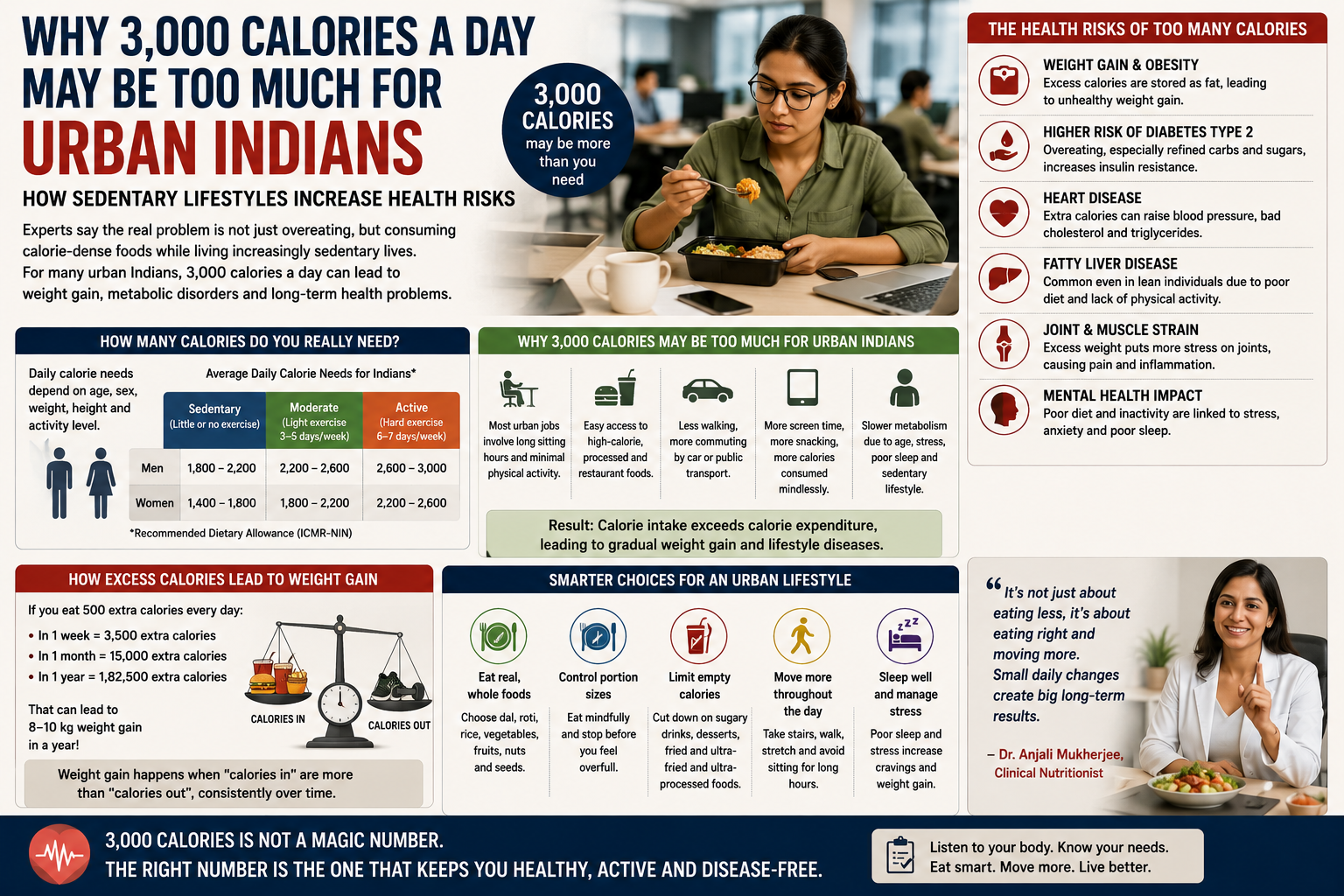
Calories fuel every heartbeat, every step, and every thought. But as India’s cities become more urbanized and technology-driven, the relationship between how much people eat and how much energy they burn has changed dramatically. A daily intake of 3,000 calories may have been appropriate for individuals performing physically demanding work, but for many office workers and city dwellers today, it can create a substantial calorie surplus.
Nutrition experts emphasize that there is no universal calorie requirement. The ideal intake depends on factors such as age, sex, body size, muscle mass, physical activity, metabolism, and overall health. However, for many adults living sedentary urban lifestyles, regularly consuming 3,000 calories without matching physical activity may contribute to gradual weight gain and long-term metabolic problems.
The issue extends beyond simple overeating. Modern diets increasingly feature ultra-processed, calorie-dense foods that are easy to consume in large quantities while providing relatively little satiety. When combined with prolonged sitting, chronic stress, and inadequate sleep, these eating patterns can significantly increase the risk of lifestyle-related diseases.
What Does a Calorie Actually Measure?
A calorie is a unit of energy. Every food and beverage provides energy that the body uses for essential functions such as breathing, maintaining body temperature, digesting food, supporting brain activity, and enabling physical movement.
Even while resting, the body continuously burns calories to sustain vital organs. Additional calories are required for daily activities ranging from walking and climbing stairs to structured exercise.
The balance between calories consumed and calories burned largely determines whether body weight remains stable, increases, or decreases over time.
Is 3,000 Calories Too Much?
For some individuals—such as endurance athletes, manual labourers, military personnel, or people engaged in intense physical training 3,000 calories or more may be entirely appropriate.
However, many urban Indians spend much of the day sitting at desks, commuting in vehicles, or working on computers. Their daily energy expenditure is often substantially lower than that of physically active populations.
When calorie intake consistently exceeds energy needs, the body stores excess energy primarily as fat.
Why Urban Lifestyles Have Changed Energy Needs
Rapid urbanization has transformed everyday life in India. Activities that once required physical effort are increasingly replaced by technology and convenience.
Common lifestyle changes include:
- Desk-based employment.
- Long commuting hours.
- Increased screen time.
- Food delivery services.
- Reduced walking.
- Greater reliance on elevators and vehicles.
Although these changes improve convenience, they also reduce daily calorie expenditure.
The Real Problem: Calorie-Dense Foods
Experts note that the challenge is not simply eating more food but consuming foods that pack large numbers of calories into relatively small portions.
Examples include:
- Sugary beverages.
- Deep-fried snacks.
- Fast food.
- Highly processed packaged foods.
- Desserts.
- Refined bakery products.
These foods often provide high amounts of fat, sugar, or refined carbohydrates while offering comparatively less fibre and fewer essential nutrients.
Not All Calories Affect the Body the Same Way
Although all calories represent energy, the foods providing those calories influence hunger, metabolism, and overall health differently.
For example, meals rich in protein, fibre, fruits, vegetables, legumes, and whole grains generally promote greater fullness than calorie-equivalent servings of sugary snacks or processed foods.
Diet quality therefore matters alongside calorie quantity.
| Food Choice | Typical Effect |
|---|---|
| Whole grains | Provide sustained energy and fibre |
| Vegetables | High nutrient density with fewer calories |
| Lean protein | Supports satiety and muscle health |
| Sugary drinks | High calories with low fullness |
| Ultra-processed snacks | Easy to overconsume |
How a Sedentary Lifestyle Compounds the Problem
Physical inactivity affects health in multiple ways beyond reducing calorie expenditure.
Regular movement supports:
- Healthy insulin sensitivity.
- Heart health.
- Muscle maintenance.
- Bone strength.
- Mental well-being.
- Weight management.
Even individuals who exercise for an hour each day may still experience health risks if they remain seated for most of their remaining waking hours.
What About Traditional Indian Meals?
Traditional Indian diets often include nutritious combinations of whole grains, pulses, vegetables, dairy, spices, and seasonal produce. Problems typically arise when balanced meals are replaced by highly processed convenience foods or when portion sizes increase significantly.
Nutrition experts increasingly encourage preserving the strengths of traditional dietary patterns while limiting excessive intake of refined foods, sugary beverages, and deep-fried snacks.
Healthy eating is more about overall dietary patterns than avoiding any single ingredient.
Calories Are Only One Part of Metabolic Health
Weight gain and metabolic disease are influenced by numerous interacting factors.
These include:
- Genetics.
- Sleep quality.
- Stress levels.
- Hormonal balance.
- Physical activity.
- Medical conditions.
- Medication use.
Therefore, calorie counting alone cannot fully explain individual health outcomes.
How Much Energy Do Most Adults Actually Need?
Daily calorie requirements vary considerably depending on individual circumstances. Age, sex, height, body composition, occupation, and physical activity all influence energy needs.
Someone performing physically demanding labour may require significantly more calories than an office worker of the same age and body size.
For this reason, personalized nutritional guidance is often more valuable than applying a single calorie target to everyone.
| Lifestyle | General Energy Demand |
|---|---|
| Sedentary office work | Lower daily calorie requirement |
| Moderately active lifestyle | Moderate energy needs |
| Manual labour | Higher calorie expenditure |
| Competitive athlete | Substantially higher energy requirement |
| Older adults | Often lower calorie needs with high nutrient requirements |
Practical Ways to Balance Calories and Activity
Experts recommend focusing on sustainable habits rather than restrictive dieting.
- Choose minimally processed foods more often.
- Increase fruit and vegetable intake.
- Include protein with each meal.
- Walk regularly throughout the day.
- Reduce prolonged sitting.
- Stay physically active outside structured workouts.
- Prioritize adequate sleep.
- Manage stress effectively.
Small lifestyle improvements repeated consistently often produce greater long-term benefits than dramatic short-term changes.
The Bigger Picture: Modern Living Requires Modern Nutrition
India’s rapid urbanization has transformed not only how people work but also how they eat, move, and rest. As daily physical activity decreases, nutritional habits must adapt accordingly.
The future of healthy eating is unlikely to revolve around strict calorie counting alone. Instead, experts increasingly advocate a holistic approach that combines balanced nutrition, regular movement, quality sleep, stress management, and preventive healthcare.
Recognizing that energy needs evolve alongside lifestyle changes is an important step toward reducing the growing burden of obesity, diabetes, and cardiovascular disease.
Conclusion
For many urban Indians, consuming 3,000 calories a day may exceed actual energy requirements because modern lifestyles involve significantly less physical activity than in previous generations. However, the larger concern is not merely the calorie total—it is the combination of calorie-dense diets, prolonged sitting, inadequate sleep, and chronic stress that can gradually undermine metabolic health.
Rather than focusing solely on eating less, experts recommend eating better: choosing nutrient-rich foods, maintaining an active lifestyle, improving sleep quality, and reducing sedentary time. These sustainable habits support healthier body weight, better blood sugar control, improved heart health, and overall well-being.
Ultimately, good nutrition is not about chasing a specific calorie number. It is about matching energy intake to individual needs while building daily habits that nourish both the body and long-term health.
For breaking news and live news updates, like us on Facebook or follow us on Twitter and Instagram. Read more on Latest Lifestyle on thefoxdaily.com.






COMMENTS 0