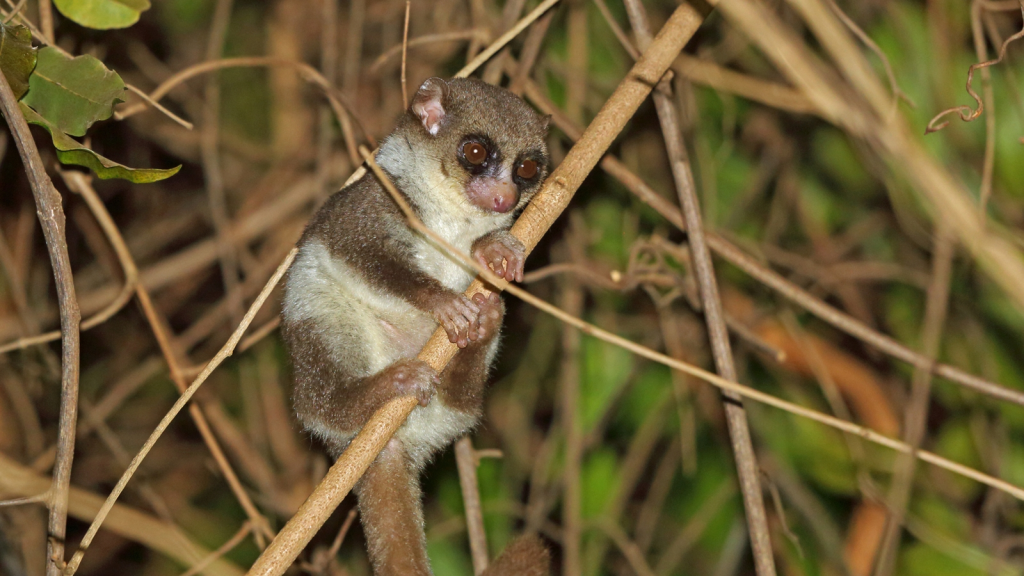
The fat-tailed dwarf lemur may look like an unlikely scientific superstar, but this tiny primate has challenged assumptions about what happens to the brain during hibernation. Native to Madagascar, the species can survive long periods of seasonal food scarcity by dramatically reducing its metabolism and relying on energy stored in its tail. Even more remarkably, studies of its sleep physiology have detected periods of REM sleep during torpor, the physiological state associated with hibernation.
That discovery is fascinating because hibernation is generally associated with a profound reduction in body temperature, heart rate, breathing and metabolic activity. REM sleep, by contrast, is a highly active state of the brain characterised by distinctive electrical activity and rapid eye movements in many mammals.
The combination raises a bigger biological question: how can a mammal enter a state of extreme metabolic conservation while its brain still cycles through sleep states associated with dreaming?
The answer helps scientists understand that hibernation is not simply “sleep turned up to maximum.” It is a carefully regulated physiological strategy that allows certain animals to survive periods when food and energy are scarce.
What is the fat-tailed dwarf lemur?
The fat-tailed dwarf lemur is a small nocturnal primate belonging to the genus Cheirogaleus. It is found in Madagascar, where seasonal changes in rainfall can create periods during which food becomes difficult to obtain.
Its name describes one of its most distinctive adaptations. Before entering prolonged torpor, the animal stores substantial quantities of fat in its tail.
That fat acts as an energy reserve.
Instead of continuously searching for food during a period when resources are scarce, the lemur can retreat into a sheltered location and reduce its body’s energy requirements dramatically.
This strategy is particularly valuable in Madagascar’s seasonal environments, where the availability of fruits, insects and other food sources can fluctuate considerably.
How does hibernation help the lemur survive?
Hibernation is fundamentally an energy-saving strategy.
During prolonged torpor, the animal reduces its metabolic rate and allows body temperature to fall substantially. Heart rate and breathing also slow.
Every biological process requires energy. By slowing many of those processes, the lemur reduces the amount of stored fuel it needs to survive.
For a small mammal with limited energy reserves, that can make the difference between surviving a harsh season and exhausting its resources.
The fat-tailed dwarf lemur can remain in this state for months, with reports of prolonged seasonal torpor lasting up to around seven months under appropriate environmental conditions.
That is an extraordinary amount of time to survive without maintaining the level of activity associated with normal daily life.
Why does the lemur store fat in its tail?
The tail functions almost like a biological savings account.
Before the dry season, the lemur builds up fat reserves. During torpor, those stored lipids can be gradually mobilised to provide energy.
Fat is particularly useful as an energy store because it contains considerably more energy per unit of mass than carbohydrates.
The strategy also illustrates an important evolutionary principle: survival adaptations do not have to involve finding more food; sometimes they involve becoming extraordinarily efficient at using the food already available.
For the lemur, the tail is therefore more than a physical characteristic. It is an adaptation linked directly to seasonal survival.
But does the lemur really “sleep” during hibernation?
This is where the story becomes scientifically interesting.
Hibernation and sleep are related, but they are not the same physiological state.
During ordinary sleep, the brain continues to cycle through recognisable stages, while the body’s metabolism remains within a relatively normal physiological range.
During deep torpor, metabolic activity and body temperature can fall dramatically.
Researchers studying hibernating mammals have found that animals can still experience periods of sleep-like brain activity during torpor. The discovery of REM sleep during hibernation in the fat-tailed dwarf lemur therefore challenged the simplistic assumption that the brain must become almost completely inactive when the body enters extreme metabolic suppression.
What is REM sleep?
REM stands for rapid eye movement.
During REM sleep, the brain displays activity patterns that differ substantially from those seen during deeper non-REM sleep. In humans, REM is associated with vivid dreaming, although dreams can also occur during other stages of sleep.
REM sleep is also associated with changes in muscle activity, breathing and heart rate.
Because of these characteristics, observing REM-like sleep during a state of deep torpor is particularly intriguing.
It suggests that the brain can preserve elements of its normal sleep architecture even while the rest of the body is operating at an exceptionally low metabolic level.
Does that prove the lemur dreams?
Not quite.
This is an important distinction that is often lost in popular descriptions of the discovery.
Scientists cannot directly ask a sleeping lemur whether it experienced a dream. Human dream research relies heavily on waking people and asking them about subjective experiences.
Researchers can, however, identify physiological characteristics associated with REM sleep.
Because REM sleep in humans is strongly associated with dreaming, it is reasonable to describe the finding as evidence that the lemur may dream during torpor. But REM sleep is not direct proof of a particular subjective dream experience.
This distinction makes the finding more scientifically interesting, not less. It raises questions about how the neural mechanisms of REM sleep operate under extreme physiological conditions.
Why dreaming during hibernation is such a strange combination
Hibernation and REM sleep appear to pull physiology in opposite directions.
Hibernation prioritises energy conservation. REM sleep is comparatively metabolically active and involves complex changes in brain activity.
If an animal can enter REM sleep while deeply torpid, the brain is demonstrating an unusual ability to maintain organised activity during a period when many other bodily systems have been drastically suppressed.
This could provide clues about how sleep regulation evolved across mammals.
It also raises a fundamental question about the relationship between consciousness, brain activity and metabolism.
How much metabolic energy does a brain actually need to maintain complex internal activity?
The lemur offers researchers an unusual natural experiment for exploring that question.
Is the fat-tailed dwarf lemur the only animal that hibernates?
No.
Many mammals can enter forms of hibernation or prolonged torpor. Bats, rodents and other small mammals are among the best-known examples.
Some animals undergo deep seasonal hibernation, while others use shorter periods of daily torpor to reduce energy expenditure.
What makes the fat-tailed dwarf lemur especially unusual is the combination of primate biology, prolonged seasonal torpor and evidence of REM sleep during that state.
It is also important to be cautious with the phrase “only animal known to dream while hibernating.” Scientific knowledge changes as researchers study more species. The safer interpretation is that the fat-tailed dwarf lemur is the best-known example in which REM sleep has been documented during hibernation-like torpor.
Why is a hibernating primate scientifically important?
The fact that this behaviour occurs in a primate makes the species especially valuable for researchers interested in human biology.
Humans do not hibernate naturally. Yet humans share evolutionary ancestry with lemurs and other primates.
That does not mean a hibernating lemur provides a direct blueprint for human hibernation. The differences between species are enormous.
Nevertheless, studying a primate capable of extreme metabolic suppression may help researchers understand how mammalian nervous systems respond to dramatic changes in temperature, blood flow, metabolism and energy availability.
Such knowledge could eventually contribute to research in areas ranging from sleep biology to metabolic medicine.
Could hibernation research eventually help medicine?
This is one of the most intriguing possibilities, although it remains a research question rather than an established medical application.
Scientists have long been interested in how hibernating animals tolerate conditions that would be dangerous for humans.
During hibernation, animals can tolerate profound reductions in metabolic activity and body temperature. Their physiology also adapts to prolonged changes in circulation and energy use.
Researchers are studying such adaptations because controlled metabolic suppression could theoretically have applications in medicine.
For example, understanding how animals protect tissues during reduced metabolism could inform research into organ preservation, critical illness or certain forms of injury.
However, these potential applications should not be confused with current medical treatments. Scientists are studying the mechanisms; hibernation is not a proven therapy for humans.
What makes Madagascar especially important?
Madagascar is one of the world’s most distinctive centres of biodiversity.
Its long geographic isolation allowed many species to evolve in ways that are rarely seen elsewhere. Lemurs are among the clearest examples.
The island’s seasonal environments have also produced animals with remarkable strategies for coping with changes in food availability and climate.
The fat-tailed dwarf lemur is therefore part of a much larger story about how Madagascar’s wildlife has adapted to environmental pressures.
Its ability to enter prolonged torpor demonstrates that even closely related mammals can evolve radically different strategies for dealing with energy shortages.
Hibernation is more complicated than “sleeping through winter”
Popular culture often treats hibernation as an animal simply falling asleep and waking up months later.
Real hibernation is much more dynamic.
Many hibernating mammals periodically experience arousals, during which body temperature and metabolism rise toward normal levels before the animal returns to torpor.
These cycles consume energy, and researchers continue to investigate why animals undergo them.
This means hibernation is not a single continuous condition. It is a carefully regulated physiological programme involving changes in metabolism, temperature, circulation, sleep and brain activity.
A surprising comparison: hibernation versus human sleep
The difference becomes clearer when the two states are placed side by side.
| Feature | Normal human sleep | Deep torpor in hibernating mammals |
|---|---|---|
| Body temperature | Regulated within a relatively narrow range | Can fall substantially |
| Metabolism | Reduced but remains relatively active | Can be dramatically suppressed |
| Heart rate | Generally slows during sleep | Can fall to very low levels |
| Breathing | Continues at a relatively regular rate | Can become extremely slow |
| Purpose | Linked to restoration and regulation | Primarily energy conservation and survival |
The table highlights why calling hibernation simply “very deep sleep” is misleading. The two states share features, but hibernation involves a much broader reorganisation of physiology.
What scientists can learn from the lemur’s brain
The most important scientific value of the fat-tailed dwarf lemur may ultimately be what it tells researchers about the flexibility of the mammalian brain.
The brain consumes a large amount of energy relative to its size. Yet this primate can substantially reduce its overall metabolism while retaining organised sleep activity.
That suggests that neural systems involved in sleep are not simply switched off when energy becomes scarce.
Instead, the brain appears capable of negotiating between two competing demands: conserving energy and maintaining essential biological processes.
Understanding how that balance works could provide insights into the evolution of sleep itself.
The conservation lesson hidden in the lemur’s tail
There is another reason this animal deserves attention.
The fat-tailed dwarf lemur’s survival strategy depends on timing.
It needs to accumulate energy before resources become scarce. The animal is effectively preparing for an environmental downturn before the crisis arrives.
That makes its biology an elegant example of adaptation to predictable seasonal change.
It also illustrates why habitat conservation matters. A species adapted to a particular seasonal rhythm can become vulnerable if climate patterns, food availability or forest structure change faster than its biology can respond.
Protecting the animal therefore means protecting the ecological conditions that make its unusual survival strategy possible.
What remains unknown?
Despite the excitement surrounding REM sleep during torpor, major questions remain.
- What exactly triggers REM sleep while the animal is torpid?
- Does REM sleep serve the same biological functions during torpor as it does during ordinary sleep?
- How does the brain maintain this activity while energy consumption is drastically reduced?
- Do other hibernating mammals show comparable patterns that have simply not been detected yet?
- How does seasonal torpor affect memory, learning and brain function over the long term?
Answering these questions will require more detailed physiological and neurological studies.
Conclusion: A tiny lemur with a surprisingly big scientific story
The fat-tailed dwarf lemur is remarkable not merely because it hibernates, but because its biology challenges the boundaries scientists traditionally place between sleep and metabolic suppression.
By storing fat in its tail and entering prolonged torpor during periods of environmental scarcity, this small Madagascar primate can survive months when remaining active would be energetically costly.
The discovery of REM sleep during torpor adds another layer to the story. It suggests that even while the body is operating in an extreme energy-saving mode, the brain can retain organised patterns of activity associated with REM sleep.
That does not prove that the lemur experiences dreams exactly as humans do. But it provides a fascinating window into the evolution and flexibility of sleep.
Perhaps the most important lesson is that hibernation is not biological inactivity. It is an active, highly regulated survival strategy.
And in the fat-tailed dwarf lemur, scientists have found an extraordinary example of how a mammalian body can almost shut down for survival while its brain still appears to keep some of its most mysterious rhythms running.
For breaking news and live news updates, like us on Facebook or follow us on Twitter and Instagram. Read more on Latest Lifestyle on thefoxdaily.com.

COMMENTS 0