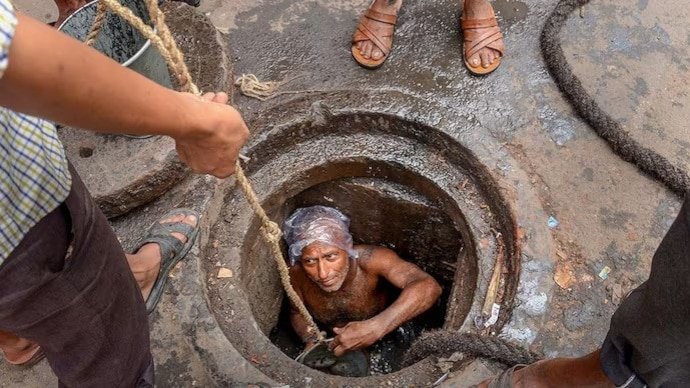
The Bombay High Court has delivered a strong rebuke over the continued existence of manual scavenging in India, observing that the country may celebrate major scientific achievements while some citizens are still forced into work that falls below basic human dignity.
A division bench of Justices Bharati Dangre and Manjusha Deshpande struck down a provision in Maharashtra government resolutions that placed the immediate burden of compensation for deaths during hazardous cleaning on private employers, contractors and housing societies. The court held that the state and local authorities must first compensate the dependants of deceased sanitation workers and may subsequently recover the amount from those found responsible.
The ruling is significant not only because of the financial relief it provides to affected families but also because the court explicitly connected the persistence of manual scavenging with the enduring effects of the caste system. The judges stressed that legal prohibitions alone have not eliminated a practice that continues to expose sanitation workers to deadly conditions.
The court directed the Maharashtra government to identify, within six months, all people who have died while carrying out “hazardous cleaning” within the meaning of the Prohibition of Employment as Manual Scavengers and their Rehabilitation Act, 2013. Each eligible family is to receive Rs 30 lakh in compensation.
Bombay High Court rejects unequal treatment of sanitation workers
The immediate legal dispute concerned provisions contained in Maharashtra government resolutions issued on December 12, 2019, and April 30, 2025. The challenged provision, identified as Item 11, dealt with compensation following the death of workers engaged in hazardous cleaning.
The petitioners argued that the policy created an unacceptable distinction between workers based on whether they were employed directly by government bodies or worked for private establishments and contractors.
According to the challenge, the state and local authorities had failed to fully implement the protections contained in the 2013 law. Instead of guaranteeing compensation to families and then determining liability, the policy effectively placed responsibility on private entities at the outset.
The High Court found that approach incompatible with the statutory framework. The judges emphasized that the 2013 Act does not create one set of protections for workers employed by the state and another for those working through private employers.
By cancelling Item 11 in both government resolutions, the bench removed the distinction that had become the central focus of the litigation.
State must pay first and recover later
One of the most important aspects of the judgment is the court’s direction on how compensation should actually be delivered.
The judges said the Maharashtra government and local authorities must immediately disburse compensation to eligible families, regardless of whether the deceased sanitation worker was employed in the public sector, private sector or through a contractor.
Only after the family receives the mandated compensation can the government pursue recovery from the private employer or other party found responsible for the death.
This approach is intended to prevent families from being trapped in prolonged disputes over liability before receiving assistance. The death of a sanitation worker can leave dependants facing immediate financial hardship, making a compensation process dependent on a separate argument over employer responsibility particularly difficult.
The court’s direction therefore separates two questions that had effectively been linked under the Maharashtra policy: the family’s right to compensation and the eventual recovery of that money from the party liable for the hazardous conditions.
Rs 30 lakh compensation for every eligible death
The court directed the state to identify all people who died while engaged in hazardous cleaning as defined by the 2013 legislation and to pay Rs 30 lakh to the dependants of each deceased worker.
The identification process must be completed within six months. The direction is particularly important because deaths linked to hazardous sanitation work have historically been difficult to track comprehensively when employment relationships are informal, contractual or spread across different authorities.
A worker may be described as being employed by a contractor, housing society, municipal body or another intermediary even though the nature of the work itself creates the same physical danger. The court’s reasoning rejects the idea that the identity of the employer should determine the value or availability of compensation.
The order instead places the focus on the actual nature of the work and the harm suffered by the worker.
Why the court invoked the caste system
The strongest observations in the judgment concerned the social origins of manual scavenging. The bench pointed to the contradiction between India’s technological progress and the reality faced by sanitation workers who continue to perform dangerous cleaning tasks.
The judges observed that India can celebrate reaching the other side of the Moon while still confronting a social system in which some citizens are pushed into work that is considered beneath human dignity.
The reference to the caste system is central to the court’s reasoning. Manual scavenging has long been associated with caste-based occupational discrimination, with particular communities historically being forced into sanitation work and the handling of human waste.
Although modern laws prohibit the practice, the court noted that social and economic structures can keep such forms of labour alive even after they have been formally outlawed.
The judges also highlighted the constitutional promise of equality, noting that more than 75 years after the adoption of the Constitution, the country continues to struggle with a social hierarchy that has deep historical roots.
Manual scavenging remains prohibited under Indian law
India has a specific legal framework intended to eliminate manual scavenging and rehabilitate people who have historically been engaged in it. The Prohibition of Employment as Manual Scavengers and their Rehabilitation Act, 2013 prohibits manual scavenging and imposes duties on authorities to identify affected workers and provide rehabilitation.
The legislation also addresses hazardous cleaning and seeks to prevent people from being sent into sewers, septic tanks and other dangerous spaces without the necessary safeguards.
The existence of these legal protections makes deaths during hazardous cleaning particularly significant. Such fatalities raise questions not only about individual negligence but also about whether authorities and employers have complied with statutory duties meant to prevent workers from entering dangerous environments in the first place.
The Bombay High Court’s latest decision reinforces the principle that the prohibition of manual scavenging must operate in practice, not simply remain on paper.
What the petitioners argued
The case was brought by Shramik Janata Sangh, a Trade union, along with affected individuals and an activist challenging Item 11 of the Maharashtra government’s resolutions.
The petitioners argued that the state and local authorities had failed to properly implement the 2013 law and had created an unfair compensation mechanism that effectively shifted responsibility away from public authorities.
They contended that the legal prohibition on manual scavenging should apply equally regardless of whether a sanitation worker was formally employed by a government body or worked for a private organisation.
The court accepted the core of that argument, finding that the law itself does not distinguish between workers on the basis of the identity of their employer when determining protection from hazardous sanitation work.
The court found the Maharashtra policy discriminatory
The judges described the challenged policy as clearly violative of the fundamental right to equality. That conclusion is significant because it places the compensation dispute within the broader constitutional principle that similarly situated citizens should not receive materially different treatment without a lawful and rational basis.
A sanitation worker who dies while performing hazardous cleaning faces the same devastating consequence whether the work was carried out for a municipal authority, a private contractor, a housing society or another employer.
From the family’s perspective, the identity of the employer does not change the loss of a parent, spouse or child. The court’s decision recognizes that reality by requiring uniform compensation for eligible deaths.
The judgment therefore moves the focus away from employment classification and toward the state’s broader responsibility to eliminate hazardous sanitation practices.
Private employers can still face financial recovery
The decision does not mean private employers or organisations are insulated from liability. Instead, it changes the order in which financial responsibility is enforced.
The government must provide the statutory compensation first. Once that payment is made, authorities can pursue recovery from the employer, contractor or other party that bears responsibility under the law.
This mechanism allows the government to protect bereaved families from delays while preserving its ability to hold responsible parties financially accountable.
In practical terms, the ruling creates a faster route to relief without removing the possibility of subsequent recovery proceedings.
Why hazardous cleaning is especially dangerous
Hazardous cleaning can expose workers to poisonous gases, lack of oxygen, contaminated water, infections, drowning and other life-threatening conditions. Sewer and septic-tank environments can be particularly unpredictable, especially when workers enter without appropriate equipment and supervision.
The danger becomes even greater when workers are informal, outsourced or unaware of the risks associated with entering confined spaces.
The legal requirement to prevent manual entry into dangerous sanitation environments exists precisely because workers should not have to trade their lives for essential public hygiene services.
When a worker dies during such operations, the tragedy therefore raises a larger question about whether the work should have been carried out manually at all.
The hidden cost of sanitation work
Sanitation is essential to public Health, yet the people performing some of the most dangerous sanitation tasks often remain economically and socially vulnerable.
Many of these workers operate behind the scenes, cleaning sewage networks, septic tanks, drains and other hazardous Infrastructure that most members of the public rarely see. Their work becomes visible primarily when something goes wrong.
The Bombay High Court’s observations challenge that invisibility. By connecting hazardous sanitation work with social discrimination, the judges treated manual scavenging not merely as a labour-safety issue but as a constitutional and human dignity issue.
That distinction matters because better equipment alone may not eliminate the deeper social conditions that make workers vulnerable to dangerous assignments.
A constitutional issue beyond compensation
The judgment invokes the fundamental right to equality, but its broader message is about dignity and equal citizenship.
The Constitution promises equality before the law and equal protection of the law. The persistence of caste-linked sanitation work, according to the court, demonstrates that formal legal equality has not automatically erased social practices that have survived for generations.
The judges’ observations suggest that eliminating manual scavenging requires more than prosecuting individual violations. Governments must also identify affected workers, ensure rehabilitation, prevent dangerous labour practices and create mechanisms that guarantee timely support when deaths occur.
In that sense, the compensation ruling is only one part of a much larger obligation.
Why the order is important for private contractors
Private contracting is widespread in sanitation services, and responsibility can become fragmented when a worker is hired through multiple layers of contractors or intermediaries.
That fragmentation can create uncertainty over who should be held accountable after an accident. Families may then face a long process of establishing which company, local authority or contractor employed the worker.
The High Court’s order addresses this practical difficulty by ensuring that the family does not have to wait for that liability question to be resolved before receiving compensation.
Once the money has been paid, authorities can investigate responsibility and pursue recovery through the appropriate legal process.
The decision could therefore have implications for how government departments and local bodies structure contracts for sanitation services and monitor compliance with worker-safety requirements.
The role of government authorities under the 2013 law
The court’s direction to identify all eligible deaths within six months places a substantial administrative responsibility on Maharashtra.
Authorities will have to examine records across departments and local bodies, identify deaths connected to hazardous cleaning and determine whether the cases fall within the statutory definition.
That process could require coordination between municipal authorities, district administrations, labour officials, health departments and other agencies.
The effectiveness of the judgment will therefore depend not only on the legal principle established by the court but also on the state’s ability to identify victims accurately and ensure that eligible families actually receive the money.
A ruling that puts dignity at the centre
The Bombay High Court’s judgment goes beyond a disagreement over a government resolution. It highlights the continuing gap between India’s legal commitments and the lived reality of sanitation workers who remain exposed to dangerous and degrading conditions.
By referring to India’s achievements in Space Exploration alongside the persistence of caste-linked manual scavenging, the court drew attention to a stark national contradiction: technological advancement does not automatically translate into social equality.
The ruling also makes clear that compensation cannot depend on whether a worker was employed by the government or a private entity. If a person dies while performing hazardous cleaning prohibited by law, the dependants must receive the protection guaranteed by the legal framework.
What the Maharashtra government must do next
The immediate task is to identify all eligible sanitation workers who have died while engaged in hazardous cleaning and ensure that their families receive Rs 30 lakh as directed by the court.
Authorities must also establish systems to recover compensation from private employers or other responsible parties after the families have been paid.
More broadly, the state will have to ensure that the statutory prohibition against manual scavenging is actively enforced and that workers are not sent into hazardous environments in violation of safety requirements.
The success of the judgment will ultimately be measured not only by the compensation reaching families but by whether the number of workers dying during hazardous sanitation work begins to fall.
India’s Moon achievements and the unfinished social challenge
The Bombay High Court’s unusually powerful language has turned a compensation dispute into a wider reflection on India’s development.
The country has made major advances in science, technology and space exploration, yet the continued existence of manual scavenging exposes a persistent failure to extend the same sense of progress to social dignity and labour conditions.
The court’s message is clear: ending manual scavenging is not simply about enforcing a prohibition; it is about ensuring that no section of society is trapped in hazardous work because of caste, poverty or social exclusion.
By ordering the Maharashtra government to compensate families first and recover the money later, the judgment also places immediate responsibility where it matters most on ensuring that families who have already suffered an irreversible loss are not left waiting for justice.
The decision now sets a clear constitutional and administrative expectation for Maharashtra: workers performing essential sanitation services must receive equal legal protection, and deaths caused by hazardous cleaning cannot be treated as an ordinary occupational risk.
For breaking news and live news updates, like us on Facebook or follow us on Twitter and Instagram. Read more on Latest India on thefoxdaily.com.






COMMENTS 0