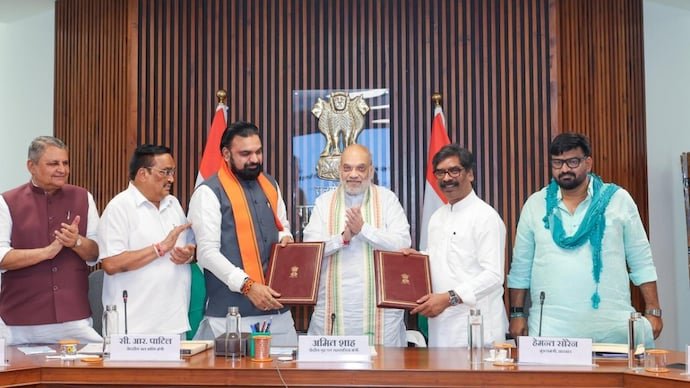
Bihar and Jharkhand have signed a memorandum of understanding to settle their long-running dispute over the sharing of Sone River water, bringing an issue that has remained unresolved since Jharkhand was created in 2000 to a formal agreement.
The pact was signed in New Delhi on August 31, 2026, in the presence of Union Home Minister Amit Shah and Union Jal Shakti Minister C.R. Patil. Bihar Chief Minister Samrat Choudhary and Jharkhand Chief Minister Hemant Soren were among the senior leaders present.
At the centre of the agreement is the 7.75 million acre-feet (MAF) of Sone River water that had originally been allocated to undivided Bihar under the 1973 Bansagar arrangement involving Bihar, Madhya Pradesh and Uttar Pradesh. Under the new understanding, 5.75 MAF will go to Bihar and 2 MAF to Jharkhand.
The significance of the agreement extends beyond the allocation numbers. The settlement could help improve planning for irrigation and drinking-water supply while removing a major inter-state obstacle surrounding the use of Sone water in the two states.
What the Bihar-Jharkhand Sone River agreement changes
The dispute emerged because the original 1973 arrangement was negotiated before Bihar was divided. At that time, there was only one Bihar, and its allocation of 7.75 MAF was not divided between the two states that later emerged from the bifurcation.
Jharkhand was created in November 2000. After the division, the question of how the former Bihar allocation should be shared became a source of disagreement between the two governments.
Jharkhand sought a defined share of the water, while Bihar continued to rely on the allocation established under the earlier Bansagar agreement. The disagreement affected the planning of projects that depend on a predictable supply of Sone water.
The new agreement establishes a state-wise division of the former undivided Bihar allocation. Bihar will receive 5.75 MAF, while Jharkhand will receive 2 MAF.
That division is important because water-sharing disputes are rarely just about a number on paper. A state’s formal allocation affects how reservoirs, canals, irrigation systems and drinking-water projects can be planned and operated over the long term.
Why the Sone River matters to Bihar and Jharkhand
The Sone is one of the major rivers of the region and has long been important to agriculture in southern and western Bihar. Its water is also linked to a canal network that serves several districts.
The Sone Canal System draws water through the Indrapuri Barrage near Dehri in Bihar. Government documents have described the system as serving districts including Rohtas, Kaimur, Bhojpur, Buxar, Gaya, Aurangabad, Arwal and Patna.
That makes the settlement particularly relevant for farmers who depend on irrigation rather than rainfall alone. A more clearly defined allocation can provide a stronger basis for planning water releases and future irrigation Infrastructure.
In Jharkhand, the agreement is expected to improve access to water for irrigation and drinking purposes in areas including Palamu and Garhwa, according to the Centre.
The practical benefits, however, will depend on implementation. Signing a water-sharing agreement establishes the framework, but actual benefits require infrastructure, dependable releases, efficient canal systems and coordination between governments.
How the 25-year dispute began
The roots of the dispute go back to the Bansagar Agreement of 1973. The agreement was reached among Madhya Pradesh, Uttar Pradesh and undivided Bihar to regulate the use of Sone River water and address the needs associated with the Bansagar project.
Under that arrangement, undivided Bihar received an allocation of 7.75 MAF. Madhya Pradesh and Uttar Pradesh had their own allocations under the broader agreement.
The situation changed fundamentally when Bihar was reorganised in 2000 and Jharkhand became a separate state. The old allocation had been assigned to Bihar as a single administrative entity, creating the need to determine how the water should be distributed after bifurcation.
For years, negotiations over the issue continued. The disagreement became especially important because Bihar had plans for additional water infrastructure, while Jharkhand sought recognition of its own requirements from the share previously assigned to undivided Bihar.
The eventual agreement therefore represents more than a new water-sharing formula. It addresses a legal and administrative problem created by the division of the original beneficiary state.
The new allocation: 5.75 MAF for Bihar, 2 MAF for Jharkhand
The central feature of the agreement is the division of the 7.75 MAF previously allocated to undivided Bihar.
Bihar will receive 5.75 MAF, while Jharkhand will receive 2 MAF. Together, the two allocations account for the full 7.75 MAF share.
For Bihar, the agreement provides greater clarity over the quantity available for its Sone-based irrigation system. For Jharkhand, the 2 MAF allocation gives the state a formally defined share of water that was previously part of undivided Bihar’s allocation.
This clarity matters because large water projects require long-term planning. Reservoir capacity, canal construction, irrigation command areas and drinking-water schemes all depend on assumptions about how much water can be made available.
The agreement does not mean that every farmer or household will immediately receive more water. Rather, it establishes the framework within which the two states can plan and use the resource.
Indrapuri Reservoir project gets a major boost
One of the most important implications of the Sone water agreement is its connection with the proposed Indrapuri Reservoir project in Bihar.
The project has been held up for years in part because of questions surrounding the availability and sharing of Sone water. Bihar had previously moved forward with the proposal after the draft water-sharing arrangement received approval.
The January 2026 approval of the draft agreement by the Bihar Government was described as helping clear the way for the Indrapuri Reservoir project. The project is expected to strengthen irrigation facilities in districts including Bhojpur, Buxar, Rohtas, Kaimur, Aurangabad, Patna, Gaya and Arwal.
A reservoir of this kind can potentially improve the ability to regulate water availability across seasons. That is particularly important in agricultural regions where rainfall can be highly variable.
But the signing of the interstate agreement should not be confused with completion of the reservoir project. Construction, environmental and technical clearances, financing, land-related requirements and implementation will determine how quickly any benefits reach the ground.
What the agreement could mean for farmers
Agriculture is likely to be one of the biggest areas affected by the settlement because irrigation remains closely tied to reliable water availability across large parts of Bihar and Jharkhand.
In Bihar, the districts identified by the Centre as beneficiaries include Bhojpur, Buxar, Rohtas, Kaimur, Aurangabad, Arwal, Gaya and Patna. These areas have long been connected with the Sone canal network and related irrigation infrastructure.
For farmers, the most important issue will not be the formal allocation itself but whether that allocation translates into dependable water at the farm level.
That depends on several factors, including reservoir management, canal maintenance, seasonal river flows and the efficiency of water distribution. If those systems improve alongside the agreement, the settlement could strengthen agricultural planning and reduce uncertainty around irrigation.
Jharkhand could also gain from greater certainty over its 2 MAF share, particularly in regions where irrigation and drinking-water availability remain important development concerns.
Drinking water is another major part of the agreement
The dispute has often been discussed primarily as an irrigation issue, but the Centre has also highlighted drinking-water requirements in both states.
Water allocation has implications for cities, towns and rural settlements as well as agricultural fields. A clearly defined interstate arrangement can make it easier for governments to plan water-supply systems around a more predictable resource base.
In Jharkhand, Palamu and Garhwa have been specifically identified as areas that could receive water for irrigation and drinking purposes. In Bihar, the Centre has pointed to a wider group of districts that could benefit.
The actual impact will depend on how water is conveyed and stored. Rivers do not automatically translate into household water supplies. Treatment facilities, pipelines, reservoirs and local distribution networks are necessary to turn an interstate allocation into usable drinking water.
Why cooperative federalism matters in water disputes
Inter-state river disputes are among the most difficult issues in Indian federalism because water resources cross administrative boundaries while states have competing demands from agriculture, households, industry and environmental needs.
Each state has an incentive to protect its own water Security, particularly when rainfall is uncertain or demand is rising. That can make agreements politically sensitive and technically complicated.
The Bihar-Jharkhand settlement is therefore significant as an example of negotiation between two states that had been unable to resolve the allocation issue for decades.
Amit Shah described the agreement as an example of cooperative federalism and the government’s “Team Bharat” approach. The Centre has also presented the settlement as part of a broader effort to resolve long-standing interstate water disputes through dialogue.
For the states themselves, the value of the agreement will ultimately be measured less by political statements and more by whether it improves the reliability of water management.
The agreement follows other interstate water settlements
The Centre said the Bihar-Jharkhand agreement was the fourth major water-related agreement reached between states in 2026.
Earlier in the year, an agreement was reached among Maharashtra, Gujarat, Rajasthan and Madhya Pradesh concerning outstanding payments linked to the Sardar Sarovar Project and the Narmada Award arrangements.
Rajasthan and Haryana also signed an agreement in June concerning the construction and implementation of the Yamuna Water Project, while a consensus was reached in June on the long-pending Kishau Multipurpose Dam Project involving Himachal Pradesh, Uttarakhand, Delhi, Uttar Pradesh, Haryana and Rajasthan.
These agreements involve different rivers, projects and disputes, so they cannot be treated as identical cases. But together they illustrate the importance of negotiated arrangements when several governments depend on interconnected water resources.
What happens after the Sone water pact
The signing of the MoU marks an important political and administrative milestone, but implementation will determine whether the settlement produces lasting benefits.
The immediate priority will be to translate the agreed allocation into practical water-management arrangements. That includes coordinating releases, developing infrastructure and ensuring that irrigation and drinking-water projects are designed around the new division.
The Indrapuri Reservoir project will be particularly important to Bihar’s plans. If the project progresses successfully, it could provide additional capacity to manage Sone water and strengthen irrigation across several districts.
For Jharkhand, the key question will be how its 2 MAF share is operationalised and what infrastructure is required to use it effectively in Palamu, Garhwa and other areas.
There is also a broader lesson. Interstate water agreements can settle a dispute on paper, but changing water availability on the ground requires sustained cooperation. River flows vary from year to year, infrastructure ages and demand changes as populations and economies grow.
A long dispute now has a formal settlement
The Bihar-Jharkhand Sone River agreement closes a chapter that began with the creation of Jharkhand in 2000 and was rooted in a much older water-sharing framework.
By dividing the 7.75 MAF allocation of undivided Bihar into 5.75 MAF for Bihar and 2 MAF for Jharkhand, the two states have created a clearer basis for future water planning.
The agreement could support irrigation, drinking-water supply and infrastructure development across large parts of both states. It may also remove an important obstacle to projects such as the Indrapuri Reservoir.
But the real test begins after the signing ceremony. Farmers and households will benefit only if the agreed allocation is backed by efficient infrastructure, transparent management and reliable implementation.
For now, the settlement represents a significant shift: after roughly a quarter-century of disagreement, Bihar and Jharkhand have moved from arguing over the division of an inherited water allocation to working within a formally agreed framework for sharing it.
For breaking news and live news updates, like us on Facebook or follow us on Twitter and Instagram. Read more on Latest India on thefoxdaily.com.






COMMENTS 0