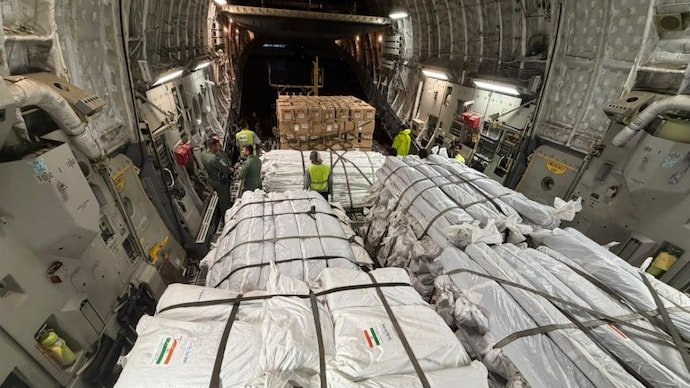
India has significantly expanded its assistance to flood-hit Nepal, sending more than 130 tonnes of humanitarian supplies and deploying 54 specialist personnel as rescue teams continue working in damaged hydropower tunnels and other difficult terrain.
The latest support arrived as the scale of Nepal’s disaster became clearer. The catastrophic flash floods of August 26 devastated communities and Infrastructure across several districts, destroyed roads and bridges and severely damaged hydropower facilities along the Bhote Koshi and Trishuli river corridors.
India’s assistance now goes well beyond conventional relief supplies. Alongside tents, blankets, medicines, hygiene kits and solar lamps, New Delhi has supplied mud-rescue suits, gas detectors, breathing apparatus, inflatable walkways, water pumps, portable generators, lighting towers and DNA-analysis equipment.
The Indian government has also deployed specialist teams for some of the most difficult parts of the response, including tunnel rescue and forensic identification. An Indian technical contingent is working with the Nepal Army in the Chilime and Langtang areas, while forensic specialists are supporting DNA analysis in Kathmandu.
The latest assistance highlights how disaster response evolves after the first wave of emergency relief. Once roads are destroyed and entire structures are buried under mud and debris, success depends increasingly on specialised engineering, medical and forensic capabilities.
India’s latest aid shipment takes total assistance beyond 130 tonnes
The Indian Air Force’s eighth special flight carrying relief and rescue material arrived in Kathmandu on September 9, continuing a series of airlifts that began after the August 26 disaster.
According to India’s Ministry of External Affairs, the eight flights have collectively carried more than 130 tonnes of relief material to Nepal.
The latest shipments include both immediate humanitarian essentials and equipment intended for technically challenging rescue missions.
The distinction is important. In many natural disasters, the first requirement is food, water, medicines and temporary shelter. Nepal’s latest catastrophe has created another problem at the same time: people are believed to remain missing inside flooded or mud-filled hydropower tunnels, where conventional rescue methods are often impossible.
India has therefore tailored part of its assistance toward the specific physical conditions confronting rescuers.
What India has sent to Nepal
The relief package combines standard humanitarian supplies with specialised equipment for underground and debris-filled rescue operations.
| Category | India’s assistance | Purpose |
|---|---|---|
| Emergency relief | Tents, blankets, hygiene kits, medicines and solar lamps | Support displaced and affected communities |
| Tunnel rescue | Mud-rescue suits, gas detectors, breathing apparatus and inflatable walkways | Enable safer operations in flooded and debris-filled underground spaces |
| Water and debris management | Water pumps and dewatering equipment | Remove water and assist access to affected structures |
| Power and lighting | Portable generators and lighting towers | Support operations in remote and poorly connected areas |
| Forensic identification | DNA kits, equipment and profiling reagents | Help identify recovered remains |
This combination shows the increasingly specialised nature of the international response.
Instead of simply sending large quantities of generic aid, India is providing equipment matched to Nepal’s specific problems, particularly the search for people who may still be trapped in underground facilities.
54 Indian specialists are supporting rescue and forensic work
Alongside the material assistance, India has deployed 54 expert personnel to Nepal.
The specialists include personnel involved in tunnel rescue, forensic work and medical support. Their role is to work alongside Nepalese authorities rather than operate as a separate response system.
This distinction is significant because rescue operations in disaster zones depend heavily on coordination. Local authorities understand the terrain, infrastructure and affected communities, while international teams can bring specialised equipment or technical expertise that may not be immediately available locally.
India’s teams have therefore been integrated into Nepal’s existing emergency response structure, including operations with the Nepal Army.
The deployment also reflects how the needs of a disaster change over time. Search teams need different equipment and skills once the immediate floodwaters subside and the focus shifts toward collapsed structures, blocked tunnels and identification of victims.
Indian tunnel-rescue team is working with Nepal Army
One of the most technically demanding parts of India’s assistance is the specialist tunnel-rescue operation.
An Indian team began work in coordination with the Nepal Army at the Chilime and Langtang sites. The operation was initially spread across both locations before attention became concentrated on Chilime.
The Chilime tunnel has proved especially difficult because of the combination of terrain, limited access, water, mud and debris inside the tunnel.
Rescuers are working using manual techniques as well as specialised methods to remove accumulated debris and water.
The conditions mean that heavy machinery cannot simply be transported to the site. Access itself has become one of the main engineering problems.
That is why Indian and Nepali teams are also working on a temporary road or track capable of bringing heavier equipment, including excavators, closer to the tunnel entrance.
Why Chilime is so difficult to reach
The geography of the Himalayan region is magnifying the challenges created by the disaster.
Mountain roads can be narrow and vulnerable to landslides, while helicopters face limitations when operating in steep valleys and around unstable terrain. Heavy construction equipment cannot be flown easily into many locations, creating a dependency on ground access.
At Chilime, the narrow valley and damaged access routes have made it difficult to move machinery to the tunnel.
India’s Ambassador to Nepal, Naveen Srivastava, has highlighted the importance of establishing a temporary road because the route would allow an excavator and other heavy equipment to reach the site.
Until that access is improved, rescuers must continue relying heavily on manual work, pumps and equipment that can be transported through difficult terrain.
The situation demonstrates a less visible reality of disaster response: sometimes the biggest obstacle is not finding the right machine but finding a way to move that machine to the place where it is needed.
Temporary track could change the rescue operation
India and Nepal have been working on a makeshift access route towards the tunnel.
The latest assessment indicates that construction is making encouraging progress and could be completed within roughly two to three days.
If the track is completed and remains usable, heavy machinery could be moved much closer to the rescue site. That would potentially allow teams to remove larger quantities of debris and water more quickly than manual efforts alone.
However, construction progress does not guarantee a successful recovery operation. The internal condition of the tunnel remains uncertain, and rescuers must continue assessing structural stability and other hazards before sending people farther inside.
The operation is therefore being conducted cautiously, with manual clearance, dewatering and technical assessment proceeding simultaneously.
Why specialised tunnel equipment matters
Flooded or mud-filled tunnels are among the most dangerous environments for rescue workers.
Visibility can be almost zero, oxygen levels may be reduced and the accumulation of mud can create unstable surfaces. Floodwater can also conceal debris and structural damage that makes movement hazardous.
That explains the importance of equipment such as gas detectors, breathing apparatus and mud-rescue suits.
Gas detectors can help teams assess atmospheric conditions before entering confined spaces. Breathing equipment can provide protection where air quality is compromised. Mud-resistant protective equipment helps rescuers work in environments where ordinary protective clothing would quickly become ineffective.
Inflatable walkways can also create temporary routes through hazardous surfaces, reducing the risk of rescuers becoming trapped or injured themselves.
These tools may receive less public attention than large excavators or helicopters, but they can determine whether specialists are actually able to enter a disaster site safely.
Forensic teams are helping identify victims through DNA
India’s assistance extends beyond rescue operations.
Indian forensic specialists are working alongside their Nepali counterparts in two laboratories in Kathmandu to examine DNA samples and support the identification of recovered remains.
This is particularly important because the disaster has resulted in a large number of fatalities and missing persons, while bodies recovered from flood-affected areas may not always be identifiable through visual examination.
DNA profiling can establish identities by comparing genetic material from recovered remains with samples from relatives or other reference material.
The process can take time, particularly when samples have been exposed to water, mud, heat or physical damage. Proper laboratory equipment and reagents are therefore essential to ensure reliable analysis.
India has supplied DNA kits, profiling equipment and reagents as part of its wider humanitarian assistance.
DNA identification is critical for families of the missing
For families, identification is often one of the most emotionally important parts of disaster recovery.
When victims remain officially listed as missing, relatives can be left without clear information about their fate. This uncertainty can continue for weeks or months, especially when large numbers of people disappeared at the same time.
Forensic identification provides a scientific mechanism to resolve at least some of those cases.
The work is especially important in Nepal because people from different countries were present in the affected region, including workers at hydropower facilities and other infrastructure sites.
As recovery operations continue, reliable identification will help authorities update casualty lists, notify families and manage repatriation where foreign nationals are involved.
India’s response goes beyond conventional disaster relief
The scale and composition of India’s assistance show that New Delhi is treating the Nepal disaster as a long-duration rescue and recovery challenge rather than a short-term humanitarian emergency.
Food, medicine and shelter are necessary in the immediate aftermath of a flood. But when roads disappear, hydropower tunnels fill with mud and victims remain missing, the response requires engineering, forensic Science, medical capabilities and specialised logistics.
India has attempted to cover all of those areas.
The 54 specialists are part of that broader approach, while the eight airlifts provide the material component needed to sustain the operations.
The assistance also reflects the geographic relationship between the two countries. India and Nepal share a close border, extensive movement of people and longstanding political, cultural and economic links.
A major disaster in Nepal can therefore have direct consequences for Indian citizens, businesses and families with relatives in the affected areas.
The disaster has exposed Nepal’s logistics problems
The latest floods destroyed or damaged much of the infrastructure rescuers would normally use to reach remote communities.
Roads were washed away, bridges collapsed and entire sections of mountain highways became inaccessible. Hydropower sites were particularly affected because many of them sit along narrow river valleys where debris can accumulate rapidly.
That has created a vicious cycle.
People need heavy machinery to clear the debris, but heavy machinery cannot reach locations because the roads are damaged. Temporary roads therefore become almost as important as the rescue equipment itself.
India’s support for access construction at Chilime illustrates how international assistance has shifted from simply bringing supplies into Nepal to helping create the conditions under which the rescue operation itself can continue.
Why helicopters cannot solve every problem
Air support has been essential during the disaster, but helicopters have obvious limitations in mountainous terrain.
Aircraft can transport people and relatively light equipment quickly, but heavy excavators, large pumps and other major machinery cannot be moved in the same way.
Weather can also restrict helicopter operations, while steep valleys and narrow landing zones limit where aircraft can safely operate.
That is why ground connectivity remains essential even in a disaster response involving extensive air operations.
The temporary access route at Chilime could therefore be a turning point in the search operation because it would provide a pathway for machines that are simply too heavy or cumbersome to transport by air.
India’s assistance also supports Nepal’s forensic capacity
The inclusion of DNA equipment and specialist forensic personnel in India’s relief package is notable because it addresses a need that often becomes more urgent after the initial rescue phase.
Forensic infrastructure allows governments to move from counting bodies to identifying individuals.
That distinction matters for families, legal records, insurance claims, Immigration procedures and the eventual return of remains to relatives.
It also helps authorities maintain more accurate casualty records when the number of missing people is large and remains are recovered over an extended period.
By combining equipment with specialist personnel, India is helping Nepal build immediate operational capacity rather than simply handing over hardware.
India and Nepal are working as a joint response team
The response is notable for the degree of cooperation between Indian and Nepali specialists.
At Chilime, Indian tunnel-rescue personnel are operating alongside the Nepal Army. In Kathmandu, Indian forensic experts are working with Nepali laboratory teams.
This model allows local authorities to retain control of the overall operation while using international specialists where specialized expertise is required.
It also helps transfer knowledge and experience during the operation itself.
Rescue methods developed or refined during one disaster can potentially improve Nepal’s capacity to respond to future incidents in the Himalayan region, where floods, landslides and other mountain hazards pose recurring risks.
The human dimension: Indian nationals are among those affected
The Nepal disaster has also directly affected Indian nationals.
Indian authorities have been coordinating the search for missing citizens while facilitating the return of those who have been rescued. Several Indian nationals were among people evacuated from affected areas during the early stages of the response.
The presence of foreign workers and visitors in the affected region complicated the identification process because casualty lists span multiple nationalities.
That makes India’s forensic support particularly relevant, as DNA testing can help authorities identify remains when conventional identification methods are not sufficient.
The Indian response is therefore simultaneously humanitarian, technical and consular in nature.
Nepal’s hydropower sector has been hit especially hard
The devastating floods struck one of Nepal’s most important hydropower corridors.
Several plants and associated infrastructure were damaged, while workers at multiple facilities were reported missing. Some of the hardest rescue operations are now taking place in or around hydropower tunnels.
This has dramatically increased the complexity of the response.
A collapsed house can potentially be reached with relatively conventional urban-search equipment. A flooded hydropower tunnel stretching deep underground is a different engineering problem, requiring specialist knowledge of tunnel geometry, ventilation, water management and structural safety.
India’s decision to deploy tunnel-rescue experts reflects that reality.
Why the rescue operation remains a race against time
Rescue teams working inside buried or flooded structures face an obvious time constraint, but the risks do not disappear simply because the first few days have passed.
Survivability depends on whether people have access to air, water and protected spaces, as well as whether the structure remains stable.
Recent operations in Nepal have shown that survival can sometimes extend well beyond the first few days. Rescuers have managed to recover people alive from disaster-damaged sites after prolonged entrapment.
That has encouraged teams to continue searching even when conditions are extremely difficult.
At the same time, authorities must balance hope against the safety of rescue personnel. Entering a structurally unstable tunnel without adequate protection can create additional casualties.
The specialised equipment and technical expertise brought by India are therefore important not only for reaching possible survivors but also for reducing risks to the people carrying out the search.
India’s aid is moving from emergency relief to recovery support
The evolution of India’s assistance reflects the changing nature of Nepal’s crisis.
Initial shipments focused heavily on emergency supplies after the August 26 floods. Subsequent consignments added technical equipment, medicines, forensic tools and specialised rescue capabilities.
The eighth flight and cumulative total of more than 130 tonnes indicate that India’s support has continued rather than being limited to the first few days after the disaster.
That sustained approach is likely to become increasingly important as Nepal transitions from rescue to rehabilitation.
Temporary shelter, road repairs, damaged power infrastructure and the restoration of essential services will require assistance long after the immediate search for survivors ends.
What the Chilime operation could achieve next
The immediate objective at Chilime is to continue clearing the tunnel and improve access for heavier machinery.
The temporary track is expected to make it possible to move excavators and other equipment to the site, potentially increasing the speed at which debris and water can be removed.
For rescuers, even a modest improvement in access could dramatically alter the operation because the amount of material that can be removed manually is limited.
The Indian and Nepali teams will therefore continue combining manual excavation with pumps and technical equipment while preparing for the arrival of heavier machinery.
The situation remains fluid, and the exact outcome will depend on what rescuers encounter deeper inside the tunnel.
India’s broader message to Nepal
The Indian government has repeatedly described Nepal as a close friend and partner and said it will continue to support the country’s search, rescue and rehabilitation efforts.
The latest assistance demonstrates what that commitment looks like in practical terms: aircraft carrying supplies, specialist personnel entering difficult rescue sites, engineers helping establish access routes and forensic experts assisting Nepalese authorities with identification.
Rather than treating the disaster solely as a relief problem, India is contributing to multiple stages of the response.
That approach is particularly relevant as Nepal begins to confront the enormous recovery challenge created by the destruction of homes, roads, bridges and energy infrastructure.
A disaster requiring more than food and medicine
Nepal’s floods have become a complex international rescue operation in which humanitarian assistance, engineering, forensic science and logistics are all intertwined.
India’s contribution reflects that reality.
The more than 130 tonnes of relief material delivered through eight special flights provide essential supplies and specialised equipment, while the 54 deployed experts add the technical capacity required for tunnel rescue, forensic identification and related emergency work.
The rescue effort at Chilime demonstrates why specialised assistance matters. Difficult terrain, poor access, mud-filled tunnels and the need for heavy machinery have made conventional rescue methods inadequate. A temporary road could help unlock the next stage of the operation, while Indian and Nepali specialists continue working manually and with technical equipment.
At the same time, India’s forensic teams in Kathmandu are helping address another painful part of the disaster: identifying those who have died so that families can finally receive definite answers.
India’s Nepal relief effort is becoming a long-term partnership
The latest aid flight is more than another shipment of emergency supplies. It represents a broader Indian effort to support Nepal through the most technically demanding stages of a catastrophic disaster.
From tents and medicines to tunnel-rescue equipment and DNA profiling kits, the assistance has evolved alongside Nepal’s needs. The deployment of 54 specialists shows that India is contributing people as well as materials, while the work at Chilime demonstrates cooperation on the ground with Nepal’s own security and rescue agencies.
The disaster has destroyed much of the infrastructure that normally makes rescue possible. India’s support is therefore helping address both sides of the problem: providing equipment and expertise while assisting Nepal in creating access to places where that equipment can be used.
For families still waiting for news, the most important measure of this international effort will remain the rescue and identification of people lost in the disaster. For Nepal as a whole, however, the assistance will also matter in the longer recovery, when damaged roads, hydropower facilities, homes and communities must be rebuilt.
India’s expanded response shows that the relationship between the two neighbours is extending beyond immediate relief. As Nepal moves from emergency rescue toward rehabilitation and reconstruction, the specialised support delivered in these critical days could become an important foundation for the much longer task of recovery.
For breaking news and live news updates, like us on Facebook or follow us on Twitter and Instagram. Read more on Latest World on thefoxdaily.com.






COMMENTS 0