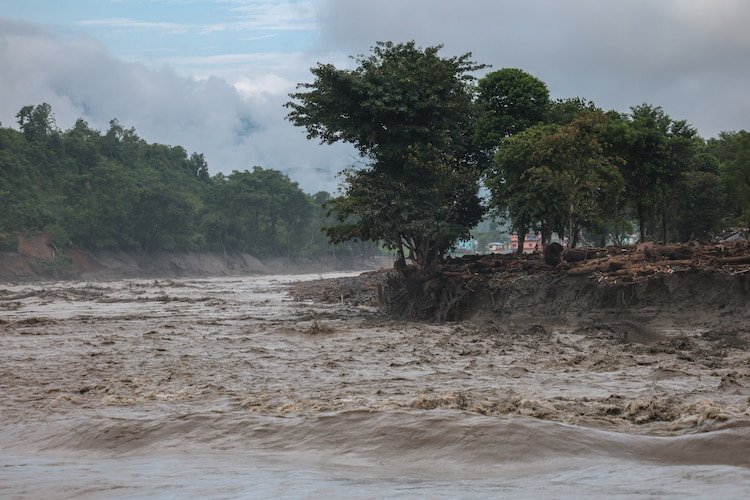
Nepal’s devastating floods have created a second emergency that is harder to see than the destruction left by the water: a rapidly emerging Mental Health crisis among survivors.
Children in temporary shelters are waking from nightmares and crying that the flood has returned. Adults are showing anxiety, heightened fear and exaggerated startle responses. Families separated during the disaster are trying to locate one another while survivors struggle to understand the scale of what they have lost.
The psychological impact is emerging as Nepal continues to deal with the physical consequences of the disaster. Government figures released on August 31 put the death toll at 903, with more than 4,200 people still unaccounted for. More than 10,000 people had been rescued, while search teams continued working in some of the worst-hit areas.
With rescue and relief operations still underway, Nepal’s health authorities are expanding psychological support. Around 50 psychiatrists, psychologists and psychosocial counsellors have been deployed in Rasuwa and Nuwakot, while another 64 trained counsellors are on standby in Bagmati Province.
The scale of the response reflects a growing recognition that the consequences of a disaster do not end when survivors are pulled from floodwaters. For many people, the psychological effects may become more apparent only after immediate survival needs have been addressed.
Nepal’s flood survivors are entering the psychological aftermath
The floods struck on August 26 and caused catastrophic destruction across parts of Nepal, particularly along the Bhotekoshi and Trishuli river systems. Entire settlements were damaged or destroyed, roads and bridges were swept away, and hydropower infrastructure suffered major losses.
The disaster has also separated families and displaced people from places that had provided a sense of safety and community.
That combination creates a difficult Environment for mental recovery. Survivors may have lost relatives, homes, livelihoods or personal possessions while still facing uncertainty about missing family members.
Psychologist Gopal Bohara, who is working with a psychosocial team in Bidur, Nuwakot, described survivors as being in a state of shock. Some were unable to explain what they were experiencing, while children at a holding centre repeatedly woke during the night, crying and saying that the flood had returned.
Adults have also displayed anxiety, fear and an unusually strong reaction to sudden sounds or movements.
These reactions are not surprising immediately after a disaster of this magnitude. Survivors are still processing an event that threatened their lives and radically altered their surroundings.
Why children may be particularly vulnerable
Children often experience disasters differently from adults because they depend heavily on parents, caregivers, schools and familiar surroundings for emotional Security.
When those structures disappear suddenly, children can struggle to understand what has happened or whether the danger is truly over.
Nightmares, crying, withdrawal, fear of separation and repeated references to the disaster can all occur after a traumatic event. The presence of these reactions in the immediate aftermath does not by itself mean that a child will develop a long-term psychiatric disorder.
What matters is whether children have access to safety, stable caregivers, routine and appropriate psychosocial support as the emergency develops.
The United Nations has estimated that more than 22,000 children affected by the disaster need protection services, while more than 10,000 school-aged children require psychosocial care. Authorities are also tracking children who have become separated from their families.
That makes family reunification an important part of the mental health response, not merely a logistical task.
Family separation is becoming a major psychological concern
For survivors, uncertainty about missing relatives can be more difficult to process than a confirmed loss.
Families affected by the floods have been separated as people fled rising water, debris and damaged settlements. Some were evacuated to different locations, while others have been searching for relatives whose whereabouts remain unknown.
Mental health workers in Nuwakot have been involved in helping families reconnect. In one case described by the Kathmandu Post, psychologists helped reunite separated family members who were subsequently flown by helicopter to a holding centre, where their children ran toward them crying.
Such interventions demonstrate why psychological first aid during a disaster is broader than formal therapy. Establishing safety, reconnecting families and helping people access shelter, medication and basic services can itself reduce distress.
Nepal expands Psychological First Aid in the worst-hit districts
The government’s response is now moving beyond the earliest rescue phase and into what mental health professionals describe as Psychological First Aid.
Psychological First Aid is designed to provide practical and emotional support after traumatic events. It does not necessarily involve formal psychotherapy. Instead, responders help survivors feel safe, identify immediate needs, reconnect them with support networks and link those requiring further care with appropriate services.
Pomawati Thapa, a senior consultant and medical generalist at Nepal’s Department of Health Service, said around 50 mental health professionals had been deployed in Rasuwa and Nuwakot. About 10 of them are directly providing Psychological First Aid, while a four-member team has been sent to Uttargaya in remote Rasuwa, where road access has been disrupted.
The government initially focused on Psychological First Aid and volunteer mobilisation while officials assessed the conditions in affected communities. As the extent of the disaster became clearer, the Health Ministry expanded its deployment plan.
The response is being supported by organisations including the Nepal Red Cross Society, the Centre for Mental Health and Counseling Nepal and other non-governmental groups.
Why mental health support cannot wait until the rescue ends
It might appear logical to address psychological care only after the search for survivors has finished. In a major disaster, however, the two responses have to happen simultaneously.
Someone whose house has been destroyed may need shelter immediately. Someone separated from a child may need help finding family members. A person whose psychiatric medication was lost in the flood may need replacement treatment.
These are both physical and psychological needs.
Psychiatrist Nirajan Bhattarai, part of a Health Ministry team working in Bidur Municipality, said the immediate priorities remain safety, basic needs and coordination.
His team is also providing emergency medication to people whose psychiatric treatment was disrupted by the disaster and to those experiencing severe sleep disturbances.
The approach reflects an important principle of disaster mental health: people cannot be expected to process trauma while they remain uncertain about food, shelter, medication, family members or personal safety.
Nepal has expanded mental health helplines
Because many survivors cannot easily reach a psychologist or psychiatrist in person, Nepal’s health authorities have also expanded telephone-based support.
The 1115 health hotline provides general health counselling and coordination. Staff answering calls have also been trained to provide basic psychosocial support following the floods.
A dedicated mental health service is available through the 1166 hotline, operated from Patan Mental Hospital. Calls are routed to the service regardless of where they originate, allowing people outside Kathmandu to access psychosocial counsellors by telephone.
Seven counsellors are currently working in rotation to provide round-the-clock support through the service.
The government is also facilitating the 1098 Child Helpline, providing another route for children and families requiring assistance.
| Support channel | Purpose | Current role |
|---|---|---|
| 1115 | General health counselling and coordination | Staff trained to provide basic psychosocial support |
| 1166 | Dedicated psychosocial support | Counsellors available through Patan Mental Hospital |
| 1098 | Child Helpline | Support channel being facilitated for children |
| Field psychosocial teams | Psychological First Aid and direct assistance | Deployed in affected districts including Rasuwa and Nuwakot |
What survivors are experiencing on the ground
The psychological response is being shaped by what field teams are seeing in temporary shelters and holding centres.
Bohara said many survivors were still too shocked to articulate their concerns. For some adults, the first priority has been finding missing relatives and securing basic necessities rather than speaking about their emotions.
Children, however, have sometimes been more willing to interact with responders.
This difference can matter when designing support. A child may not be able to describe trauma in clinical language but may communicate distress through crying, nightmares, repeated play about the disaster or fear of being separated from caregivers.
Adults may instead become withdrawn or reluctant to engage with responders while focusing on practical responsibilities such as finding family members, securing housing or dealing with the loss of income.
Mental health teams therefore have to work alongside medical, rescue and relief workers rather than operating as a separate service.
The loss of communities could deepen the trauma
The psychological consequences of the Nepal floods extend beyond individual bereavement.
Many survivors have lost the physical environment that gave them a sense of belonging. Homes, roads, schools, religious sites and community spaces have been destroyed or damaged.
That loss can make recovery more complicated because returning home may no longer mean returning to the life people knew before the disaster.
Recent reporting from the Kathmandu Post has highlighted concerns among survivors about losing not only homes and relatives but also community identity and cultural traditions. In areas such as Rasuwa, where distinctive Buddhist and Indigenous cultures are deeply connected to ancestral communities, displacement can carry an additional psychological burden.
For children, that disruption can be particularly significant. A child may survive the flood physically but return to a community where schools, familiar neighbourhoods and social networks no longer exist.
The risk may increase after the immediate emergency
One of the most important aspects of Nepal’s mental health response is that psychological distress may not follow the same timeline as physical injuries.
During the first days after a catastrophe, people often concentrate on survival. They search for relatives, find shelter, obtain food and water, receive medical treatment and try to understand what has happened.
Only later may the emotional consequences become more pronounced.
Mental health professionals working in Nepal have warned that deeper psychological vulnerabilities could emerge in the weeks ahead, including the risk of post-traumatic stress disorder among some survivors.
This does not mean every survivor will develop a mental health condition. Most people exposed to traumatic events experience some level of distress, but many recover with social support and time. Others may need professional intervention.
The challenge for Nepal will be identifying those who require continued care without turning every normal short-term reaction to an extraordinary disaster into a psychiatric diagnosis.
Why restoring routine will be part of recovery
Mental health recovery is closely connected to restoring everyday life.
For children, that can mean reopening schools or creating safe temporary learning spaces. For adults, it can involve restoring livelihoods, reconnecting families and providing stable housing.
Routine gives survivors predictable points in the day at a time when much of their environment has become uncertain.
That is why psychosocial support should not be viewed as an isolated counselling programme. It works alongside housing, food distribution, education, medical care, family tracing and community reconstruction.
The destruction of infrastructure has made this more difficult. Recent reporting indicates that schools have been damaged and some are being used as emergency shelters, while access to badly affected communities remains a major challenge.
Remote communities face an additional challenge
Geography is another obstacle to Nepal’s mental health response.
Some of the worst-hit communities are located in mountainous areas where roads and bridges have been destroyed. Uttargaya in Rasuwa, for example, has been difficult to reach by road, prompting the deployment of a four-member psychosocial team by alternative means.
This matters because mental health services were already unevenly distributed before the disaster. When a flood destroys roads and communication infrastructure, reaching specialists becomes even harder.
Telephone services can partly bridge that gap, but they cannot replace face-to-face assistance for people who need sustained clinical care.
For Nepal, the challenge will therefore be maintaining mobile teams and referral systems after the initial emergency response winds down.
The next phase will test Nepal’s mental health system
The immediate deployment of dozens of mental health professionals is an important response, but the longer-term question is whether support can be maintained after international attention shifts away from the disaster.
The number of people affected, the scale of family separation and the destruction of communities suggest that demand may continue after the Rescue Operation is completed.
The government has already placed 64 additional trained counsellors on standby in Bagmati Province, providing a reserve that can be deployed as needs become clearer.
But the longer-term response will require more than emergency deployments. Survivors with persistent symptoms may need access to psychologists, psychiatrists, medication and follow-up services for months or longer.
Nepal’s flood recovery now has two fronts
Nepal is still in the middle of a massive physical rescue and relief operation. More than 20,000 security personnel have been involved in Search and Rescue, while teams continue looking for missing people and delivering essential supplies to affected communities.
But the psychological recovery has already begun.
The nightmares experienced by children, the fear and anxiety reported among adults, the uncertainty surrounding missing relatives and the destruction of entire communities show why disaster recovery cannot be measured only by the number of people rescued or roads rebuilt.
For the government and aid organisations, the immediate priorities remain clear: keep survivors safe, reunite families, restore access to medicines and basic services, and provide Psychological First Aid where it is needed.
The harder task will come later.
As survivors begin to leave temporary shelters, search efforts wind down and the full scale of their losses becomes clearer, some may need sustained psychological care. Children may require stable schooling and safe routines, while adults may need support rebuilding livelihoods and coping with grief and displacement.
Nepal’s flood disaster has already destroyed homes, infrastructure and communities. The emerging mental health response recognises that another form of damage is unfolding inside the survivors themselves.
The success of the recovery will ultimately depend not only on how quickly Nepal rebuilds what the water destroyed, but also on whether it can give survivors enough safety, stability and support to begin rebuilding their lives.
For breaking news and live news updates, like us on Facebook or follow us on Twitter and Instagram. Read more on Latest World on thefoxdaily.com.





COMMENTS 0