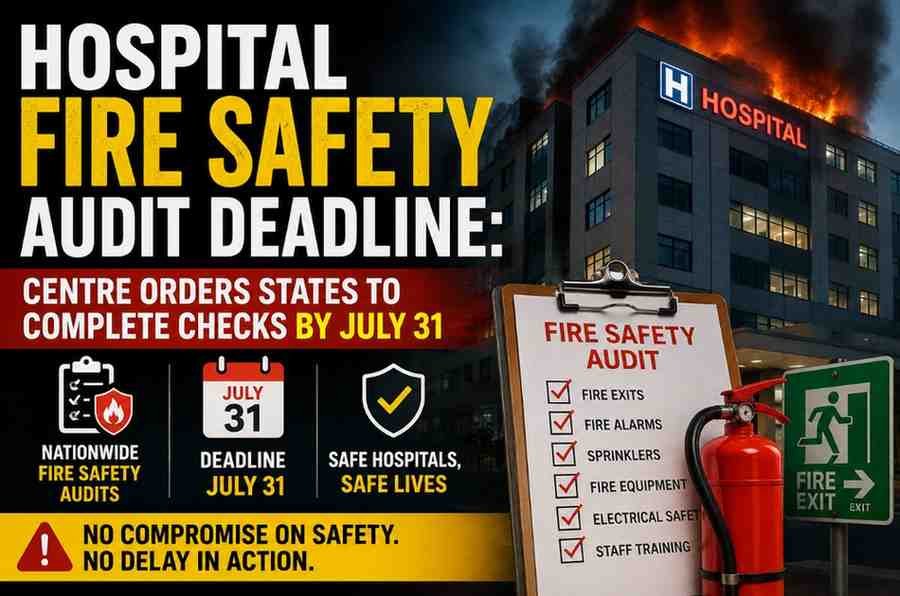
India’s hospitals have a fire safety problem that keeps repeating itself in the same tragic pattern: a blaze breaks out, often traced to an electrical fault, a government letter follows demanding urgent action, and then attention fades until the next incident. The Centre’s latest move a hard deadline of July 31, 2026, for every state and union territory to complete fire safety audits of all public and private hospitals is an attempt to break that cycle by attaching a date, a reporting platform, and a monthly follow-up requirement to what has historically been a one-time advisory.
Who issued the order: Union Health Secretary Punya Salila Srivastava, in a formal letter to the chief secretaries of all states and union territories. What is being demanded: a complete fire safety audit of every hospital, government and private, with special scrutiny of intensive care units, neonatal ICUs, and nurseries. When: audits must be finished by July 31, 2026, with monthly internal audits required afterward. Where: nationwide, across every state and UT health department. Why: a recent fire at Chigateri District Hospital in Karnataka, layered on top of a string of earlier hospital fire tragedies, exposed how uneven and inconsistent safety compliance still is. How compliance will be tracked: hospitals must upload their audit findings to the Integrated Health Information Platform (IHIP), giving the Centre, for the first time, a searchable national record instead of scattered paperwork sitting in state offices.
Background: A Pattern of Warnings That Preceded This Deadline
To understand why this directive matters, it helps to look at what came before it — because this is not the Health Ministry‘s first attempt to fix the problem.
The most searing recent example was the November 2024 fire in a neonatal intensive care unit at a government hospital in Jhansi, Uttar Pradesh, suspected to have been triggered by an electrical short-circuit. Ten infants died. In the aftermath, Srivastava sent an earlier letter urging states to review fire prevention and response plans, form district-level committees led by district collectors, and enforce Section 32 of the Clinical Establishments (Registration and Regulation) Act, 2010 — a provision that allows authorities to cancel the registration of any facility posing an imminent danger to patients.
That 2024 letter identified two structural weaknesses that still echo through the current directive: a large share of hospital fires trace back to poorly maintained electrical systems, and India lacks a centralized, searchable database of health facilities, which makes it nearly impossible for regulators to know, in real time, which hospitals have been inspected and which haven’t.
By May 2026, the ministry had shifted from advisories to infrastructure. It launched a nationwide Fire Safety Week (May 4–10), released the National Guidelines on Fire and Life Safety in Healthcare Facilities (2026), and reported that more than 50,000 healthcare workers had completed fire safety training through the government’s iGOT platform. That same month, 4,083 secondary-level hospitals reportedly completed their audits a meaningful number, but still only a fraction of India’s total hospital network, which includes tens of thousands of private nursing homes and clinics that fall outside routine government oversight.
The July 31 deadline is best understood as the enforcement layer bolted onto that groundwork: the guidelines and training already exist; now every facility has to actually prove it applied them, on a fixed timeline, in a system the Centre can audit from Delhi.
| Timeline | Event |
|---|---|
| 2010 | Clinical Establishments (Registration and Regulation) Act passed, including Section 32 allowing cancellation of registration for facilities posing imminent danger |
| November 2024 | Fire at a government hospital NICU in Jhansi, Uttar Pradesh, kills 10 infants; Centre issues advisory urging fire safety reviews and district-level inspection committees |
| May 4–10, 2026 | Health Ministry holds nationwide Fire Safety Week; releases National Guidelines on Fire and Life Safety in Healthcare Facilities (2026) |
| May 2026 | 4,083 secondary-level hospitals reportedly complete fire safety audits under the new guidelines |
| Early July 2026 | Fire at Chigateri District Hospital, Karnataka, prompts renewed urgency |
| July 31, 2026 | Deadline for all states and UTs to complete fire safety audits of every public and private hospital, with findings uploaded to IHIP |
What the Directive Actually Requires
Reading past the headline, the letter sets out a fairly specific compliance framework rather than a vague call to “be safer.” The core elements include:
- Universal coverage: both public and private hospitals fall under the audit requirement not just government-run facilities, which have historically received more scrutiny than the private sector.
- Priority zones: intensive care units, neonatal ICUs, and nurseries are explicitly flagged for extra attention, a direct response to the fact that the Jhansi tragedy and similar incidents have disproportionately involved these high-dependency wards where patients cannot evacuate on their own.
- Digital reporting through IHIP: audit results must be uploaded to the Integrated Health Information Platform, converting what used to be siloed state-level paperwork into a centralized, theoretically real-time national record.
- Recurring compliance, not a one-off check: the mandate requires monthly internal audits going forward, acknowledging that a single inspection is meaningless if wiring, extinguishers, and alarm systems aren’t checked again for another five years.
Why This Matters: The Gap Between Guidelines and Ground Reality
Here’s the analytical point that’s easy to miss in routine news coverage of this story: India has not been short on fire safety guidelines for hospitals. What it has been short on is a mechanism to verify that guidelines translate into action at the level of an individual ward’s wiring, extinguisher expiry dates, and evacuation drills.
The health ministry’s own stated concerns repeated across both the 2024 and 2026 communications point to the same root causes: aging or poorly maintained electrical systems, and the absence of a centralized database that lets regulators actually see which facilities have been checked. Requiring uploads to IHIP is a direct attempt to solve the second problem. Whether it solves the first depends entirely on whether state and district officials treat the July 31 deadline as a genuine inspection exercise or a box-ticking paperwork drill a distinction that, historically, has determined whether these initiatives outlive the news cycle that produced them.
There’s also a legal lever attached to all of this that deserves more attention than it usually gets: Section 32 of the Clinical Establishments Act allows registration to be revoked for facilities posing imminent danger. That’s a meaningful enforcement tool on paper, but its actual use against private hospitals and nursing homes which make up a huge share of India’s healthcare capacity and are often harder to regulate than government facilities has been inconsistent. The success of this July 31 push will likely hinge less on the audit itself and more on whether authorities are willing to actually invoke that provision against facilities that fail.
Real-World Impact: Who Feels This First
For patients and families, the most immediate effect of this directive is largely invisible it plays out in inspection checklists, wiring upgrades, and drill schedules rather than anything visible on a hospital floor. But the stakes are concrete. Fire risk in a hospital is fundamentally different from fire risk in an office building or home, because a meaningful share of patients those on ventilators in an ICU, premature infants in incubators, post-surgical patients who can’t walk cannot self-evacuate. That’s precisely why the directive singles out ICUs, NICUs, and nurseries rather than treating hospital fire safety as a generic building-code issue.
For hospital administrators, particularly those running smaller private nursing homes, the July 31 deadline creates real operational pressure. Many private facilities operate on thin margins and have historically deferred electrical upgrades and fire suppression system maintenance as non-urgent capital expenses. A hard, publicly tracked deadline with results visible to state health departments through IHIP changes that calculus, at least on paper.
For state governments, the burden is administrative as much as technical: standing up district-level inspection committees, coordinating with fire services departments, and actually getting tens of thousands of facilities to report through a single digital platform within a matter of weeks is a significant logistical undertaking, especially for states with large numbers of small, rural, or under-resourced hospitals.
The Comparison Worth Making
It’s worth setting this against how other countries approach hospital fire compliance. In many Western healthcare systems, fire safety compliance is tied directly to hospital accreditation and insurance a facility that fails an audit risks losing its operating license or accreditation almost automatically, with far less room for a “cure period.” India’s approach, by contrast, has historically leaned on advisories and voluntary compliance, with legal revocation under Section 32 available but rarely used as a routine enforcement tool. The July 31 deadline, paired with digital tracking through IHIP, is arguably India’s first real attempt to close that gap building a system where non-compliance is at least visible to regulators, even if the punitive consequences remain less automatic than in comparable healthcare systems elsewhere.
A Prediction: Compliance Will Be Uneven, and That’s Where the Real Story Sits
Given the scale of India’s hospital network spanning large government medical colleges, mid-sized district hospitals, and thousands of small private nursing homes full, verified compliance by July 31 is unlikely across the board. The more realistic outcome is a compliance pattern that mirrors what happened with the May audits: large government and secondary-level hospitals, which are easier for district committees to reach and which face more direct political accountability, will likely report completion at higher rates. Smaller private facilities, especially in less urbanized districts, are the group most likely to lag and, based on the pattern of past incidents, they’re also statistically the group where the next serious fire is more likely to originate. The real test of this directive won’t be the July 31 headline number of audits completed; it will be whether the monthly internal audit requirement actually survives past the initial deadline, or fades the way earlier advisories did once media attention moves on.
Conclusion: A Deadline That Only Means Something If It’s Enforced
The Centre’s July 31 fire safety audit deadline is the most concrete, trackable step India’s health ministry has taken yet on hospital fire safety a hard date, a digital reporting system, recurring monthly checks, and explicit focus on the wards where patients are least able to protect themselves. It builds directly on lessons drawn from the 2024 Jhansi tragedy and the infrastructure laid down through Fire Safety Week and the 2026 national guidelines.
But directives like this have failed before, not for lack of good intentions, but for lack of follow-through once the immediate news cycle passes. The real measure of success won’t be visible on July 31 itself it will show up months later, in whether monthly audits actually continue, whether IHIP data is used to flag and act on non-compliant hospitals, and whether Section 32’s revocation power is ever meaningfully applied to a private facility that fails to fix what an audit finds. Until then, this deadline is a genuinely stronger step than what came before it but it’s a promise that still has to be kept.
For breaking news and live news updates, like us on Facebook or follow us on Twitter and Instagram. Read more on Latest Health on thefoxdaily.com.

COMMENTS 0