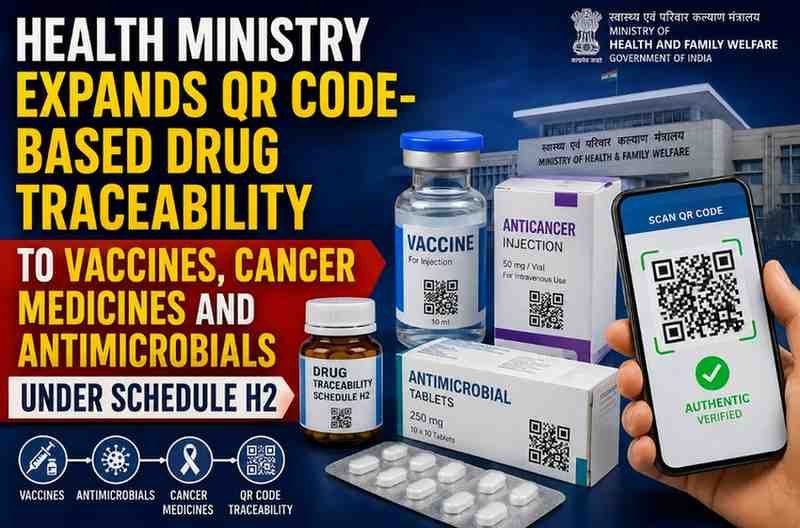
In a major step toward strengthening drug safety and combating counterfeit medicines, the Ministry of Health and Family Welfare has expanded India’s QR code-based drug traceability system to include vaccines, anti-cancer medicines, antimicrobials and medicines regulated under the Narcotic Drugs and Psychotropic Substances (NDPS) Act. The move comes through amendments to the Drugs Rules that introduce a new regulatory category Schedule H2.
The revised framework is designed to improve transparency across the pharmaceutical supply chain by enabling medicines to be tracked from the manufacturer to the patient. With phased implementation scheduled to begin from July 2027, the initiative is expected to enhance patient safety, reduce the circulation of counterfeit drugs, and improve accountability throughout India’s healthcare ecosystem.
The reform reflects India’s growing emphasis on digital healthcare infrastructure and pharmaceutical quality assurance, particularly for medicines where authenticity and proper handling are critical.
What Is Schedule H2?
Schedule H2 is a newly introduced regulatory category under the amended Drugs Rules that covers medicines requiring enhanced monitoring because of their medical importance, potential for misuse, or the need for strict quality assurance.
Unlike routine prescription medicines, drugs listed under Schedule H2 will be subject to additional traceability requirements using digital identification technologies such as QR codes.
The objective is not to restrict access but to ensure every unit of medicine can be identified, verified, and traced throughout its journey in the supply chain.
Which Medicines Will Come Under the New Rules?
The expanded traceability framework includes several high-priority medicine categories that play a crucial role in public health.
- Vaccines
- Anti-cancer medicines
- Antimicrobial drugs, including antibiotics
- Medicines regulated under the NDPS Act
- Other notified Schedule H2 medicines as identified by regulators
These medicines are particularly vulnerable to counterfeiting, diversion, improper storage, or unauthorized distribution, making traceability especially valuable.
Why QR Code-Based Drug Traceability Matters
Every year, counterfeit and substandard medicines pose serious risks to patients worldwide. Fake drugs may contain incorrect ingredients, wrong dosages, harmful contaminants, or no active medicine at all.
QR code-based traceability creates a digital identity for every medicine pack, making it easier for regulators, distributors, hospitals, pharmacies, and potentially even patients to verify authenticity.
The technology also helps authorities identify where problems occur if quality issues or recalls arise.
How the Traceability System Works
Although implementation details may evolve over time, QR code-based systems generally allow every medicine pack to carry a unique digital identifier.
The code may include information such as:
- Product name
- Batch number
- Manufacturing details
- Expiry date
- Manufacturer identification
- Unique serial number for tracking
Each movement of the product through the supply chain can then be digitally recorded, creating an auditable history from production to distribution.
| Feature | Benefit |
|---|---|
| QR Code Identification | Quick verification of medicine authenticity |
| Batch-Level Tracking | Faster product recalls when required |
| Supply Chain Monitoring | Improved transparency and accountability |
| Digital Records | Better regulatory oversight |
| Unique Product Identity | Reduced circulation of counterfeit medicines |
Why Vaccines Require Enhanced Traceability
Vaccines are among the most sensitive pharmaceutical products because they often require strict temperature control throughout storage and transportation. Even minor deviations can affect their effectiveness.
A digital traceability system can improve confidence in vaccine distribution by enabling better monitoring of product movement and helping identify affected batches if quality concerns arise.
The approach also supports public health programs by strengthening confidence in immunization supply chains.
The Importance of Tracking Cancer Medicines
Cancer medicines are often high-value products that require careful handling and timely availability. Counterfeit oncology drugs can have devastating consequences because patients depend on precise treatment regimens.
Improved traceability helps ensure that genuine medicines reach hospitals and patients while making unauthorized diversion more difficult.
It also enhances the ability to investigate supply disruptions and quality complaints.
Why Antimicrobials Are Included
Antimicrobial resistance has become one of the world’s most pressing health challenges. While QR codes alone cannot solve antibiotic misuse, better tracking may improve regulatory oversight and discourage unauthorized distribution.
Enhanced monitoring can also support pharmacovigilance and strengthen efforts to promote responsible antimicrobial use.
This complements broader public health initiatives aimed at preserving the effectiveness of life-saving antibiotics.
Benefits for Patients and Healthcare Providers
The new framework has the potential to improve confidence across the healthcare system.
- Greater assurance that medicines are authentic
- Improved patient safety
- More efficient recall processes
- Enhanced transparency across distribution networks
- Better monitoring of high-risk medicines
- Strengthened regulatory compliance
For healthcare providers, the system may also simplify inventory verification and quality assurance processes.
Challenges in Nationwide Implementation
Although the benefits are significant, implementing nationwide pharmaceutical traceability presents logistical and technical challenges.
Manufacturers will need to upgrade packaging systems, integrate digital tracking technologies, and ensure compatibility across supply chains. Pharmacies, distributors, and hospitals may also require infrastructure upgrades and staff training.
The phased rollout beginning in July 2027 is expected to provide stakeholders with time to prepare for these changes.
How India Compares With Global Trends
Several countries have already introduced medicine serialization and digital traceability systems to combat counterfeit pharmaceuticals. India’s expansion of QR code-based tracking aligns with this global movement toward safer and more transparent medicine supply chains.
As one of the world’s largest pharmaceutical manufacturers, India’s adoption of advanced traceability technologies could also strengthen international confidence in its pharmaceutical exports.
The initiative reflects the broader digital transformation taking place across healthcare regulation worldwide.
The Bigger Picture: Building a Digital Pharmaceutical Ecosystem
The Schedule H2 amendments represent more than a regulatory update—they are part of a broader shift toward digitally connected healthcare systems. By integrating technology into medicine regulation, authorities aim to improve surveillance, strengthen public trust, and support faster responses to safety concerns.
Over time, similar technologies could be integrated with electronic health records, pharmacy management systems, and pharmacovigilance programs to create a more resilient healthcare ecosystem.
The move also signals that future pharmaceutical regulation is likely to rely increasingly on real-time digital data rather than traditional paper-based documentation.
Conclusion
The Health Ministry’s decision to expand QR code-based drug traceability through the introduction of Schedule H2 marks an important milestone in India’s pharmaceutical regulatory landscape. By bringing vaccines, anti-cancer medicines, antimicrobials, and NDPS-regulated drugs under enhanced digital monitoring, the government aims to strengthen patient safety and protect the integrity of medicine supply chains.
Although nationwide implementation will require careful planning and collaboration across the pharmaceutical industry, the phased rollout beginning in July 2027 offers a clear roadmap for modernization.
As counterfeit medicines and supply chain challenges continue to evolve globally, digital traceability is expected to become an increasingly important tool in ensuring that patients receive safe, authentic, and high-quality medicines when they need them most.
For breaking news and live news updates, like us on Facebook or follow us on Twitter and Instagram. Read more on Latest Health on thefoxdaily.com.






COMMENTS 0