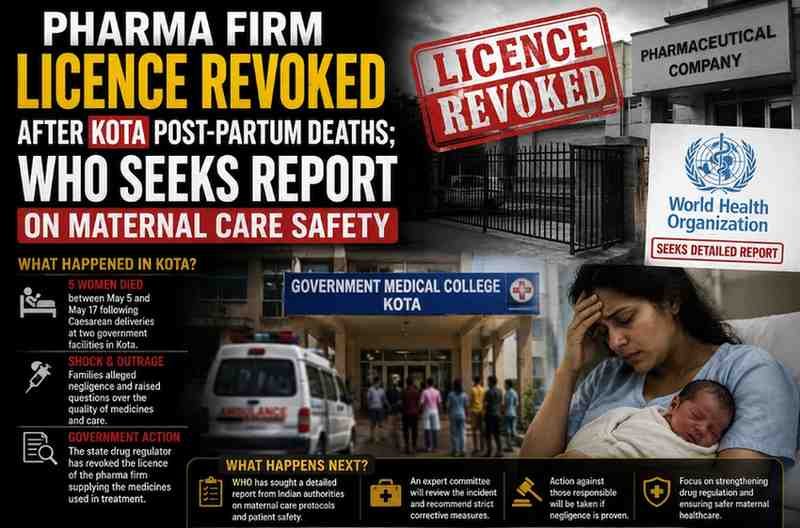
The deaths of five women following Caesarean section deliveries at government hospitals in Kota, Rajasthan, have triggered one of the country’s most closely watched healthcare investigations. In response, authorities have revoked the licence of the pharmaceutical company linked to medicines under investigation, while the World Health Organization (WHO) has requested a detailed report on the incident.
The women died between May 5 and May 17, 2026, after undergoing C-section procedures at JK Lone Hospital and the Super Speciality Wing of Government Medical College, Kota. Although investigations are ongoing, the incident has raised serious questions about pharmaceutical quality assurance, hospital infection control, procurement systems, and patient safety.
Health experts caution that determining the precise cause of such incidents requires comprehensive scientific investigation. Until official findings are completed, conclusions regarding the exact sequence of events remain premature. However, the case has already prompted regulatory action and renewed discussions on strengthening India’s maternal healthcare safeguards.
What Happened in Kota?
According to official reports, five women who had undergone Caesarean section deliveries at two government healthcare facilities in Kota died during the period between May 5 and May 17.
The deaths prompted an immediate investigation involving state health authorities and regulatory agencies. As inquiries progressed, concerns emerged regarding medicines supplied during patient treatment, leading regulators to examine manufacturing, quality control, storage, and supply-chain documentation.
Following preliminary findings, authorities revoked the licence of the pharmaceutical company associated with the medicines under investigation while further inquiries continue.
Why the Licence Was Revoked
Drug manufacturing licences may be suspended or revoked when regulators identify serious violations involving quality standards, manufacturing practices, or regulatory compliance.
Such action is generally taken to protect public health while investigations determine whether products meet required safety and quality benchmarks.
Revoking a licence does not automatically establish criminal liability or determine the final outcome of an investigation. Instead, it serves as an important regulatory measure aimed at preventing potential risks until all evidence has been thoroughly examined.
Why the WHO Has Sought a Report
The involvement of the World Health Organization highlights the broader public health significance of maternal safety incidents.
WHO routinely monitors significant healthcare events that may have implications for medicine safety, infection control, clinical practices, or healthcare quality.
By seeking a detailed report, the organization can better understand the circumstances surrounding the incident and assess whether broader public health lessons may emerge for healthcare systems.
Understanding Post-Partum Care After Caesarean Delivery
A Caesarean section is a major surgical procedure requiring careful monitoring during recovery.
After surgery, healthcare teams routinely observe patients for:
- Signs of infection.
- Bleeding complications.
- Blood pressure changes.
- Pain management.
- Medication response.
- Overall recovery progress.
Safe recovery depends on multiple factors, including surgical technique, sterile operating conditions, appropriate medications, nursing care, and timely recognition of complications.
Why Medicine Quality Matters in Hospital Care
Medicines used in surgical care undergo rigorous regulatory oversight before reaching hospitals. Manufacturers are expected to comply with strict quality standards covering raw materials, production processes, laboratory testing, packaging, storage, and distribution.
If concerns arise regarding product quality, regulators may initiate sampling, laboratory analysis, manufacturing inspections, and distribution reviews.
These systems are designed to detect potential problems before they affect larger numbers of patients.
| Area Under Investigation | Purpose |
|---|---|
| Medicine quality | Verify compliance with safety standards |
| Manufacturing practices | Assess production quality |
| Hospital protocols | Review patient care procedures |
| Drug storage | Ensure medicines remained stable |
| Supply chain | Trace product movement and documentation |
How Such Investigations Typically Proceed
Major healthcare investigations generally involve multiple agencies working together.
Authorities may examine:
- Patient medical records.
- Hospital treatment protocols.
- Laboratory test results.
- Medicine samples.
- Manufacturing facilities.
- Distribution records.
- Clinical expert opinions.
The objective is to identify contributing factors accurately while preventing similar incidents in the future.
The Importance of Maternal Healthcare Safety
Maternal healthcare extends far beyond childbirth itself. Safe pregnancy outcomes depend on coordinated care before delivery, during labour, surgery when necessary, and throughout the recovery period.
Modern maternity care emphasizes:
- Evidence-based clinical practices.
- Strict infection prevention.
- Safe medication management.
- Emergency preparedness.
- Continuous patient monitoring.
- Quality assurance systems.
Maintaining these standards helps reduce preventable complications and improves outcomes for both mothers and newborns.
What This Means for India’s Pharmaceutical Industry
India is one of the world’s largest producers of medicines, supplying pharmaceutical products to domestic and international markets.
Cases involving suspected quality concerns reinforce the importance of maintaining robust regulatory oversight throughout manufacturing and distribution.
They also demonstrate why continuous inspections, quality testing, and transparent reporting remain essential to protecting public confidence in healthcare systems.
| Healthcare Safety Measure | Benefit |
|---|---|
| Quality drug manufacturing | Reduces patient risk |
| Regular regulatory inspections | Improves compliance |
| Hospital infection control | Prevents surgical complications |
| Clinical monitoring | Enables early detection of problems |
| Transparent investigations | Builds public trust |
The Bigger Picture: Strengthening Patient Safety Systems
While investigations often focus on individual incidents, healthcare experts increasingly emphasize strengthening entire safety systems rather than addressing isolated failures. This includes improving hospital quality assurance, enhancing medicine surveillance, modernizing procurement systems, expanding pharmacovigilance, and ensuring rapid reporting of adverse events.
Such system-wide improvements help healthcare institutions identify potential risks earlier while reducing the likelihood of similar incidents in the future.
What Patients and Families Should Know
Incidents involving hospital investigations can understandably create anxiety among patients. However, experts advise against drawing conclusions before official investigations are completed.
Patients undergoing surgery should continue following medical advice, discuss any concerns directly with their healthcare providers, and seek immediate medical attention if they experience unusual symptoms after discharge.
Healthcare decisions should always be based on qualified medical guidance rather than speculation surrounding ongoing investigations.
Conclusion
The deaths of five women following Caesarean section deliveries in Kota have prompted significant regulatory action, including the revocation of a pharmaceutical company’s licence and a request from the World Health Organization for a detailed report. While investigations continue to determine the precise causes, the incident underscores the importance of rigorous medicine quality standards, hospital safety protocols, and transparent regulatory oversight.
Beyond identifying accountability, the broader objective is to strengthen maternal healthcare systems and ensure that lessons learned lead to safer clinical practices across hospitals. Maintaining public confidence in healthcare requires not only thorough investigations but also continuous improvements in patient safety, pharmaceutical regulation, and quality assurance.
For breaking news and live news updates, like us on Facebook or follow us on Twitter and Instagram. Read more on Latest Health on thefoxdaily.com.






COMMENTS 0