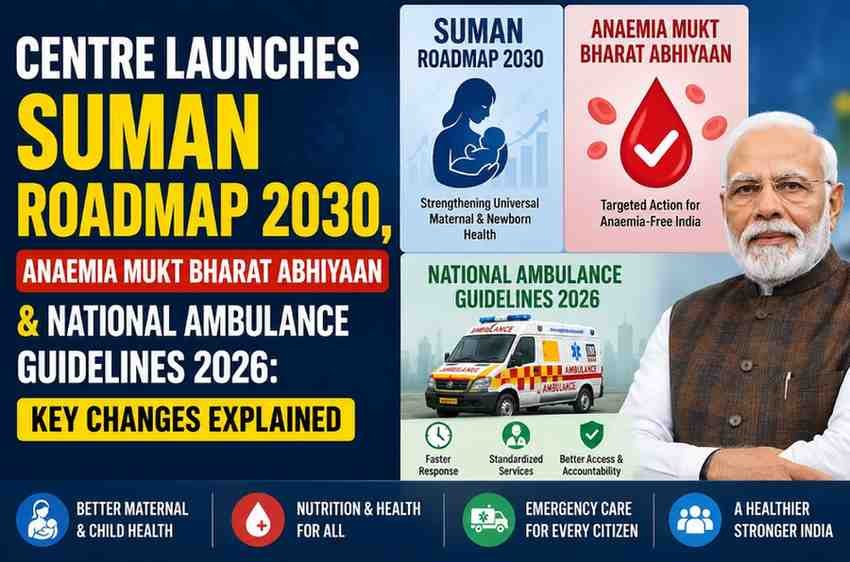
On June 29, 2026, at the 16th meeting of theCentral Council of Health and Family Welfare in Vigyan Bhawan, New Delhi, UnionHealth Minister J.P. Nadda rolled out three policy documents that, takentogether, mark the most significant restructuring of India’s maternal and childhealth architecture in nearly a decade. The SUMAN Roadmap2030, the revised Anaemia Mukt Bharat Abhiyaanoperational guidelines, and the new OperationalGuidelines on National Ambulance Services (NAS), 2026 werereleased together, and that timing is not incidental. Each addresses adifferent failure point in the same chain of care: getting a pregnant womantested and treated in time, getting her to a facility in time, and keeping herand her newborn alive once she’s there.
Who launched it: Union Health Minister J.P. Nadda,through the Ministry of Health and Family Welfare. What was launched: threelinked frameworks covering anaemia management, emergency transport, and a 2030maternal-newborn mortality strategy. When: June 29, 2026. Where: the CCHFWconference in New Delhi, a body that brings together health ministers fromevery state and Union Territory. Why: India’s maternal mortality ratio andinfant mortality rate have fallen sharply over the past two decades, but progresshas plateaued in several high-burden states, and officials want a renewed,time-bound push to hit Sustainable Development Goal targets before 2030.
This article goes beyond the press-release summaryto explain what’s actually changing on the ground, why the sequencing of thesethree announcements matters more than it appears, and what the policy gaps andexecution risks are that most coverage has skipped over.
Why These Three Announcements BelongTogether
Most reporting has treated the SUMAN Roadmap, theanaemia guidelines, and the ambulance framework as three separate stories.That’s a missed opportunity to see the actual logic of the policy. Maternaldeath in India rarely has a single cause; it’s usually a sequence of failures.A woman enters pregnancy already anaemic because nutrition and screeningsystems missed her. She develops a complication late in pregnancy that isn’tpicked up early enough. When the emergency hits, there’s no ambulance nearby, orthe one that arrives isn’t equipped to stabilise her. By the time she reaches afacility, it’s too late, or the facility itself lacks a High Dependency Unit orICU to manage the crisis.
Releasing the anaemia guidelines, the ambulancestandards, and the 2030 roadmap on the same day signals that the HealthMinistry is trying to close all three gaps simultaneously rather than patchingone and leaving the others open, which is precisely how many previoussingle-scheme interventions have under-delivered. That’s the unique angle worthnoting here: this is less a single new scheme than a synchronised three-partsystem redesign, and its success will depend on how well these three pieces areimplemented together at the district level, not on any one document inisolation.
The Anaemia Mukt Bharat Abhiyaan: From Preventionto Treatment
Anaemia has long been one of India’s most stubbornpublic health problems. It reduces oxygen supply to the body’s organs andtissues, and in pregnant women it sharply raises the risk of complications,premature birth, low birth weight, and maternal death. The original AnaemiaMukt Bharat programme, launched in 2018, focused heavily on prophylactic ironsupplementation — essentially, handing out iron tablets at scale. The revisedguidelines represent a deliberate philosophical shift.
The programme is now renamed Anaemia Mukt BharatAbhiyaan, and its core strategy has moved from theT3 model (Test, Treat, Talk) to a T4 model that adds “Track” as afourth pillar. In practical terms, that means every woman or child tested foranaemia is now meant to be followed through a digital system rather than testedonce and forgotten. For severe anaemia or cases that don’t respond to oraliron, the guidelines formally bring in Intravenous Iron Therapy using FerricCarboxymaltose and Iron Sucrose as a recognised clinical intervention, a meaningfulupgrade from a programme that previously leaned almost entirely onsupplementation.
The beneficiary framework itself has also expanded.The earlier “6x6x6” structure, covering six population groups, sixinterventions and six institutional mechanisms, has become a “7x7x7″framework, with low birth weight infants aged 0 to 6 months added as a newseventh beneficiary group. That single addition matters more than its sizesuggests: it acknowledges that anaemia management can no longer start at schoolage or even at conception, but needs to begin at the most fragile point oflife.
| Feature | Old AnaemiaMukt Bharat | Anaemia Mukt Bharat Abhiyaan(2026) |
|---|---|---|
| Core approach | T3:Test, Treat, Talk | T4: Test, Treat, Talk,Track |
| Beneficiaryframework | 6x6x6 | 7x7x7 (adds 0–6 monthlow birth weight infants) |
| Primaryintervention | Prophylactic oral ironsupplementation | Therapeutic care including IV iron therapy(FCM, Iron Sucrose) |
| Monitoring | Fragmented,paper- and scheme-level tracking | Unified digital trackingvia JANANI, RBSK and U-WIN feeding into one AMB AbhiyaanPortal |
| Communitylayer | Limited outreach | Structuredcommunity participation through “Jan Chetna” |
On the digital side, haemoglobin records forpregnant women will now be captured through the JANANI Portal, while children’sdata flows in through the Rashtriya Bal Swasthya Karyakram and the UniversalImmunisation WIN portal. All three are meant to eventually converge into asingle Anaemia Mukt Bharat Abhiyaan Portal. This is the kind of detail that’seasy to skim past but is actually the load-bearing element of the whole reform:without a working, interoperable data layer, “tracking” remains aslogan rather than a clinical practice. India’s track record with health-datainteroperability across multiple legacy portals has been mixed, and thatintegration risk deserves more scrutiny than it has received so far.
National Ambulance Services Guidelines, 2026:Standardising the Most Overlooked Link in Emergency Care
If anaemia management is about prevention, the newOperational Guidelines on National Ambulance Services address the moment thingsgo wrong. India currently runs ambulance services through a patchwork ofstate-level systems, with wide variation in vehicle quality, staffing,training, and response times. A woman in obstetric distress in a well-resourcedstate may reach a trauma-ready ambulance within minutes; in a high-burden,low-resource district, the “ambulance” may be a borrowed vehicle withno trained attendant on board.
The 2026 guidelines attempt to fix that by settinguniform national standards covering deployment, staffing, equipment andtraining quality across the country. The explicit goal is timely patientstabilisation, transport and referral, treating pre-hospital emergency care asa standardised clinical service rather than a logistics afterthought. This is,frankly, overdue. Emergency obstetric and neonatal transport has historicallybeen the weakest link in India’s “three delays” model of maternal death,the delay in deciding to seek care, the delay in reaching care, and the delayin receiving adequate care once there. Of the three, the delay in reaching carehas had the least dedicated national policy attention, which makes thisframework arguably the most consequential of the three documents released, eventhough it’s likely to get the least headline space.
SUMAN Roadmap 2030: A Life-Cycle Strategy withTeeth
The Surakshit Matritva Aashwasan, or SUMAN,initiative was first launched in 2019 to guarantee zero-cost, dignifiedmaternal and newborn care. The 2030 Roadmap reframes it as a comprehensive,time-bound national strategy aligned with India’s Sustainable Development Goalcommitments on maternal and infant mortality.
Structurally, the roadmap takes a life-cycleapproach, intervening from the pre-pregnancy stage through antenatal care,delivery, and the postnatal period, rather than treating pregnancy as a singleisolated event. Concrete measures include pre-pregnancy folic acidsupplementation for women planning conception, intensified nutritioninterventions to tackle maternal anaemia and undernutrition, and strongertracking of high-risk pregnancies across the antenatal, third-trimester,intrapartum and postnatal stages.
On infrastructure, the roadmap calls for themandatory establishment of Birth Waiting Homes, Maternal and Child HealthWings, Obstetric High Dependency Units and Intensive Care Units specifically indifficult and underserved areas, rather than concentrating advanced facilitiesin urban centres where maternal mortality is already comparatively low. It alsoproposes financial support for a designated caregiver to accompany mothersthrough the postnatal period, a small but meaningful recognition that recovery care,not just delivery care, affects outcomes.
To accelerate impact where it’s needed most, theroadmap introduces time-bound interventions across 130 districts spanning 13high-focus states: Assam, Bihar, Chhattisgarh, Haryana, Jharkhand, Karnataka,Madhya Pradesh, Odisha, Punjab, Rajasthan, Uttar Pradesh, Uttarakhand and WestBengal. This district-targeted design is a notable departure from earlierblanket, state-wide schemes, and reflects a more data-driven approach toresource allocation.
Community ownership is built in through “SUMANPanchayats,” aimed at driving zero maternal and infant deaths, universalantenatal care, institutional deliveries and full immunisation at the locallevel, supported by a new “Mothers’ Picnic” initiative designed tomake awareness-building feel less clinical and more participatory. On thetechnology side, the roadmap brings in AI-enabled labour rooms, expanded use ofNon-Pneumatic Anti-Shock Garments for managing obstetric haemorrhage, strengthenedMaternal Death Surveillance and Response systems, and a centralised SUMAN CallCentre for grievance redressal. It also explicitly flags climate-responsivehealthcare planning, an acknowledgment that heatwaves, flooding and extremeweather increasingly disrupt maternal care access in vulnerable districts, adimension almost entirely absent from India’s earlier maternal healthframeworks.
What Most Coverage Is Missing
Three things deserve more attention than they’vegotten so far. First, the success of this entire package hinges on portalintegration, not policy language. The Anaemia Mukt Bharat Abhiyaan Portal, theJANANI Portal and the ambulance dispatch systems all need to talk to each otherin real time for a “tracked” high-risk pregnancy to actually triggera faster ambulance response. If these systems remain siloed, the system reformon paper won’t translate into faster response on the ground.
Second, the district-targeting model used in theSUMAN Roadmap, concentrating intensive intervention in 130 high-burdendistricts, is a reasonable resource-allocation choice, but it also meansoutcomes in the remaining districts will depend almost entirely on each state’sown implementation capacity. Comparisons with countries that have successfullycut maternal mortality, such as Sri Lanka’s decades-long investment in skilledbirth attendance and referral transport, suggest that the transport and HDU/ICUinfrastructure commitments in this roadmap, if funded and staffed consistently,could be the single highest-leverage piece of the entire package, more so thanthe anaemia portal integration.
Third, expect implementation friction at the statelevel before any mortality data moves. Ambulance staffing standards, inparticular, will require states to recruit and train personnel at a pace thathas historically lagged policy announcements; a realistic prediction is thatthe National Ambulance Services guidelines will see uneven, multi-year rollout,with better-resourced states adopting them faster than the 13 high-focus statesthe SUMAN Roadmap is specifically trying to help.
Conclusion: A Coordinated Bet on the 2030Deadline
Taken individually, the revised Anaemia Mukt BharatAbhiyaan, the National Ambulance Services guidelines, and the SUMAN Roadmap2030 are each useful but incremental updates to existing programmes. Takentogether, they represent a coordinated attempt to close theprevention-to-emergency-to-recovery chain that has historically determinedwhether a maternal or newborn complication in India ends in survival or death.The real test won’t be the documents released in Vigyan Bhawan; it will bewhether the digital portals actually integrate, whether ambulance staffingstandards are funded and enforced at the district level, and whether the 130high-focus districts see measurably faster declines in maternal and infantmortality over the next few years. With 2030 as the stated horizon, the nexttwo or three CCHFW meetings will be the real indicator of whether thissynchronised approach is working, or whether it becomes anotherwell-intentioned framework that outpaces ground-level execution.
For breaking news and live news updates, like us on Facebook or follow us on Twitter and Instagram. Read more on Latest Health on thefoxdaily.com.





COMMENTS 0