Dengue fever continues to pose a major public health challenge in tropical and subtropical regions, with rising temperatures, urbanization, and changing rainfall patterns contributing to the spread of mosquito-borne diseases. Against this backdrop, vaccines are increasingly viewed as a critical tool in reducing severe illness and hospitalizations.
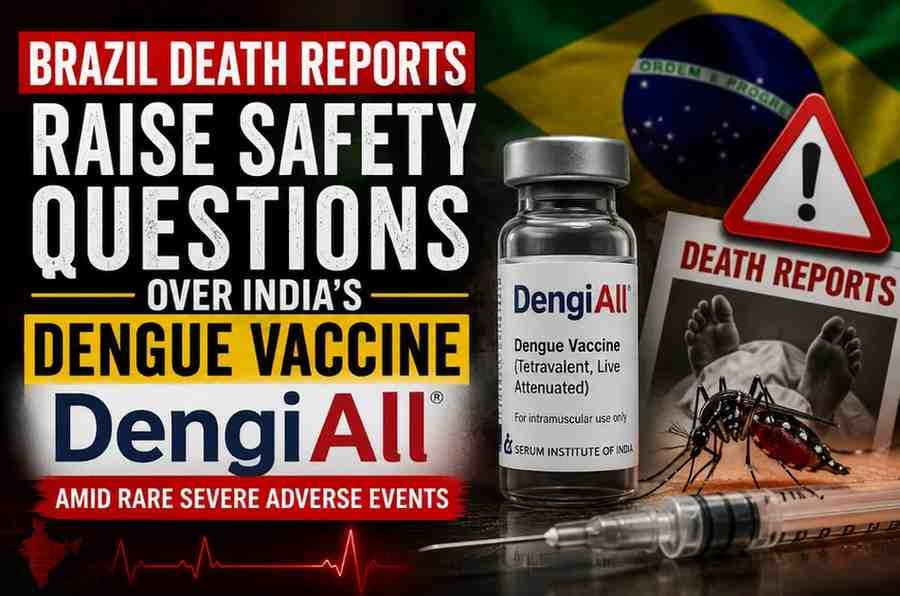
However, recent reports from Brazil involving deaths and dozens of severe adverse events linked to India’s dengue vaccine, DengiAll, have sparked concern among healthcare professionals and the public alike. According to Brazilian authorities, 42 severe adverse events were recorded among approximately half a million vaccinated individuals—a rate of roughly 0.008%.
Statistically, that represents an extremely small risk. But medicine is not experienced statistically by individuals and families. For someone who suffers a severe complication, percentages offer little comfort. This tension lies at the heart of modern vaccine debates.
Why Dengue Vaccines Matter More Than Ever
Dengue has evolved from a seasonal tropical illness into one of the world’s fastest-growing vector-borne diseases. Mosquitoes carrying the virus are spreading into new regions, and outbreaks are becoming increasingly frequent.
Severe dengue can cause:
- High fever.
- Internal bleeding.
- Shock syndrome.
- Organ damage.
- Hospitalization and death.
Because there is no specific antiviral cure for dengue, prevention through mosquito control and vaccination remains a central public health strategy.
What Happened in Brazil?
Brazil, one of the countries most heavily affected by dengue outbreaks, has been expanding its use of vaccines to reduce disease burden.
Following the administration of around 500,000 doses of DengiAll, authorities identified 42 severe adverse events. Reports of deaths associated with these cases have prompted investigations and renewed discussions regarding vaccine monitoring and risk assessment.
Brazilian health officials have stressed that the overwhelming majority of vaccinated individuals experienced no serious complications, emphasizing that the benefits of preventing dengue-related hospitalizations and deaths remain substantial.
Understanding Severe Adverse Events
A severe adverse event following vaccination does not automatically prove that the vaccine caused the outcome.
Health authorities typically investigate whether:
- The event was directly caused by the vaccine.
- An underlying medical condition contributed.
- Coincidental illness occurred after vaccination.
- Specific risk factors increased vulnerability.
These investigations are essential because temporal association does not always imply causation.
Why Rare Risks Can Become Major Headlines
Vaccines are administered to healthy individuals, meaning society expects exceptionally high safety standards.
Even extremely rare adverse reactions receive intense attention because they involve preventive medicine rather than treatment for existing illness.
This scrutiny is not unique to dengue vaccines. Similar discussions have surrounded vaccines for influenza, COVID-19, and other infectious diseases.
The challenge for public health authorities is maintaining transparency without amplifying fear.
Comparison: Population Risk vs Individual Risk
| Perspective | Population-Level View | Individual-Level View |
|---|---|---|
| Main concern | Preventing large outbreaks | Avoiding personal harm |
| Risk assessment | Based on statistics | Based on personal outcomes |
| Benefits | Reduced disease burden | Protection against infection |
| Tolerance for adverse events | Very low | Virtually zero |
| Public expectation | Maximum benefit | Maximum safety |
The Importance of Pharmacovigilance
Modern vaccines do not stop being monitored after approval.
Continuous surveillance systems—known as pharmacovigilance—track safety signals and investigate unexpected reactions.
These systems help authorities:
- Detect rare complications.
- Identify high-risk groups.
- Update recommendations.
- Improve vaccine safety profiles.
- Maintain public trust.
In many ways, post-approval monitoring is as important as clinical trials.
An Insight Competitors Often Miss: Vaccine Success Makes Risk More Visible
Paradoxically, successful vaccination programs can make adverse events appear more prominent.
When millions of people are protected from disease, those prevented illnesses remain invisible. What becomes visible are the rare complications.
This creates a perception imbalance.
For example, preventing thousands of hospitalizations may receive little public attention, while a handful of severe reactions dominate headlines.
Experts argue that risk communication should account for both realities—the benefits and the harms—rather than focusing exclusively on one side.
Dengue Itself Carries Serious Risks
Discussions about vaccine safety should also consider the disease being prevented.
Dengue infections can result in:
- Severe bleeding.
- Plasma leakage.
- Shock syndrome.
- Hospital admissions.
- Deaths, particularly among vulnerable populations.
Public health decisions often involve comparing two risks rather than choosing between risk and no risk.
This makes vaccine policy one of the most complex areas of medicine.
Why Transparency Matters More Than Reassurance Alone
Public confidence is built not by denying concerns but by addressing them openly.
Experts emphasize that transparency regarding adverse events strengthens trust rather than undermining it.
People are more likely to accept vaccination when they believe authorities are honestly communicating both benefits and limitations.
Acknowledging uncertainty and investigating every serious event remain essential components of ethical public health.
The Future of Dengue Vaccination
Researchers continue working on next-generation vaccines designed to provide broader protection and improved safety.
Future advances may include:
- Better identification of risk factors.
- Personalized vaccination strategies.
- Enhanced surveillance systems.
- Improved vaccine formulations.
- More precise recommendations based on age and immune status.
As dengue spreads globally, the demand for effective and safe preventive tools will only increase.
Conclusion
The reports of deaths and severe adverse events associated with DengiAll in Brazil have raised important questions about vaccine safety, risk communication, and public trust. While authorities emphasize that the incidence of serious reactions remains extremely low at the population level, each severe outcome deserves thorough investigation and transparency.
Ultimately, vaccine policy is rarely about choosing between perfect safety and perfect protection. It involves balancing the risks of disease against the risks of intervention a challenge that requires scientific rigor, ethical responsibility, and clear communication.
As investigations continue, one principle remains clear: maintaining trust is just as important as maintaining immunity.
For breaking news and live news updates, like us on Facebook or follow us on Twitter and Instagram. Read more on Latest Health on thefoxdaily.com.





COMMENTS 0