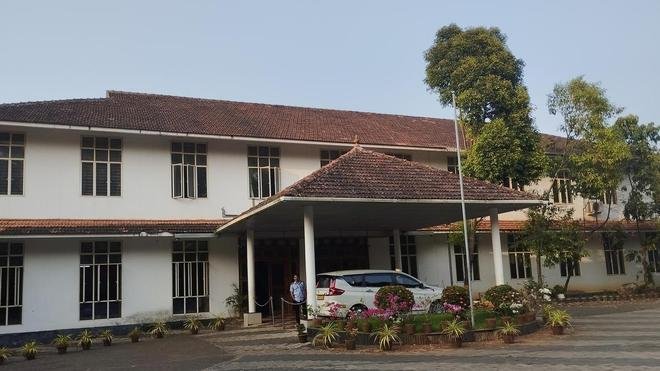
IMHANS Kozhikode remains without a full-time director, leaving one of Kerala’s most important public mental-health institutions under interim leadership. The Institute of Mental Health and Neurosciences currently lists Dr Jithu V P as Director (In-charge), even as the institution continues its work in clinical care, postgraduate training, research, community mental health and policy development.
The leadership vacancy is significant because IMHANS is not an ordinary hospital. It is an autonomous institution under the Government of Kerala and was selected by the Government of India to develop as a centre of excellence in mental health. Its responsibilities extend across treatment, education, research, rehabilitation and public-health programmes.
The previous LDF government had initiated the process to appoint a full-time director, but the exercise could not be completed for various reasons. The continued absence of a regular head therefore raises a broader administrative question: how long can an institution with such a wide mandate effectively operate without completing its permanent leadership structure?
Why the IMHANS director’s post is important
The director of a specialist institution such as IMHANS is not merely an administrative designation. The position sits at the intersection of clinical services, academic programmes, research, staffing, financial management and institutional planning.
IMHANS describes its core focus as mental-health care delivery, training, research and policy development. It is also affiliated with Kerala University of Health Sciences as a postgraduate training centre and operates from the Government Medical College campus in Kozhikode.
That combination makes institutional leadership particularly important. A director has to balance the immediate demands of patient care with longer-term priorities such as recruitment, infrastructure development, academic expansion, research programmes and community-based mental-health services.
An in-charge arrangement can maintain continuity, but it is not necessarily equivalent to having a permanent appointment backed by a full mandate and a defined long-term institutional vision.
What is the current status at IMHANS?
The institute’s official administration information currently identifies Dr Jithu V P as Director (In-charge). The same institutional information shows that the director serves as convener of both the governing body and executive committee structures.
This is an important detail because it illustrates how central the position is to the functioning of IMHANS.
The governing body includes senior representatives from Kerala’s Health and Family Welfare, Finance and Planning departments, the Director of Medical Education, the Director of Health Services, the Principal of Government Medical College Kozhikode and other institutional representatives.
The executive committee is responsible for routine institutional administration and includes senior government officials as well as the Principal of Government Medical College, Kozhikode and the IMHANS director.
In other words, the director’s position is built into the governance architecture of the institution rather than being simply the title attached to the person managing day-to-day hospital operations.
How the vacancy developed
The appointment process was initiated during the previous LDF government’s tenure. However, the process did not culminate in the appointment of a full-time director.
There can be several stages between initiating a senior government appointment and actually filling the post, including determining eligibility, issuing notifications, evaluating applications, constituting selection mechanisms, completing administrative procedures and obtaining the required approvals.
The important point in the IMHANS case is that the process was started but remained incomplete.
This makes the current situation different from an institution where no recruitment process has ever been contemplated. The question now is whether the existing government will revive, restart or otherwise complete the process and establish a permanent leadership arrangement.
IMHANS is much more than a psychiatric hospital
One reason the vacancy deserves attention is the breadth of IMHANS’s work.
The institute’s history stretches back to the early 1980s. It began functioning in the Government Mental Health Centre campus in Kozhikode during the 1984-85 period and later shifted to its present building at the Government Medical College campus.
Over the years, its role expanded beyond conventional psychiatric treatment. The institute developed programmes in community psychiatry, child and adolescent psychiatry, rehabilitation and developmental services, alongside clinical and academic activities.
This evolution is important. Modern mental healthcare is no longer limited to treating people after they reach a hospital. It increasingly involves early intervention, community services, rehabilitation, prevention, psychological support, child and adolescent care and integration with broader public-health systems.
IMHANS has been part of that transition in Kerala.
A major role in child and adolescent mental health
Child and adolescent mental health is one of the areas in which IMHANS has developed significant institutional expertise.
The institute’s history records the development of multidisciplinary services for children with developmental and psychological difficulties. Outreach programmes were also developed across northern Kerala.
This matters because children often require a different approach from adults. Mental-health conditions can affect education, family relationships, social development and long-term functioning. Early identification and intervention can therefore have consequences extending well beyond a single clinical appointment.
A permanent institutional leader can play an important role in ensuring that such programmes have continuity, adequate staffing, research support and long-term strategic direction.
IMHANS and Tele-MANAS: another reason leadership matters
IMHANS has also assumed a wider public-health role through Tele-MANAS, the national tele-mental-health initiative.
The Government of India selected IMHANS as the mentoring institute for Tele-MANAS in Kerala and Lakshadweep. The programme is designed to make mental-health support more accessible, particularly to people who may live far from specialist services.
This is an important development because the shortage of specialist mental-health professionals is not limited to one district. Telehealth can help connect people with psychological and psychiatric support without requiring every patient to travel to a major specialist centre.
When an institution serves simultaneously as a hospital, academic centre, research organisation, training hub and mentoring institute for a national programme, leadership stability becomes more than an internal administrative issue.
The hidden cost of prolonged interim leadership
An in-charge director can keep an institution functioning. That should not be underestimated. Patients cannot wait for government files to move, and essential services must continue regardless of whether a permanent appointment has been completed.
But prolonged interim arrangements can create a different set of challenges.
- Long-term planning may become more difficult: major initiatives often require a sustained institutional vision.
- Recruitment decisions can become sensitive: senior appointments and organisational restructuring may be easier to pursue under permanent leadership.
- Academic development can be affected: postgraduate institutions need continuity in training and research planning.
- External partnerships may require stability: collaborations with universities, government programmes and research organisations benefit from clear institutional leadership.
- Accountability can become less straightforward: a permanent office-holder has a clearly defined long-term mandate for institutional outcomes.
None of these consequences automatically follows from an in-charge arrangement, and there is no evidence that IMHANS’s services have stopped because of the vacancy. The issue is instead one of institutional resilience and strategic continuity.
Why the distinction between “in-charge” and “full-time” matters
The difference between an acting or in-charge administrator and a regularly appointed director is often misunderstood.
An in-charge official can have substantial operational authority. The arrangement can be entirely appropriate when a vacancy is temporary and a permanent appointment is actively progressing.
The concern arises when a temporary arrangement continues for an extended period without a clear endpoint.
At that point, the government has to demonstrate that the interim arrangement is not becoming a substitute for completing the recruitment process.
For a specialist institution like IMHANS, this distinction is particularly important because its responsibilities are not limited to routine administration. It has a role in shaping mental-health services and training professionals who will work across Kerala.
The bigger Kerala mental-health picture
The leadership question at IMHANS comes at a time when mental healthcare is becoming increasingly central to public-health discussions.
Kerala has relatively high levels of health awareness and a strong public healthcare network, but mental health presents challenges that cannot be addressed through hospital-based treatment alone.
People may face barriers related to stigma, cost, availability of specialists, geographical access, family support and continuity of treatment. Children and adolescents may face additional barriers because their care often depends on parents, schools and community systems.
That makes institutions such as IMHANS valuable not only for patients who directly visit the facility but also for the wider mental-health ecosystem.
What a permanent director could bring to the institution
A full-time director would have an opportunity to develop a clear multi-year strategy for IMHANS.
Such a strategy could potentially bring together five major areas:
- Expansion and strengthening of specialist clinical services.
- Greater integration of community mental-health programmes with primary healthcare.
- Expansion of training opportunities for mental-health professionals.
- Stronger research capacity and collaborations with academic institutions.
- Improved use of digital platforms, including tele-mental-health services.
The exact priorities, however, should be determined through institutional assessment rather than political slogans. A new director should be given measurable objectives, adequate administrative support and the authority needed to implement them.
A unique governance problem: who leads an institution built to lead?
There is an irony at the heart of the IMHANS situation.
The institute has been designed to serve as a centre of excellence and to help strengthen mental-health systems across Kerala. It provides training, develops services, undertakes research and supports public-health programmes.
Yet its own leadership structure remains dependent on an in-charge arrangement.
This does not diminish the work being carried out by the existing team. Rather, it highlights the importance of matching institutional ambition with administrative stability.
A centre of excellence requires more than infrastructure and talented professionals. It also needs predictable governance, clear accountability and the ability to plan beyond the next administrative cycle.
What should the Kerala government do now?
The immediate priority should be to clarify the status of the director appointment process.
If the earlier process remains legally and administratively usable, the government should determine whether it can be completed. If circumstances require a fresh process, the government should communicate the next steps and establish a reasonable timeline.
The process should ideally be transparent, merit-based and consistent with the institution’s specialist character.
There is also a broader lesson for senior appointments in public institutions: vacancies should be managed before they become institutional problems.
When a director retires, resigns or completes a tenure, succession planning can reduce prolonged periods of uncertainty. An interim appointment may be necessary, but the permanent recruitment process should ideally move in parallel.
Comparison: temporary continuity versus permanent strategic leadership
| Area | In-charge arrangement | Full-time director |
|---|---|---|
| Daily administration | Can continue with an authorised officer | Can continue with a permanent mandate |
| Long-term planning | May be constrained by temporary status | Better suited to multi-year institutional planning |
| Accountability | Linked to interim responsibilities | Clearer long-term responsibility for institutional outcomes |
| Strategic expansion | May depend on government-level decisions | Permanent leadership can provide sustained direction |
| Institutional continuity | Useful as a bridge during vacancies | Provides a stable leadership structure |
What the public should watch next
The most meaningful development will not simply be another announcement about the vacancy. It will be evidence that the appointment process is moving toward completion.
Observers should look for clarity on the recruitment mechanism, eligibility requirements, selection process and expected timeline. They should also watch whether the government addresses broader staffing and administrative requirements at the institute.
For patients and families, however, the immediate concern remains continuity of services. The leadership debate should not distract from the people who rely on IMHANS for psychiatric care, psychological services, rehabilitation and specialist support.
Prediction: leadership stability could become a strategic test for IMHANS
If the government completes the appointment process and provides the new director with a clear mandate, the leadership change could become an opportunity to consolidate IMHANS’s position as a centre of excellence.
The institution already has a broad foundation spanning clinical care, education, research, rehabilitation, community psychiatry and tele-mental-health initiatives. The next challenge is connecting these capabilities through a coherent long-term strategy.
If the vacancy continues indefinitely, however, the issue could increasingly be viewed not as a temporary administrative gap but as a governance weakness in one of Kerala’s most important specialist mental-health institutions.
Conclusion
IMHANS Kozhikode’s continued operation under an in-charge director raises an important governance question for Kerala’s mental-health system. The institution remains active in patient care, postgraduate education, research, community programmes and Tele-MANAS, but its permanent leadership position has not yet been filled despite an appointment process having been initiated by the previous LDF government.
The issue is not about questioning the work of the current in-charge leadership or suggesting that patient services have stopped. The more fundamental concern is whether a premier institution can plan and grow most effectively when its permanent leadership structure remains unresolved.
Kerala has invested heavily in building specialist public-health institutions. The next step should be ensuring that these institutions have stable leadership, transparent appointments and the administrative capacity to plan for the future.
For IMHANS, filling the director’s post should therefore be seen not merely as filling a vacancy, but as an opportunity to give one of Kerala’s most important mental-health institutions the long-term direction its expanding responsibilities demand.
For breaking news and live news updates, like us on Facebook or follow us on Twitter and Instagram. Read more on Latest Health on thefoxdaily.com.

COMMENTS 0