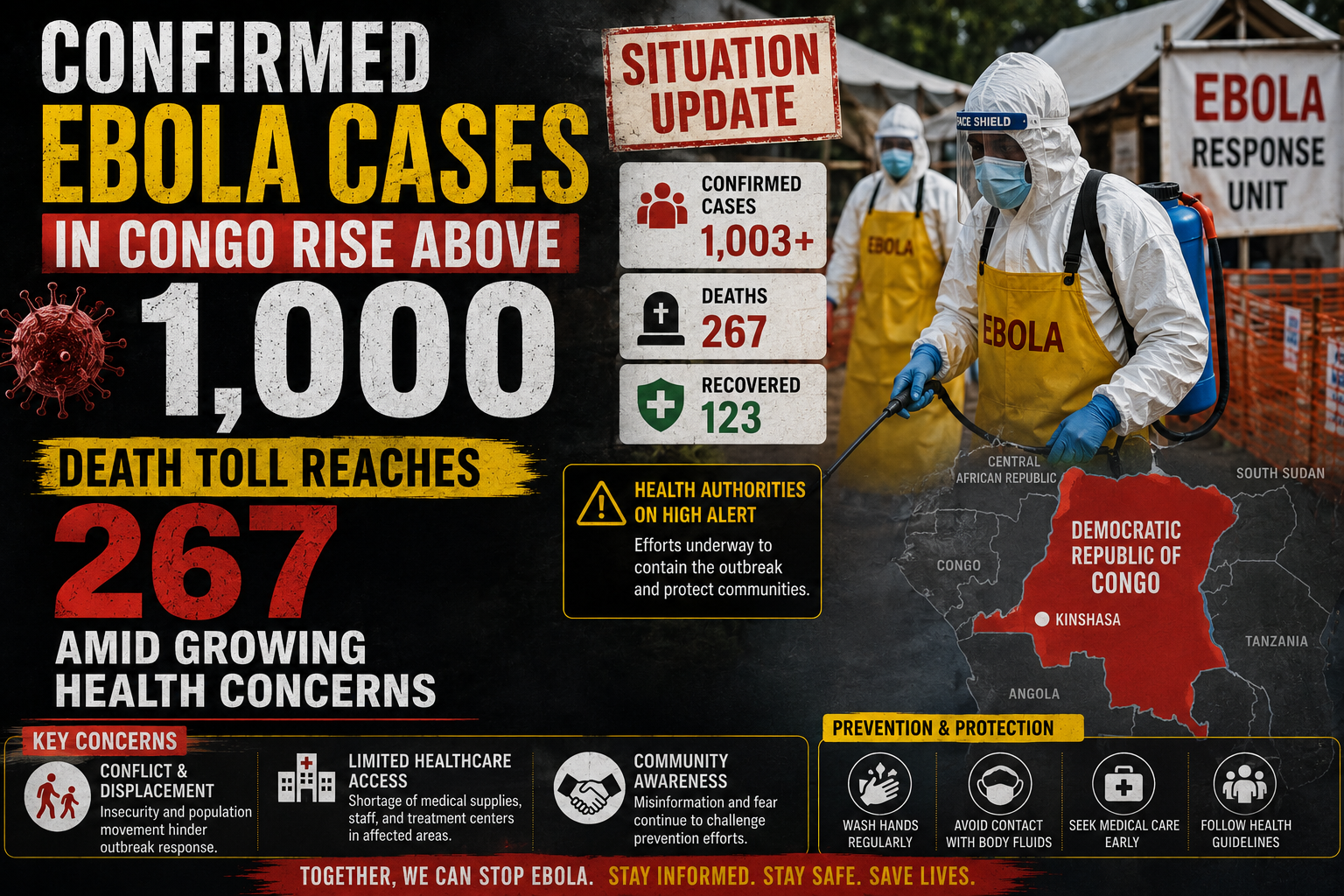
The Democratic Republic of Congo (DRC) has crossed a grim milestone in its ongoing fight against Ebola. Health authorities have confirmed more than 1,000 Ebola cases, with the death toll rising to 267, underscoring the severity of an outbreak that has rapidly expanded across multiple provinces. The figures reflect the escalating challenge facing public health officials as they work to identify cases, isolate patients, trace contacts, and prevent further community transmission. :contentReference[oaicite:0]{index=0}
While Ebola outbreaks are not new to the DRC, the current epidemic is notable for both its speed and the complex humanitarian conditions in which it is unfolding. Ongoing armed conflict, large-scale internal displacement, overstretched healthcare facilities, and logistical barriers have made outbreak control significantly more difficult than in many previous epidemics. Public health experts believe that containing the virus will require not only medical interventions but also strong community engagement and sustained international support. :contentReference[oaicite:1]{index=1}
What Is Happening in the Democratic Republic of Congo?
According to the latest official figures, the DRC has reported 1,048 confirmed Ebola cases, including 267 confirmed deaths. The country crossed the 1,000-case mark for the first time since the outbreak began, highlighting how quickly infections have increased despite ongoing containment efforts. :contentReference[oaicite:2]{index=2}
The outbreak has primarily affected eastern parts of the country, where fragile health infrastructure and security challenges have complicated disease surveillance and emergency response.
Understanding Ebola Virus Disease
Ebola virus disease is a severe viral illness that spreads through direct contact with infected bodily fluids, contaminated objects, or infected animals. Symptoms often begin suddenly and may include fever, weakness, headache, muscle pain, vomiting, diarrhoea, and, in severe cases, internal and external bleeding.
Although Ebola can be highly fatal, early diagnosis, supportive medical care, rapid isolation, and effective infection control measures can significantly improve survival.
Why This Outbreak Is Different
The current epidemic is caused by the Bundibugyo strain of the Ebola virus, a relatively uncommon species compared with the better-known Zaire strain. Unlike some previous outbreaks, there is currently no widely approved vaccine specifically targeting this strain, making containment efforts more dependent on traditional public health measures such as surveillance, isolation, contact tracing, and community awareness. :contentReference[oaicite:3]{index=3}
Researchers continue to evaluate vaccines and therapeutic approaches, but the absence of a readily deployable vaccine has increased the importance of rapid outbreak detection and strict infection prevention.
Why Cases Continue to Rise
Several factors have contributed to the rapid growth of confirmed infections:
- Population displacement caused by regional conflict.
- Difficulty accessing remote communities.
- Delayed diagnosis in some areas.
- Healthcare workforce shortages.
- Challenges in contact tracing.
- Community mistrust in certain regions.
Health officials note that intensified surveillance has also led to earlier identification of infections, meaning part of the increase reflects improved case detection alongside continued community transmission. :contentReference[oaicite:4]{index=4}
| Current Outbreak Snapshot | Status |
|---|---|
| Confirmed Ebola cases | 1,048 |
| Confirmed deaths | 267 |
| Most affected region | Ituri Province |
| Virus strain | Bundibugyo Ebola virus |
| Primary response measures | Isolation, surveillance, contact tracing, infection control |
Why Conflict Makes Disease Control More Difficult
One of the defining characteristics of this outbreak is that it is unfolding in regions affected by prolonged insecurity. Armed conflict has displaced thousands of families, disrupted healthcare delivery, and limited access for emergency response teams.
In areas where movement is restricted or health facilities are difficult to reach, identifying infected individuals and monitoring close contacts becomes significantly more challenging.
These conditions increase the risk of undetected transmission chains that allow the virus to spread before patients receive medical attention.
The Critical Role of Contact Tracing
Contact tracing remains one of the most effective tools for containing Ebola outbreaks.
When a confirmed case is identified, public health teams work to locate individuals who may have been exposed. These contacts are monitored for symptoms during the virus’s incubation period so they can be isolated quickly if illness develops.
High-quality contact tracing can interrupt transmission before outbreaks expand further, making it a cornerstone of Ebola response strategies.
How Communities Help Stop Ebola
Successful outbreak control depends not only on hospitals and laboratories but also on community participation.
Public awareness campaigns encourage:
- Early reporting of symptoms.
- Prompt medical evaluation.
- Avoiding direct contact with infected bodily fluids.
- Safe caregiving practices.
- Cooperation with contact-tracing teams.
- Respecting infection prevention measures.
Building trust between health workers and local communities is often just as important as medical treatment itself.
| Key Public Health Measure | Purpose |
|---|---|
| Case detection | Identify infections early |
| Isolation | Reduce virus transmission |
| Contact tracing | Monitor exposed individuals |
| Laboratory testing | Confirm diagnosis quickly |
| Community education | Improve cooperation and awareness |
Regional and Global Implications
Although the outbreak is centred in the DRC, neighbouring countries remain on alert because of cross-border travel and population movement. Uganda has already reported linked cases associated with the ongoing epidemic, prompting enhanced surveillance and preparedness measures. International public health agencies continue coordinating with regional governments to strengthen border screening, laboratory capacity, and emergency response planning. :contentReference[oaicite:5]{index=5}
Experts emphasize that rapid international cooperation is essential to preventing wider regional spread while ensuring affected countries receive adequate medical supplies, technical expertise, and financial support.
Lessons From Previous Ebola Outbreaks
The DRC has experienced multiple Ebola outbreaks over the past several decades, giving health authorities substantial experience in outbreak management. Previous epidemics demonstrated that early intervention, strong surveillance systems, transparent communication, and community engagement are among the most effective strategies for reducing transmission.
Those lessons continue to shape today’s response, although current humanitarian conditions present additional obstacles that require sustained international collaboration.
What This Means for Global Public Health
Modern infectious disease outbreaks illustrate how interconnected global health has become. Even when epidemics begin in remote regions, international travel and cross-border movement make rapid detection and coordinated response increasingly important.
Investment in disease surveillance, laboratory networks, healthcare infrastructure, and emergency preparedness benefits not only individual countries but also global health security.
Looking Ahead
The coming weeks will be critical in determining whether health authorities can slow transmission through intensified surveillance, improved contact tracing, expanded treatment capacity, and stronger community engagement.
If these measures succeed, the outbreak’s growth may begin to stabilise. If transmission continues unchecked, however, additional international assistance may become increasingly necessary to support local health systems and humanitarian operations.
Conclusion
The confirmation of more than 1,000 Ebola cases and 267 deaths marks a significant escalation in the Democratic Republic of Congo’s latest outbreak. Beyond the numbers, the crisis highlights the complex interaction between infectious disease, humanitarian emergencies, and healthcare capacity.
Containing Ebola requires far more than clinical treatment alone. Strong surveillance, rapid diagnosis, effective infection control, trusted community partnerships, and international cooperation remain essential to protecting lives and preventing further spread. As health authorities continue their response, the outbreak serves as a reminder that investment in resilient public health systems remains one of the world’s most important defences against emerging infectious diseases. :contentReference[oaicite:6]{index=6}
For breaking news and live news updates, like us on Facebook or follow us on Twitter and Instagram. Read more on Latest Health on thefoxdaily.com.






COMMENTS 0