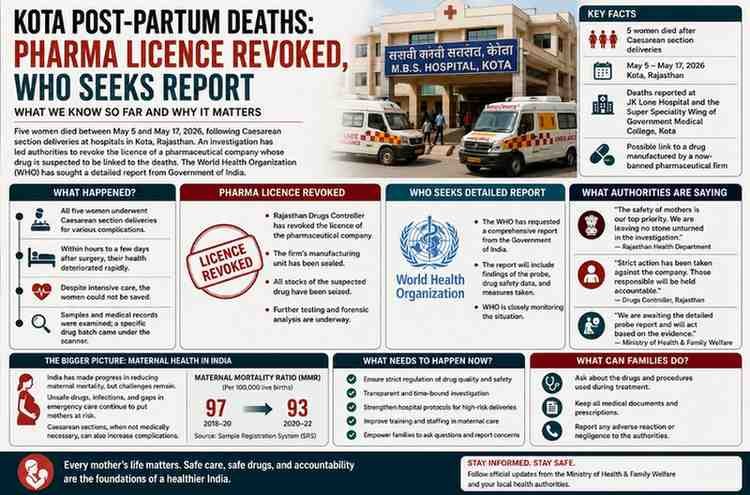
The deaths of five women following Caesarean section (C-section) deliveries at JK Lone Hospital and the Super Speciality Wing of Government Medical College in Kota, Rajasthan, have prompted major regulatory action and raised urgent questions about patient safety. In response to the ongoing investigation, authorities have revoked the licence of a pharmaceutical company linked to the case, while the World Health Organization (WHO) has sought a comprehensive report on the incident.
The women reportedly died between May 5 and May 17, triggering multiple investigations into possible causes, including medicines, infection control practices, hospital protocols, and post-operative care. While the exact cause remains subject to official investigation, the incident has renewed focus on India’s systems for ensuring medicine quality and protecting mothers during childbirth.
The case also highlights the importance of rapid regulatory action whenever unexpected clusters of serious medical events occur.
What Happened in Kota?
According to official information, five women died after undergoing Caesarean section deliveries at government healthcare facilities in Kota over a relatively short period.
Such clustering of maternal deaths naturally prompted health authorities to initiate detailed investigations into possible contributing factors, including medicines administered, surgical procedures, sterilization practices, infection prevention measures, and post-operative monitoring.
Determining the precise cause requires careful scientific investigation rather than assumptions based on preliminary observations.
Regulatory Action Against the Pharmaceutical Company
Authorities have revoked the licence of the pharmaceutical firm connected to the investigation. Licence suspension or cancellation is among the strongest regulatory measures available when serious concerns arise regarding compliance with pharmaceutical manufacturing standards or product safety.
Such action is generally precautionary while investigations continue and does not by itself establish responsibility for patient outcomes.
Regulatory authorities typically conduct extensive reviews before reaching final conclusions.
Why Has the WHO Sought a Report?
The involvement of the World Health Organization (WHO) reflects the global importance of Maternal Health and medicine safety.
International health agencies often seek detailed reports following unusual medical events to better understand their causes, identify potential public health lessons, and strengthen future safety practices.
Information gathered through such investigations may contribute to improved clinical guidelines and patient safety measures worldwide.
Understanding Post-Partum Complications
The post-partum period begins immediately after childbirth and extends through the weeks following delivery. Although most mothers recover safely, complications can occasionally develop and require prompt medical attention.
Potential risks after Caesarean delivery may include:
- Severe infection.
- Excessive bleeding.
- Blood clots.
- Adverse drug reactions.
- Surgical complications.
- Organ dysfunction.
Each case requires careful medical evaluation because multiple factors may contribute to adverse outcomes.
Why Medicine Quality Matters
Medicines used during surgery and post-operative care undergo extensive regulatory oversight before reaching hospitals. Manufacturers must comply with strict quality standards governing production, testing, packaging, storage, and distribution.
Whenever questions arise regarding medicine quality, authorities typically perform laboratory analysis alongside reviews of manufacturing records, supply chains, and quality assurance systems.
This process helps determine whether medicines met required safety standards.
| Area Under Investigation | Purpose |
|---|---|
| Medicine quality | Verify product safety and standards |
| Hospital protocols | Review clinical practices |
| Infection control | Assess sterilization and hygiene measures |
| Patient records | Understand clinical progression |
| Regulatory compliance | Evaluate manufacturing and distribution processes |
How Maternal Death Investigations Are Conducted
Maternal death investigations involve multidisciplinary teams that examine every stage of patient care.
Investigators may review:
- Medical histories.
- Surgical records.
- Laboratory findings.
- Medication administration.
- Hospital infrastructure.
- Clinical decision-making.
- Emergency response timelines.
The objective is not only to determine the immediate cause but also to identify systemic improvements that could prevent similar incidents.
The Importance of Infection Prevention
Preventing infection is a critical component of Caesarean section care. Hospitals rely on sterilized equipment, aseptic surgical techniques, carefully selected antibiotics when indicated, and close post-operative monitoring to minimize infection risks.
Continuous adherence to infection-control protocols remains essential for protecting both mothers and newborns.
Healthcare facilities regularly review these measures to maintain patient safety.
Why Pharmacovigilance Is Essential
Pharmacovigilance refers to the ongoing monitoring of medicines after they enter clinical use. Even after regulatory approval, medicines continue to be evaluated for safety through reporting systems, inspections, laboratory testing, and adverse event investigations.
Rapid identification of unusual patterns enables authorities to intervene promptly whenever potential safety concerns emerge.
This continuous surveillance forms an important safeguard within modern healthcare systems.
What Patients Should Know
While incidents involving maternal deaths understandably raise public concern, experts emphasize that Caesarean sections remain commonly performed procedures that are generally safe when appropriate clinical standards are followed.
Pregnant women should continue seeking antenatal care, discuss individual risks with qualified healthcare professionals, and follow recommended post-operative instructions if a Caesarean delivery is required.
Prompt medical attention remains essential whenever warning signs develop after childbirth.
| Patient Safety Measure | Benefit |
|---|---|
| Quality medicines | Supports safe treatment |
| Sterile surgical practices | Reduces infection risk |
| Post-operative monitoring | Enables early complication detection |
| Regulatory oversight | Maintains pharmaceutical standards |
| Transparent investigations | Strengthens public confidence |
The Bigger Picture: Strengthening Maternal Healthcare Systems
The Kota case underscores the importance of robust healthcare systems that combine high-quality clinical care with strong regulatory oversight. Safe childbirth depends not only on skilled medical teams but also on reliable medicines, effective infection control, transparent reporting, and continuous quality improvement.
Investigations following serious medical incidents provide valuable opportunities to strengthen healthcare delivery by identifying gaps and implementing corrective measures.
Maintaining public trust requires that such investigations remain thorough, evidence-based, and transparent.
Conclusion
The revocation of a pharmaceutical firm’s licence following the deaths of five women after Caesarean deliveries in Kota marks a significant regulatory response while investigations continue. With the World Health Organization seeking a detailed report, the case has drawn attention to the critical importance of medicine quality, maternal healthcare standards, and patient safety.
Although the precise causes remain under official investigation, the incident highlights the need for rigorous oversight across every stage of healthcare from pharmaceutical manufacturing and hospital protocols to post-operative monitoring and transparent regulatory action.
Ultimately, every investigation into maternal deaths serves a broader purpose: learning from tragedy to strengthen healthcare systems, improve clinical practices, and help ensure safer outcomes for mothers in the future.
For breaking news and live news updates, like us on Facebook or follow us on Twitter and Instagram. Read more on Latest Health on thefoxdaily.com.



COMMENTS 0