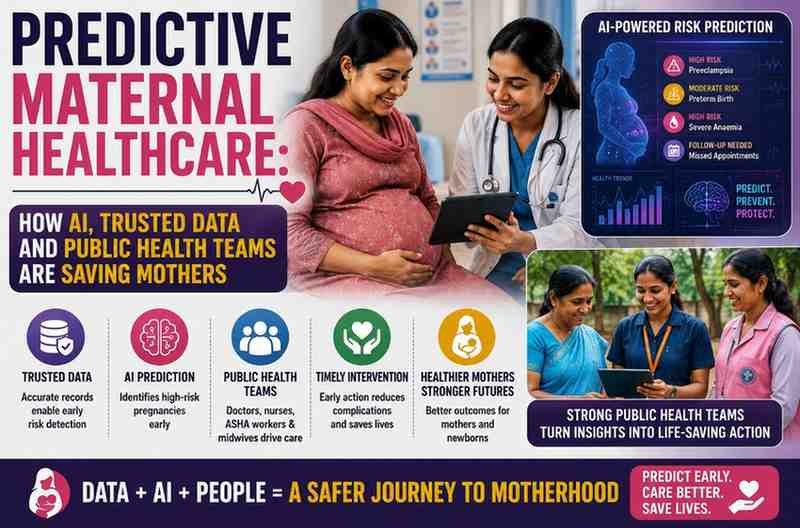
Pregnancy is one of the most closely monitored periods in a person’s life, yet thousands of women around the world continue to experience preventable complications due to delayed diagnosis, missed follow-ups, and unequal access to healthcare. The future of predictive maternal healthcare promises to change this reality by combining trustworthy medical data, Artificial Intelligence, digital health records, and coordinated public health teams to identify high-risk pregnancies before complications become emergencies.
Instead of waiting for warning signs to become visible, predictive healthcare enables doctors and health workers to anticipate problems using patterns hidden within antenatal records, laboratory reports, maternal history, nutritional status, and previous pregnancy outcomes. However, the success of predictive maternal healthcare depends on much more than sophisticated algorithms. It requires accurate data, trained healthcare professionals, community outreach, and public trust.
As governments worldwide continue investing in digital health infrastructure, predictive maternal healthcare is emerging as one of the most promising innovations capable of reducing maternal mortality, improving newborn health, and making healthcare systems more proactive rather than reactive.
What Is Predictive Maternal Healthcare?
Predictive maternal healthcare is the use of medical data, statistical models, and artificial intelligence to estimate the likelihood of pregnancy-related complications before they occur. Rather than treating problems only after symptoms appear, predictive systems analyze multiple health indicators to determine which pregnancies require closer monitoring.
These systems typically combine information from:
- Antenatal care records
- Blood pressure trends
- Blood sugar levels
- Hemoglobin and anaemia status
- Maternal age
- Previous pregnancies
- Body Mass Index (BMI)
- Ultrasound findings
- Medical history
- Medication records
- Lifestyle and nutritional factors
When these variables are analyzed together, healthcare providers gain a much clearer picture of potential risks than any single test could provide.
Why Pregnancy Needs Predictive Healthcare More Than Ever
Pregnancy can change rapidly. A woman whose early prenatal visits appear completely normal may later develop conditions such as gestational hypertension, gestational diabetes, severe anaemia, or preeclampsia.
Traditional healthcare often reacts after symptoms emerge. Predictive healthcare attempts to identify subtle warning patterns weeks—or even months—before serious complications develop.
This shift offers several advantages:
- Earlier medical intervention
- More personalized antenatal care
- Better allocation of healthcare resources
- Reduced emergency hospitalizations
- Improved maternal and newborn outcomes
Instead of treating every pregnancy identically, healthcare systems can prioritize women who need intensive monitoring while continuing routine care for low-risk pregnancies.
The Role of Artificial Intelligence in Maternal Health
Artificial intelligence has become one of the most exciting developments in modern healthcare. In maternal care, AI can process enormous volumes of clinical information far faster than humans while identifying patterns that may otherwise remain unnoticed.
AI models can evaluate combinations of risk factors including:
- Age-related pregnancy risks
- Repeated elevated blood pressure readings
- Declining haemoglobin levels
- Irregular prenatal visit attendance
- Abnormal laboratory values
- History of cesarean delivery
- Previous miscarriages or stillbirths
Rather than replacing physicians, AI acts as a decision-support tool that helps clinicians prioritize patients requiring immediate attention.
This partnership between technology and healthcare professionals represents one of the biggest shifts in modern obstetric care.
Trustworthy Data Is the Foundation of Predictive Maternal Healthcare
Even the most advanced predictive model becomes unreliable if the underlying data are inaccurate or incomplete.
Healthcare systems depend on trustworthy information collected consistently across every stage of pregnancy. Missing laboratory reports, incorrect medical histories, delayed record updates, or inconsistent documentation can significantly reduce predictive accuracy.
Reliable maternal healthcare data should be:
- Accurate
- Complete
- Updated regularly
- Standardized across hospitals
- Securely stored
- Accessible to authorized healthcare providers
Digital health records make this process easier by reducing paperwork errors while enabling seamless communication between clinics, hospitals, laboratories, and specialists.
Digital Health Records Are Transforming Antenatal Care
Electronic Health Records (EHRs) have become essential for predictive healthcare.
Instead of maintaining fragmented paper files across multiple clinics, digital records allow every authorized healthcare provider to access a patient’s complete pregnancy history.
This improves:
- Continuity of care
- Clinical decision-making
- Referral management
- Follow-up scheduling
- Emergency preparedness
- Data analysis for predictive algorithms
When healthcare providers have access to comprehensive medical histories, they are less likely to miss subtle changes indicating emerging complications.
Why Human Healthcare Workers Remain Irreplaceable
One common misconception is that artificial intelligence will replace doctors and nurses. In reality, predictive maternal healthcare works best when technology supports—not replaces—human expertise.
Doctors interpret clinical findings, nurses monitor patient progress, midwives provide continuous maternal care, and community health workers ensure women remain connected to healthcare services.
Frontline workers often identify barriers that algorithms cannot detect, including:
- Transportation challenges
- Financial difficulties
- Cultural beliefs
- Family support issues
- Mental health concerns
- Nutritional insecurity
These social factors frequently determine whether pregnant women receive timely medical attention.
Community Health Workers Bridge the Healthcare Gap
In many countries, especially in rural and underserved regions, community healthcare workers serve as the first point of contact for pregnant women.
Their responsibilities extend beyond basic healthcare.
- Encouraging regular antenatal visits
- Tracking missed appointments
- Providing nutrition counselling
- Supporting vaccination programs
- Educating families about pregnancy warning signs
- Facilitating referrals to higher-level facilities
Predictive systems become significantly more effective when frontline workers act on early risk alerts by ensuring vulnerable women receive timely follow-up care.
Major Pregnancy Complications Predictive Models Can Help Detect
Predictive healthcare can identify women who may be at increased risk of developing several serious maternal conditions.
| Pregnancy Condition | Potential Early Indicators | Benefits of Early Detection |
|---|---|---|
| Preeclampsia | Blood pressure trends, protein tests, medical history | Closer monitoring and timely intervention |
| Gestational Diabetes | Blood glucose levels, BMI, family history | Diet management and glucose control |
| Severe Anaemia | Declining haemoglobin levels | Earlier nutritional and medical treatment |
| Preterm Birth | Previous pregnancy history, cervical assessments | Improved pregnancy management |
| Fetal Growth Restriction | Ultrasound patterns, Maternal Health indicators | Closer fetal surveillance |
| Postpartum Complications | Delivery history and maternal risk profile | Enhanced postnatal monitoring |
Beyond Hospitals: Predictive Healthcare Improves Public Health Planning
One overlooked advantage of predictive maternal healthcare is its ability to strengthen public health management.
When anonymized health data are analyzed across districts or regions, policymakers can identify trends such as:
- Areas with high anaemia prevalence
- Regions experiencing poor antenatal attendance
- Communities requiring additional healthcare workers
- Hospitals facing increasing high-risk deliveries
- Shortages of maternal specialists
This enables governments to distribute healthcare resources more effectively instead of responding only after healthcare systems become overwhelmed.
Privacy and Ethics Must Remain a Priority
Predictive healthcare depends on sensitive personal information, making privacy protection essential.
Healthcare organizations must ensure:
- Secure data storage
- Patient consent where appropriate
- Strict cybersecurity safeguards
- Limited access to authorized personnel
- Transparent use of health information
Public confidence in digital healthcare will only grow if patients trust that their medical records remain confidential and protected.
The Biggest Challenge Isn’t Technology—It’s Data Quality
Many discussions focus on artificial intelligence, but the larger challenge often lies in inconsistent healthcare documentation.
Predictive systems are only as reliable as the information entered into them. Missing antenatal visits, delayed laboratory reporting, inaccurate diagnoses, or incomplete patient histories can significantly reduce predictive accuracy.
Improving routine healthcare documentation may produce greater benefits than developing increasingly complex algorithms.
How Predictive Healthcare Supports Personalized Pregnancy Care
Every pregnancy is unique.
Rather than applying identical care pathways to every patient, predictive maternal healthcare enables clinicians to personalize monitoring according to individual risk.
For example:
- Low-risk pregnancies may continue routine antenatal schedules.
- Moderate-risk patients can receive additional laboratory monitoring.
- High-risk pregnancies may require specialist consultations and more frequent assessments.
This targeted approach allows healthcare systems to use limited resources more efficiently while improving patient outcomes.
A Comparison: Traditional Maternal Care vs Predictive Maternal Healthcare
| Traditional Maternal Care | Predictive Maternal Healthcare |
|---|---|
| Reactive treatment | Proactive risk prediction |
| Focuses on current symptoms | Identifies future risks |
| Uniform monitoring schedules | Personalized follow-up plans |
| Manual record review | Automated data analysis |
| Limited population insights | Supports public health planning |
| Higher chance of delayed intervention | Earlier preventive care |
The Future of Maternal Healthcare Is Preventive, Connected, and Collaborative
The next decade is likely to witness deeper integration between digital health platforms, wearable monitoring devices, telemedicine, and predictive analytics. Pregnant women may increasingly benefit from remote monitoring, automated appointment reminders, digital risk assessments, and real-time communication with healthcare providers.
However, technology should never overshadow the human side of maternal care. Compassionate counselling, skilled clinical judgment, and community engagement remain essential for ensuring healthy pregnancies.
The strongest healthcare systems will be those that combine advanced technology with accessible, equitable, and patient-centered care.
Why This Matters for Every Family
Every healthy pregnancy contributes to healthier families, stronger communities, and more resilient healthcare systems. Early identification of risk not only improves survival but also reduces emotional stress, financial burdens, and long-term health complications for both mothers and newborns.
Predictive maternal healthcare represents a shift from treating illness to preventing it. That transition has the potential to transform maternity services worldwide, especially in regions where healthcare resources are limited and timely intervention can make the greatest difference.
Conclusion
Predictive maternal healthcare is redefining how pregnancy care is delivered by combining reliable medical data, artificial intelligence, digital health records, and experienced healthcare professionals. Its greatest strength lies not in replacing clinicians but in helping them identify risks earlier, personalize care, and intervene before complications become life-threatening.
The future of maternal health will depend on trustworthy data, strong digital infrastructure, ethical use of technology, and well-supported frontline healthcare workers. Countries that invest in these interconnected pillars will be better equipped to reduce preventable maternal deaths, improve newborn outcomes, and build healthcare systems that are proactive rather than reactive.
Ultimately, the real promise of predictive maternal healthcare is not smarter software—it is ensuring that every expectant mother receives the right care at the right time, regardless of where she lives. When data, technology, and dedicated healthcare teams work together, safer pregnancies and healthier generations become far more achievable.
For breaking news and live news updates, like us on Facebook or follow us on Twitter and Instagram. Read more on Latest Health on thefoxdaily.com.






COMMENTS 0